Showing posts with label missouri. Show all posts

Wednesday, February 26, 2014

Jute Gyte - Vast Chains (2014)

You know, one day I'm probably going to make a weekend out of revisiting these DVD-shelled Jute Gyte albums, and when I do, it's not likely that Vast Chains will rank as the favorite. Yet this is hands down one of the most fascinating and fucked up products he's produced, memorable not for that alone, but for Adam Kalmbach's continued ability to stretch at, and tear through those amorphous membranes of stylistic convention that so dearly require disintegration if extreme metal is to overrun the roadblocks it often seems to set up for itself. Perhaps the most accurate means I could summon forth to describe this would be as a grand disjunction of black, death, thrash, doom and post-punk aesthetics as translated by a deep schizophrenic so beyond treatment that he or she was locked in the asylum basement and nearly forgotten...only the Bizarro World of that situation.

You'll recognize the use of microtonal riffing if you've experienced last year's Discontinuities, only rather than repeating that album, he's interpreted the technique into a more unpredictable, angular geometry that throws you curve balls in almost every track on the album. Songs are divided into harsher passages of insectoid, bristling dissonance, or springier and cleaner riffs set off against distorted dementia, with the tempos fluxed between the faster black metallic rushes of his prior works and a slower, creepier miasma of impenetrable doom that is compounded by the fresh intervals being picked and strummed. I couldn't even begin to accurately compare this to anything outside of Jute Gyte's own body of work, but strange word puzzles like 'Philip Glass being filtered through the unwashed demos of the stranger LLN bands' seem to pop into my imagination as I'm listening. That this is a difficult experience goes without saying, he's never been all about the comfort of music but rather in seeking that comfort through unusual circumstances, and yet there is certainly a consistent set of traits (certain rhythm guitar tones, drum tracking) that fasten these Chains into a fairly cohesive album...or at least as cohesive as any strain of madness I've encountered.

Probably my favorite tracks were "The Inexpressible Loneliness of Thinking", which was like having a few gallons of effluvia dumped upon my head after being pumped through an Escher-designed sewer sytem, and "Endless Moths Swarming" which becomes so bonkers nearing the bridge that it's almost comical. In fact, this sense of black humor permeates the entirety of the disc, but not for cheap laughs, for unbridled horror. It would also be remiss to not mention how damned excellent the lyrics are...it's pretty early on in 2014, and I've often enjoyed Kalmbach's words as much if not more than the compositions they represent, but these are superb even among the esteemed crowd of his past releases, and the best I've read so far this year. On the flip side, there are definitely a couple riffs here that simply aren't ugly enough to live up to others, so there's a sense of clashing and contrast which doesn't always subdue the listener levelly. I also thought his raving snarled vocals were superior to the death grunts, as you can compare in the first tune "Semen Dried into the Silence of Rock and Mineral", but it's strange to say that these are the most sanity-tethered components of the album, which is just this tornado of disjointed nightmares whipping across the plains of Missouri. Recommended with the lights on, but without...you're on your own there, friends.

Verdict: Win [8/10] (solitude may rust your words)

http://jutegyte.bandcamp.com/

Friday, March 15, 2013

Jute Gyte - Discontinuities (2013)

Traditionally, I've not been the sort to ramble on about musical theory when composing reviews. Part of this is that a sizable chunk of readers might not have any idea what I was talking about if I were to count out the 64th notes or harp over the Mixolydian scale for a paragraph. The other is that, being separated from the Music Major since the mid 90s, when I swapped to another out of boredom, more the fault of the particular curriculum and professors than the subject itself, I'm probably rusty and would have to do far more technical research on the exact terminology being thrown around these years. Having said that, when vectoring in on an album like Jute Gyte's latest black metal adventure, Discontinuities, it would be criminal not to at least make mention of the techniques being employed, since they're representative of why the album is so revolutionary in its style.

Kalmbach's music has always been experimental and original in both structure and theme, but this time out, he's shifted over to a customized, 24-tone guitar, exploring microtonal intervals in note phrasing rather than the normalized 12 step semitone. Various other cultures (ancient and modern) have employed the practice before, in particular a number of 19th/20th century composers, but its use in rock music, and by extension extreme metal, is a rarity at best. I had heard a track from a Florida death metal group a while back (Last Sacrament) who were messing with microtonal composition, and while impressive, I felt like a lot of the rhythms did not heavily diverge from the standards of what I'd normally expect. Lo and behold, the guitarist for that band is the very same individual (Ron Sword of Sword guitars) who helped adjust Kalmbach's axe here, and it's a good thing: because through this novelty, Kalmbach has managed to reinvent his pre-installed vision into something even more unnerving and cacophonous. Having long been a fan of unusual, alternate tunings and instrumentation as applied to genre, the very notion of this is a thrill; even if it comes with some escalated trepidation due to my familiarity with just how disturbing Jute Gyte's music can get..

I've probably said it before, but this is basically a one-man Sonic Youth for the post-Burzum generation. The guitars fixated more on the former comparison, the vocals and shared love of ambiance redolent of the latter. This is an album which heavily explores textures. Warped, wonderful textures. From the thundering, droning inaugural progression of  "The Haunting Sense of an Unrepeatable Unidirectional Vector", you can immediately feel the difference in the chords as subtle bass grooves are wrought below them. There is still a propensity for sheer 'wall of noise' amplitude, especially in some of the faster, harder hitting sequences, but these are never given so much face time that they grow to any level of annoyance. Instead, they're measured off against jangling, cleaner passages of dissonant tranquility, and once in awhile he pulls off a truly climactic, otherworldly chord sequence: near the minute mark of the wryly titled "Romanticism is Ultimately Fatal" (best song title this year?) would be one example, or the hustling post-punk clamor opening "Supreme Fiction and the Absolute Fake", which turns out to be perhaps my favorite overall of the metallic tracks.

Ironically, while I often find his instrumental/ambient tracks highlights of his albums, this time around I found the titular "Discontinuities" to be the least remarkable piece among these seven. Instead of synthesizers, this is replete with murky guitar strums that trade the usual distortion for some echo, but though the notes change, and the middle of the album is the perfect placement to give the listener some rest from the surrounding chaos, it simply wasn't as interesting as its neighbors. The production is about even with prior releases. Bass lines are fluid and mesmeric, but obviously simpler than the quarter-tone guitar passages and bright shards of ear stabbing bedlam. Drums are tightly fit and mechanical, but I found myself so drawn to the unusual guitar phrasing that I only paid them cursory attention. Vocals are harrowing and impetuous, unfettered rasping which never seems monotonous or rehearsed; almost like someone experiencing acts of self-mutilation and being captured on a microphone. There is no sense of overly cautious syllabic structure, just deep and disturbing poetry being channeled via the suffering. No, it doesn't lend itself to the conventional, glorious dichotomy of verse/chorus songwriting, but it's fresh and mildly unpredictable (other than the voice).

Discontinuities is symbolic in title, because it does break from the slowly stagnating course of the previous albums, which were themselves pretty damn discordant and distinct. Jute Gyte will remain unlistenable to many, more to their narrow range of aural acceptance than through any fault of the music, but I honestly was surprised that the shift in intonation didn't render the music inhumanly annoying. There's a shocking sense of warmth exuded by even the most frenzied and insect-like polyphonic picking patterns, and though it might not be labyrinthine on a purely technical level, there's a natural complexity that builds while the mind reels and attempts to place the guitars into perspective. Uncomfortable? Of course. But in the clause of 'it if didn't hurt, it wasn't worth it'. Kalmbach continues to traverse genre boundaries as if they were mere hallucinations, and I do hope he continues to incorporate aesthetic divisions, implement nuanced instrumentation, and twist the knobs (and spines of the listeners). Another killer in a largely unbroken line of killers.

Verdict: Win [8.5/10] (flowing irresistibly onward)

http://jutegyte.bandcamp.com/

Friday, November 16, 2012

Jute Gyte - Senescence (2012)

Though I found it the least engrossing of the six Jute Gyte albums I've yet covered here, it speaks volumes that Senescence maintains that sense of driving discomfort and experimentation that dominates Adam Kalmbach's project. In terms of artistry, this disc continues to carve out some of the more poignant and frightening terrain in all of USBM, a dissonant monolith of isolation unperturbed by trend or accessibility. But I found my disappointment stemmed largely from the first three tracks (representing about 30 minutes of material), which for some reason just weren't hooking me like these records usually do, and then there were a few dry spells later on the album that returned to the same, numbing sense that I'd been here before, and that this particular path of composition might be drawing to its natural conclusion.

There is some trace of redundancy with the earlier Jute Gyte black metal albums, but I would say that this is perhaps the most consistent in terms of its dry, heaving, scorched earth affectations. The lengthy tracks tend to hover around a 9-10 minute duration and mesh together a weave of faster paced, dissonant grime and breakouts of drudging, bombastic chords, which is not atypical for this project, and strangely mirrors a lot of the lower tier underground black metal which uses a good deal of repetition and padding along to the drum programming. That said, where Kalmbach's work has always differed is in his constructions of chords, which bring a fresh, yet still harrowing nuance to the predictability often associated with your usual tremolo patterns or Darkthrone/Hellhammer grooves. As such it has almost always felt like Jute Gyte was some parallel development of black metal which came out of some long lost continent, that had lost contact with the world since the first few releases from Burzum, Ildjarn, or other tortured souls responsible for bringing this primal and repulsive instinct to the niche. Senescence is no exception to this agenda, it simply loses of that element of surprise inherent to its predecessors.

I thought the most unique and fascinating piece here was tucked away at the end with "Griefdrone", a mortifying afterthought which almost feels like something off Filosofem if it had been infested with an almost sporadic improvisation of dungeon synth/B-grade horror score keys to create a convoluted canvas of slowly elevating filth. Once that imminent wall of distorted girth arrives deep into the track, it's like a crushing weight being applied to the listener's throat, and it's without a doubt the most memorable of these tunes. The titular "Senescence" is another of the Jute Gyte instrumentals, but this time quite different than "Isolation", which is hands down one of my favorite cuts in his whole catalog. Sad, stripped guitars ring off into a folksy ambiance with a 70s glaze of synthesis for support, and this is yet another of the album's standouts. As for the more purely black metal material, it's "The World Falls Apart Into Facts" which struck me hardest, a 10 minute behemoth of nihilistic blasting, atonal spikes of descending tremolo melody and some incredibly breakdowns into pummeling chords or spatial clean guitars and asylum screams in the substantial bridge.

Otherwise, I felt like a lot of the other material, especially on the first half of the disc, seemed to blend together, if only because the riff textures just didn't seem so distinct as others he's written. I do like the weird, swerving current of bass that rides the edge of perception alongside the thundering chord sequences, but there were only a few passages of guitars, generally during bridges, that came out of left field. The lyrics remain a highlight of this act, especially in "Striated Rubies" and  "The World Falls Apart Into Facts", evocative snips of poetry that eschew a lot of the faux-occult grandstanding popular with the genre in favor of some relevance to civilization, mortality and the individual's relationship to nature. The vocals have ever been the least novel aspect of Jute Gyte, but they still pursue that genuine suffering once manifest by the outsiders of the genre (Varg Vikernes the strongest comparison). Ultimately, Senescence is an hour of measured savagery with a few exhilarating twists, but it didn't rattle my perceptions quite so much as its slightly more eccentric predecessors like Impermanence or Old Ways.

Verdict: Win [7.25/10] (oh, for any patent from oblivion)

http://www.myspace.com/jutegyte

Saturday, June 16, 2012

Marasmus - Mountains of Dead (2012)

Much like the catastrophic tornadoes that often strike at their native Missouri soil, Marasmus perform in a very pent up vortex of hostility that, if one is not careful, can easily snap you up in its violent winds and proceed to break every bone in your flailing frame. That's not to say that they're any more explicitly unique, barbaric or inventive than many others in the spectrum of USDM, but their debut Mountains of Dead works up enough of a dynamic sweat that both the slam set and those followers of faster paced, acrobatic technicality will find it effectively taxing. Loyal to the obvious influence of a Deicide, Morbid Angel, Suffocation or Cannibal Corpse without ever coming off like some exacting derivative.

This is achieved through tightly reined compositions that primarily hover in the 2-3 minute bracket and fire off dozens of dizzying rhythmic configurations against the backdrop of blasted snares and athletic footwork so harried it seems like there must be 2-3 guys playing it. I can only imagine how much endurance it must take to rifle through a set of beats like these without your limbs giving in on you with fits of rebellious convulsion, but Trynt Kelly levels this kit like whatever storm hit the heaps of bodies on the album cover. The vocals are kept blunt and guttural, not exactly novel or compelling on their own, but occasionally affixed with additional snarls and background gurgles that add another dimension of serial killer intensity. The guitars, meanwhile, focus on a very intestine-churning tone that spins into this surgical excision when they race up and down the frets in callous contortions; and the leads are mixed with just the right level of effect to help them strike out above the concentrated clamor like a flight of eagles warning one another of the impending stormblast.

Still, Mountains of Dead does suffer from the setback that its twisting, turbulent nature never aligns itself with strong enough songwriting to its brand upon the listener's skull. Only the signs of actual impact. The riffs feel like so many you've heard before, splayed out in patterns that don't necessarily heighten or intensify the immense strength behind the instrumentation, and moments of climactic, frightening atmosphere are few and far between, lost amidst the storm of limbs and gutturals. I really liked the intros and intervals used for the album, but the metallic components are little more than the business end of a hastened landfill tractor, unforgiving but systematic, a well-oiled machine performing the same task as others off its same assembly line. From a compositional standpoint, it often felt difficult to discern where one track ended and another began. Marasmus knows its shit very well, and when taken as a 25 minute lozenge of aural manslaughter, this is an effectively relentless debut. Just not one that I'm likely to remember in a few months' time.

Verdict: Indifference [6.75/10]

http://www.facebook.com/MarasmusKCDM

Tuesday, May 8, 2012

Jute Gyte - Isolation (2012)

Isolation is the fifth album I'm reviewing from Adam Kalmbach's Jute Gyte, and I can say with certainly that I've yet to be disappointed. In fact, this is precisely the direction underground black metal in the States needs to take: textured, creative and intelligent without shunning the conventions that were originally conceived overseas by the genre forebears. Part of Kalmbach's charm does originate from his heavy investment in nuance and experimentation (a lot of albums under the Jute Gyte brand eschew the metallic ingredients entirely in favor of other styles), but really when you strip away the influences it comes down to his skill at bare bones sound architecture and songwriting. The guy can keep you engaged for often 9-11 minutes per track, even through the more repetitious sequences, and that's more than I can say for most trying their hand in this field.

Immediately, the poetic imagery of the lyrics and the driving depth of the chords to the opener wrap themselves about the listener's ears like a caul of warmth and carrion, tortured and desolate yet strangely alluring like a sunrise on a frosted, open plain. "The Hopelessness of Passing Time and the Melancholy of Unalterable Past Events" is one mouthful of a song title, but its fitting to the nostalgia imparted through the beautiful, somber and romantic trails of melody that are carved out over the denser fibers of the rhythm guitar, not unlike some of the more modern, progressive Enslaved records. The second piece, "Age, Separation and Cold" is at once more high pitched and dissonant, driven into the listener's brain over 9 minutes of blasting with breaks into slower vistas where the guitars continue their acidic reign over the steady, mid-paced drums. Isolation deviates further left of center with more of a post-metal deconstruction in "A Wind Upon the Open Fields", or the thrashing indoctrination of "The Cry Essaying the Waters", or the jangling post-punk belligerence of "The Irreality of the Past" in which Kalmbach evades the usual rasp in favor of a guttural aesthetic to his voice. Intense.

However, by far my favorite piece on the album is actually the titular "Isolation": a 7+ minute foray into pure, scintillating ambiance which is easily one of the best I've heard of its type lately. Through simple flute-like synthesis and airy textures, you're hurled into this sad, expansive terrain in which you feel as if something major is just about to happen. Perhaps the grasslands will flood with rain from a restless sky, or perhaps the earth will just rise silently and swallow you, but it's an incredibly effective and poignant means of escape. I feel like the only downside to this track is that it's so blindingly awesome that the rest of the disc almost seems pale by comparison, despite its own ingenuity. All I know is I've listened to this on repeat about a dozen times one afternoon, numerous times since, and I'm completely hooked. Granted, I'm a sucker for the stuff.

As usual, with any Jute Gyte release you're getting the great DVD packaging, simplistic natural artwork that truly reflects the aural environment contained within the music, and humble production values which capture all the grisly hiss of the black metal underground, incendiary guitars, machine gun mechanical blasting, and lush rasping vocals. There are a few points at which the drumming can become monotonous, and the curves of the bass lines are often inconsequential, but otherwise this is another floodgate of melancholic aspiration which deserves any earspace you might grant it. Past Jute Gyte recordings have, in truth, felt more eclectic and varied in nature, and I may not have been engaged by this quite so fully as Old Ways or Impermanence, but Isolation is worth having for the title track and the opener alone, the rest is just an added icing of pain, an hour of fitful release. It's time to start talking about this project with the same reverence once given to US underground mavens like Xasthur and Leviathan.

 Verdict: Win [8.5/10] (something so long dead)


http://jutegyte.bandcamp.com/

Monday, April 16, 2012

Meatshank - Scavengers (2010)

Meatshank is a three piece crossover/thrash band out of Missouri, with a stronger emphasis on the latter genre in terms of how they structure their compositions. They've been kicking around for a few years, and Scavengers is their second self-released album which was released a couple years ago in 2010 but is just now getting a surge of additional promotion. Normally, I don't go out for a lot of the material I hear in modern bands of this niche, because too often do I feel that they rest on the laurels of the 80s forebears like Cryptic Slaughter or D.R.I. and don't offer any sort of ambition or forward momentum. That said, I felt that Scavengers, while not entirely blowing me over in terms of its song craft, is rather a dynamic and hopeful sophomore which doesn't ever come across as either derivative or excessively nostalgic in its execution, and the level of variation employed by the band often pays off.

You definitely get a hint of that explosive, faster paced crossover riffing in the driving tunes like opener "Meet Your Maker" which seems a mix of violent 80s US thrash (both coasts) and some of the splatter core stylings of Cryptic Slaughter or The Accüsed; as riff-oriented as heroes Municipal Waste but not so goofy in its demeanor. However, a good portion of this album is devoted to a more traditional, mid-speed thrashing gait, and here is where the band delivers most of their best riffs, like the bridge to "Rape, Murder, Arson, Rape", or the straight late 80s Anthrax/CoC/Exodus vibes of "Atmosphere of Violence" which had my neck quivering and my teen years flashing before my eyes. I think where the band really explores that pure thrashing side, they actually do a decent job of capturing that decade, with the caveat that the vocals of Vincent Camarillo are more distinctly angry enough that they might have drawn a little influence from Exhorder, Pantera or Pissing Razors.

But to their credit, they vary things up even beyond this, with the atmospheric clean intros to "Sweet Release" and "Hell Road" which are rather well plotted, or the melodic/speed sequence that inaugurates "Symbiotic Annihilation", one of the better songs outside of the admittedly lacking inclusion of the more guttural vocal experimentation. All proof that Meatshank are not just a bunch of skate rats trying to relive another age, but a band actively trying to balance its attack with a well-rounded aural architecture. The very meaty tone of the guitar and its organic interface with the rhythm section only adds to this charm, though I'd certainly like to hear a slightly fatter tone on the bass (since he can obviously play). If I had some criticisms, I think I greatly prefer the more sneering, faster paced percussive vocals than the more 'tough' thrash timbre on the slower sequences, and the rate of sticky, memorable guitar progressions here is only about 50/50, with the leads feeling little more than filler that never capitalizes on the excitement of the rhythms. Sequentially, I found the first few tunes forgettable and then it grew more interesting over the course of the remainder.

Overall, though, Scavengers is not in any way a bad effort, and these guys clearly have the chops and sincerity to go the distance. There's nothing pretentious, cheesy or needlessly complex here, just abusive, street ready thrash, and even if my reaction to the end product was lukewarm, I do sense a caged potential here which might either burn itself out or go nova.

Verdict: Indifference [6.75/10]

http://meatshank.angelfire.com/

Wednesday, January 4, 2012

Timeghoul - Complete Discography (2012)

A few years back, I wrote up a review for this Missouri obscurity's second demo, Panaramic Twilight, a rather unsung and exemplary foray into science fiction inspired death and doom which has seen a resurgence in popularity thanks to the widespread 'word of mouth' that is the internet. Dark Descent Records has thoughtfully paid heed to the myriad cries for a reissue, and thus both of the band's mid 90s tapes are now available in one convenient location, with new artwork, packaging and lyrics. It couldn't have come at a better time, honestly. The hydra of death metal nostalgia is in full bloom, its many heads devouring new generations who have tired of the technical excesses of the genre's modernization, and Timeghoul manage to fit that old school bill while retaining a progressive, dynamic personality all unto themselves, in a rare space between the sounds and aesthetics of Nocturnus, Deicide and later Pestilence records upon which the Dutchmen flew off into space.

Of the two demos included, I must admit some favor towards the Panaramic Twilight material (1994). It seems far better organized, cleaner and more approachable as far as its production values, and incorporates a grander, more absurd narrative. But there isn't a massive stylistic gulf from the Tumultous Twilight sessions (1992). The songs went from 6-7 minutes to even more expansive lengths, but the core techniques remain much the same. A burgeoning, low end death metal frenzy incorporating all the brutal squeals and early Deicide chugging you could ask for, complete with low gutturals on a level not unlike Demilich. More intriguing is how the band incorporates a lot of the clinical, surgical guitars that dominated late 80s tech thrash opuses like Watchtower's Control and Resistance, Deathrow's Deception Ignored or a handful of the Mekong Delta records. It creates this constant sense of exciting variation in which the listener cannot fully predict what will happen next, and that's part of what keeps me glued to BOTH of these demos, and generates a pang of sadness that they weren't able to take it all further.

Timeghoul took chances, and a lot of this can be heard in the breadth of vocal choices. They can pull off chanted, unnerving clean harmonies ("Boiling in the Hourglass") or the grunting/rasping hybrids made popular by Glen Benton ("Occurence on Mimas"). I prefer the actual gutturals to an extent from the first demo, but the creepy ambient breaks, morbid cosmic intro transmission ("Occurence...") and aforementioned chants really make a wealth of difference. The lyrics are superb, especially for those into science fiction and horror, whether that be the grim future revealed through the Warhammer 40K fiction or the more ominous, isolationist atmospheres wrought by the legendary Arthur C. Clarke. Like Nocturnus and Voivod, this band excels at taking the listener to its source of creative chaos through both the words AND the music, and the marriage of pummeling, sporadic rhythms and frightening speculative brain candy was a huge part of its appeal to me personally.

I am a god, the prime being
I shall impale you
On the crumbled pillars of the millenia


I can cite a few minor gripes with the production of the earlier demo, such as the fact that the tone of the guitar is a little ruddy and some of the rhythm notes lost behind the percussion of both the drums and vocals, but this was pretty typical of early death metal albums in that whole Roadrunner and Earache scene (particularly some of the Morrisound productions like Deicide and Gorguts). And really, it's a demo, so one can't expect too much. Not to mention that Timeghoul addressed all of this the improved Panaramic Twilight, and songs like "The Siege", "Gutspawn" and "Infinity Coda" are well worth hearing regardless of the mix. Ultimately, this is a band which deserves to be experienced by all who missed them the first time around, and a Complete Discography is the perfect vehicle. Whether anything further comes of this is anyone's guess, as the band's own website seems rather nebulous on the possibility, but either way, this is worth the investment for any sci-fi death metal sicko dreamer.

Verdict: Win [8.25/10] (he stepped into the ceaseless beyond)

http://www.timeghoul.com/

Friday, December 2, 2011

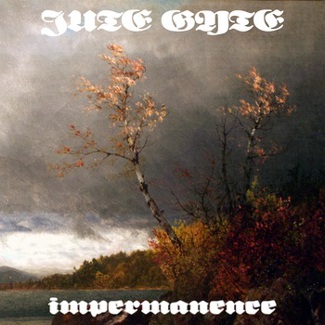
Jute Gyte - Impermanence (2011)

I could very easily see Adam Kalmbach's Jute Gyte project become a sort of Blut Aus Nord for the states, a consistent exhibition of both the black metal and ambient spectra which is wholly unafraid to join the two in a selection of marrow draining compositions. To date, he has danced both sides of the line, with several recordings that are fully in one camp or the other, but even so, external influences very often bleed into the stream of inspiration, and Impermanence proves no exception. The rustic, leaning limbs and autumn leaves of the cover would normally leave one in question of just what the DVD packaged album might aurally contain, and yet the title itself is married completely to the image, a portent that no living thing can sustain indefinitely, and that the dying itself imprints an fleeting and desperate beauty upon the retina. Or, in the case of Jute Gyte, the ear.

I've warned before that Kalmbach's records are not easy to access, and the constant holds here. Why, even in the very first track, "Meaninglessness and Waste", a rush of dense and raw, drum programmed blasting must be endured before one arrives at the more curious bits, like the wending, droning guitar melody and the alien dissonance in the rhythm guitar and bass tone. You will not find the sort of consonant, ear pleasing tremolo spurts you expect from the friendlier, Scandinavian exports, but rather noisy and drudging tones aligned more within the controlled discord of French acts Blut Aus Nord or Deathspell Omega, if not always performed at the same intensity. Or maybe a touch of Havohej. Where Jute Gyte excels, however, is in Adam's patient ability for the 'reveal' of the composition, how its bared teeth gradually part to expose a tongue which turns to the cadence of several musical languages. Several of the tracks on this album feel as if I'm watching a Lars von Trier film, awaiting the inevitable, always fucked revelation that makes the audience gasp in confusion or release.

Some of their opening credits consist of a more metallic nature, as in the aforementioned opener "Meaningless..." or the harrowing onrush of "Partial Wing", but then you've got exceptions like "The Wild Rain", which feel more like a canter of epochal sludge-punk dowsed in a guttural vocal dressing. Or "Hermit Haunter of the Lonely Glen", which is inaugurated by descending cycles of glinting melodies that lapse into the black/noise onslaught. A lot of the songs have these great, plunking bass patterns that erupt into some sodden progressive fog which falls somewhere in betwixt a garage Primus and undiluted Seattle grunge haze. But there are also some notable ambient passages, like the janky titular guitar interlude or the sinister, warped bridge of "The Old Hills' Indifference" before it storms into the unhallowed traffic of its oozing bass and ambient spikes around 5:30. The point is, with just about every single piece of music (excepting the title track), there is something waiting in the wings, something you might not expect...

And this is crucial in maintaining the listener's attention span. Most of the songs here are around 9-10 minutes in length, so to loop the same ideas endlessly would cripple their effect. Yet, Jute Gyte somehow never seems aimless in direction. The surreal, impressive lyrical imagery seems to compensate for the often one-track, tormented Burzum vocals, and while not every guitar pattern is captivating, they are never recycled beyond the point of no return. Something new is always around the corner, but the songs never seem excessively spastic or ADD-attuned. The production is feral and traumatic without actually hurting the ears like a Nattens Madrigal. In the end, I've found Impermanence to be the most impressive of Jute Gyte's works to date, further exploring along the axis of an Old Ways or Verstiegenheit without abandoning that same, isolate, outsider vision.

Verdict: Win [8.75/10] (swallowing all dimensions)

http://www.jeshimoth.com/jutegyte/

Wednesday, November 30, 2011

Bellicist - The Eternal Recurrence (2011)

When a band comes on as technically strong as this one, I admit to feeling some apprehension that I'm in for a soulless train wreck of technical wankery and sterile pop studio polish that won't turn out so memorable. Somehow, Missouri's Bellicest manage to avoid this stylistic sand trap by blending the old in with the new. You'll still be hearing harried arpeggio sweeps and ass-loads of technicality, yet they are just as content bursting into an old school New York brutal chug-fest or some churning Florida evil, while mixing up the vocals between guttural norms and rancid snarls. The Eternal Recurrence is a pretty staggering effort for a debut, and I doubt these guys would remain unsigned for long, but it's worth checking out even if you're normally averse to such proficient punishment.

I can't say I entirely loved the production of the record, but it very much gets the job done. You can hear every little spike of lead guitar, and yet the rhythm tracks are deep, dark and intensely pummeling, machine-like in their execution. The drummer, bassist and guitar player are all quite insane, and about the only time they ever dip in quality is when they enter a brick-house slam segment like in the middle of "Insignificant". And yet, even when something like this occurs, they follow it up with the unexpected...in this case, a wild little bass solo and a rupture of melodic death metal played at a far higher speed. But there are other tracks here which are completely surgical bursts of intensity that brake for absolutely no one ("Philistines" or the more spastic "For Your War"). They're quite tight at incorporating all these fast-break technical thrash parts played at such speeds that bands like Cynic and Atheist come to mind, or perhaps the Swedish Theory in Practice, but there's that added substrate of brutality here for those who like their neolithic fist fighting death metal.

Surprisingly, there's a lot of diversity in the songwriting, and they'll attempt some longer pieces in here, like "The Iscariot Path" which is almost 9 minutes, or "To Serve the Pigs" which is over 11. The latter is a grooving bludgeon at a slower pace, while the latter alternates between airier, noisy passages and churning Morbid Angel solutions, and neither of them manages to bore me despite their swollen enormity. And it's this reason that The Eternal Recurrence functions: not only for the obvious skill of the musicians, but for the fact that they throw so much at you and somehow keep it interesting enough to remain attentive. That's not easy for an album which sounds like the ungodly spawn of an orgy between Skinless, Morbid Angel, Necrophagist, Arsis and Behemoth, but that's what these guys do. Even lyrically, the band is more concerned with sociopolitical affairs than they are with gore and zombies, which might not be unique, but it's an interesting match for the style they play. The Eternal Recurrence not perfect, and I don't really love all the vocals or individual riffs, but taken as a whole it's formidable enough that people ought to start taking notice.

Verdict: Win [7.5/10]


http://www.myspace.com/bellicist

Monday, July 11, 2011

Troglodyte - Welcome to Boggy Creek (2011)

Missouri's Troglodyte has an admittedly cool, campy gimmick going for it that should open a few doors to exposure, but unfortunately that is where their distinction begins and ends. Adorned in rubbery masks that give off the impression of a band of murderous neolithic brutes, a prehistoric alternative to Slipknot or Gwar, they have decided to fixate their lyrical concepts upon the cryptozoological myths and legends of primitive manlike primates: yeti, sasquatch, abominable snowmen, Bigfoot, whatever the fuck you want to call them. The vehicle of choice? Why, brutal death metal of course, with equal parts slam and competent acceleration that never quite stand to memory quite as much as they stand to leave knuckle imprints upon your face.

The old horror paperback (or film poster) cover art is quite cool, as well as the potential here for a focused concept album, but Welcome to Boggy Creek squanders much of its advantage by not playing it seriously enough. The debut is just too tongue in cheek, with songs like "Skunk Ape Rape: The Rapture" and "The Only Good Hippie...is a Dead Hippie", or "Hit By the Hendersons". A Harry and the Hendersons tribute! Less direct silliness would have actually worked in its favor and made the album that much more humorous and compelling. I mean, the band had me at the cover and title, but the music itself all plays out like just another USDM record with aims that have been pre-defined by bands like Deicide and Suffocation. More of the former, as the layered guttural and snarl vocals are highly redolent of Glen Benton, and a lot of the riffs move along the same bludgeoning axis as those composed by the Hoffman brothers in the 90s, but in their defense, Troglodyte is not necessarily a derivative of any one band.

In fact, the musicianship is quite competent, with intense if predictable drumming that can accelerate to maddening speeds, and obvious skill between the guitarists, who can rifle out elegant leads ("Beaten and Eaten") and unexpected atmospheric passages (as in the bridge of "Bring Me the Head of Bigfoot") amidst the less surprising slamming grooves and blast beats. The band is versed in variation, no two tracks sound precisely the same, and the short length of the debut (under 30 minutes) ensures that its unlikely to bore anyone to tears, but with such a primitive and hilarious aesthetic I was left wanting more. Welcome to Boggy Creek isn't half bad as an establishing shot. The production is on par with much of the modern, brutal death we've been hearing the past few years. The riffs, while never memorable, are inoffensive and vaguely exciting. The visuals seem like they could be a lot of fun, and the aptitude of the individual band members is unquestionable. I'm down for some neander-core...I'd just like to hear them write more effective music that isn't so quickly lost in the super-saturated environs of this genre.

Verdict: Indifference [6.75/10]


http://www.neandercore.com/

Wednesday, May 18, 2011

Jute Gyte - Verstiegenheit (2011)

Missouri's Jute Gyte continues to lead an impressive double life as an experimental/ambient obscurity and an adventurous black metal combo. Verstiegenheit is the latest evocation of the latter, following upon the poignant heels of prior efforts like Old Ways (2008) and Eagle Heart (2010). Wrought from a moral haze, sauteed in emotional escapism, and primed in a stark poetic discourse. You'll of course experience all of the baleful repetition and raw potency you'd expect from other 'bedroom' acts within the black metal genre at large, but Adam Kalmbach assures more than a mere mirror to the familiar nihilistic pandering, but layers of nuance and substrate that catch at the edge of perception like muted specters hidden in a watercolor painting.

From the onset, Versteigenheit operates under the deceit of a straight black metal affair than either of the other albums I've covered, "Gates of Day and Night" providing roughly nine minutes of grim, charging abandon. However, despite the monotony of the drum sequence, and the Burzum-like grated torment of Kalmbach's vocal presence, the choice in chords is incredibly curious, almost like a mesh of accelerated grunge and 90s noise rock rather than the bleeding Scandinavian miasma of oppression. This is further expounded within the next track, "Apparitions in the Woodlands at Dusk", in which a similar rush of pummeling chords are affixed to a hissing layer of distortion. This track is where the experimentation truly arrives, first in the mellow, muddled bluesy breakdown at 2:00, then later in the jarring rock riffs and curving bass-lines after 4:00.

Trust me, you've not heard anything quite like this before, and such strange hypnosis provides one of the compelling reasons that Jute Gyte deserves further examination aloft the saturated spectrum of underground darkness. Most of the tracks follow a comparable formula in that they are between 8-12 minutes in length, opening with steady rhythmic charges, but they've all got surprises in store for those who dread that ennui might set in. There are several deviations in the tonal ambiance of brief interlude "Church Not Made With Hands" or the resonant guitar instrumental "To Return and Revere the Desolate Places (Late Idyll)", but on the whole the pieces fit with a formidable, haunting balance. Verstiegenheit might require several exposures before it seeps into the listener's skin, but as usual, Kalmbach is not interested in accessibility, nor the cheap rewards of the easier road. This is impressive, important music, but it flits across the depths of the surreal and secret. It's not coming to you. You're going to have to chase it.

Verdict: Win [8/10]
(an echo from the ageless hills)

http://www.jeshimoth.com/jutegyte/