 Rather than making some major career choice and consigning one of their two styles to oblivion or a side project, Blood Incantation instead move forward with both their death metal and cosmic ambient halves on this latest single. As someone who enjoyed both of these creative entities, I can't say that I'm terribly disappointed, but I'm not sure how long this sort of split personality can be maintained without the band needing to spin off of them off. Or perhaps it never will be. On the downside, I don't feel that, for this particular release, both halves are created equally. Competent, for sure, but while the band expends a lot of effort to return to the death metal that put it on the map, and succeeds there, I don't feel like the opposite is the case...
"Obliquity of the Ecliptic" is quite good, at least on the level of the first two tracks off Hidden History, with some dark grooves to it and no shying away from the blasted mayhem, with just a few hints of proggier structures poking through. This track itself does have an ambient segue, and a nice one with the drums rolling around, an organic and glittering vibe to it when the soft synth pads do arrive. Eventually, it explodes into a more glorious, melodic second half and you really do feel through the almost 9 minutes that you've gone on some adventure. As for "Luminescent Bridge", it's got some nice clean guitar tones and spacious ambient textures, as well as a lead guitar that breaks out deep in its bridge (if ambient tracks can really have a 'bridge'), but it's just not as immersive for me as Timewave Zero was, though I dug the horn sounds at the end. It might even feel like it was thrown together because they didn't have two death metal tracks ready...I've mentioned it before, but considering the band's huge underground status they haven't put out a ton of tunes, they tend to take their time.
Nothing wrong with that, but I just can't envision myself revisiting this piece very often, and thus would probably prefer of "Obliquity" was just on another EP or full-length album. Is that track good enough after four years since Hidden History? I'd say it's adequate, if not exemplary. As a brief, 20 minute single or EP though, this is barely enough to tide the audience over as they anticipate whatever comes next or what style it might invoke. It's hard not to think, with all their exposure, and then the total turn towards the ambient for the 2022 record, that whatever comes next for Blood Incantation could be their 'ride or die', their 'make or break' to the fanbase and their expanding audience. No reason to believe they can't rise to the challenge, but I don't think we'll need any more little morsels like this while we wait to find out.
Verdict: Indifference [6.25/10]
https://www.facebook.com/BloodIncantationOfficial/

Monday, July 29, 2024
Blood Incantation - Luminescent Bridge EP (2023)

Sunday, July 28, 2024
Blood Incantation -Timewave Zero (2022)
 Timewave Zero was met with an understandably divisive reaction as it went on to more fully explore Blood Incantation's ambient influences, which to this point had only been manifest in parts of a few instrumentals or interludes on their albums. To an extent, I can sympathize with the naysayers...the logo is the same, and it's such a massive shift that it might as well be another band entirely, but it's not as if this was the first time in history some extreme metal acts took 180 turns. Hell, look at Beherit or Burzum, or many others who embarked on ambient or electronic or dungeon synth paths away from the blasting and growling. I'm all for bands evolving, in fact some of my favorites like Enslaved or Voivod have made careers of it, but this could certainly be seen as a bridge too far...
Fortunately, Timewave Zero is quite good. 2-3 epic length ambient tracks, (depending on which version you've acquired), moody and mesmerizing, and at the very least, featuring contributions from all the death metal band members. So even though this might come off as a vanity project that extends the earlier hints of this style, it's all hands on deck as they surf further along the radiance of quasars and emptiness of the vacuum between worlds. The textures are obvious but also subtle, with a couple different synth-lines layered together, some repetitious and others more celestial and spacious, but it's mostly quite smoothed-over, you don't get into the abrasive droning or noisy sounds that a lot of darker ambient projects explore, at least not in "Io" or "Ea". As most you feel the atmosphere of alien worlds through a few sweltering crescendos of what might feel like colossal elder beings stretching their galaxy-wide limb, or really a cinematic feel that will trigger nostalgia for old sci fi films in which the synthesizer-based composers really earned their scratch.
There's also a little touch of acoustic guitar deep into the experience which is a nice bridge back to the familiar, and this is perhaps my favorite part, when the little synths play off against this. If you've got the version with "Chronophagia", this is a much darker, improvised and longer tune where a lot of those more droning aspects come into effect, with some moody synth lines out in the astral murk that really impress as another of the highlight. My CD copy does not have this track and it kind of pisses me off, I didn't do my research but I HIGHLY recommend you get that version with the CD + Blu Ray or the multiple records, because it definitely adds a lot of value to the release and then it really becomes more of a full-length than an EP as the band states.
Now, admittedly I don't have a ton of knowledge when it comes to this genre...I do have hundreds of ambient, dark ambient, New Age, dungeon synth, space synth and other releases digitally, and also a bunch in physical form. I love the stuff. I dig my Tangerine Dream, Klaus Schulze, Jean-Michael Jarre, Fenriz' Neptune Towers, and many more, but I don't know that I can precisely pinpoint the influences that Riedl and company most lean on for this. But it's clearly fluent in that spacey style, immersive and just as easy to get lost in as any of their death metal material, though I think this is obviously a lot simpler and probably easier to put together. I think it would work better as a spin-off, or perhaps integrated into their heavier side, but ultimately what matters is the quality of what's on the disc, and this is enjoyable if not revolutionary for its style.
Verdict: Win [8/10]
https://www.facebook.com/BloodIncantationOfficial/
Tuesday, May 30, 2023
Minneriket - Gjennom meg går ingen til hvile (2022)
 Gjennom meg går ingen til hvile comes not only after the biggest gap in Minneriket releases, but also as the biggest single leap in progression that the band has made to date. The hallmarks of the project's original style are still present in the rasped vocal and the raw black metal guitars, but these have been joined here with a far more Romantic, prominent use of pianos and keyboards, and a large cast of guest musicians who are providing everything from female guest vocals, to strings, cello, harp, flute, gongs, and saxophones...this was clearly not an album to be given anything less than the full-on, almost overblown artsy treatment, but even if this might seem pretentious when compared to his early work like Vargtimen, it's still quite the alluring album.
I'm particularly impressed by how he's able to slap together a dreamy piano instrumental like "Hjemlengsel" and then flood you with an operatic piece like "Begravelsens hjertseslag", on which the female vocals are very chilling and the lead snarls are as evil as ever. The pianos creep alongside this and other tracks, used as an almost cinematic accompaniment to whatever the guitars are doing beneath. The drums here don't need to blast or anything so you can feel out the beats more, and probably the biggest surprise was the bass guitar, which is groovy and moody and finally creates in own layer of mood that fits write in with the spooky esoterism of the album's classical side. It's so good that I could just turn off everything but the rhythm section and I'd still be bobbing my head along to this one.
This might have more appeal to the Gothic/black metal audience more than those who valued the original Minneriket recordings, but I think its quite an improvement at maintaining my own interest level. There's just so much going on here, and it's both seductive and evil while still doing its own thing and not aping other bands that have mixed the styles. Not entirely avant-garde in structure, but definitely building a unique identity among a scene of so many other great bands that have progressed into their own distinct realms. I don't even know what to really compare it to...Peccatum? The few extra years off were put to good use, and this is one absorbing listen.
Verdict: Win [8/10]
https://www.minneriket.com/
Sunday, May 28, 2023
Minneriket - Anima Solis (2018)
 If I didn't know better, and saw only this raven-haired beauty hanging in her corset, I'd have thought that Minnerket went full out Goth or something, but Anima Solis is instead another incremental evolution of the industrial/ambient black metal style that was started on Vargtimen. If anything, this album is even more accessible than the sophomore, but probably only because it is better produced and somewhat stricken through with more traditional black metal concepts in its construction. There is still that element of edgy, mechanistic-driven noise, the vocals are quite grimy and hostile, and plenty of the guitars produce a splatter of sinister, dissonant, droning lines above the central thrust of the beats, but it's a fraction easier on the ears.
It's also very weird, with a fair dynamic range between cuts, and arguably as experimental as anything the guy has written before. Take "When Life Gets Sick the Dead Grow Strong" with its weird, broken industrial rhythms, constant atmospheric roiling and trolling, and some of the most impish vocals he has committed to an album yet. Evil shit, and he gets the vocals to sound even more ridiculous on other tunes like "Between Infinity and Melancholy" with its cacophony of industrial clatter, or "I Am the Serpent Son" and its dash between gruesome, protracted growls and a snarl so ludicrous it sounds like its being performed by small, wounded mammals. I don't want to accuse the album of having a sense of humor, but it's certainly willing to go as far over the top as needed to make the listener lose his/her nerve.
It's pretty good, though, I mean there aren't really enough of these sorts of experimental and industrial black metal spinoffs out there, or at least not as weirdly absorbing as this one. Just when you think you've got it figure out, then he gets you with the hugely atmospheric "Alle hjerter banker ei" and its deep, narrative vocals and dreamy, dissonant guitars. This is weirdly creative, terrifying stuff, though it runs the risk of coming off a bit too childish or churlish when it goes full into its zanier passages.
Verdict: Win [7.5/10]
https://www.minneriket.com/
Friday, May 26, 2023
Minneriket - From the Veins of a Nearly Dead Boy (2017)
 Minneriket's third album swerves away from original material to pay tribute to one of his favorite artists, and I'm willing to bet that you can guess it in three. You got it in one, Burzum. While Varg's material doesn't entirely inform the first few albums of this project, it's unquestionable that its leaning towards atmospherics and even pure ambience is partly inspired by an album like Filosofem, and why shouldn't it be? The rawness, the hostility, but also the melancholy and wantonness you would feel from that album translate quite well into so many of the potential successors, and Stein is able to capture that here while putting a slight spin on the original material.
That of course comes in the form of the more mechanical sounds that Minneriket is prone to. You will certainly recognize the lyrics and riffs of the tracks that are being covered, but they are almost all surrounded in an added level of ambient/industrial black noise, and occasionally feature a riff or two that he will deconstruct for further make it his own. It works best in tracks like "Lost Wisdom" or "Glemselens Elv", whereas others play it a little closer to the belt. They're still not exact duplicates, because there is always some difference, in the beats or the level of saturated noise, but I'm the sort that really doesn't need close approximations when a band is paying tribute though covers, I'd like to see the material adapted further, and this only fulfills that goal in particular places.
Granted, the originals sound fairly chilling and hostile even in these contexts, and as one who enjoyed most of them when they came out, I found this familiar and listenable, or at least as familiar and listenable as something like this Norse project could ever be. The melodies work just as well beneath the added level of mechanical grime, and clearly he's got taste in his choices, even dipping into some of the later, understated material for an instrumental. Not an altogether unworthy tribute, but I'm more curious to see where Minneriket would head with his own material next.
Verdict: Indifference [6.75/10]
Wednesday, May 24, 2023
Minneriket - Stjerner, speil og svartebøker... (2016)
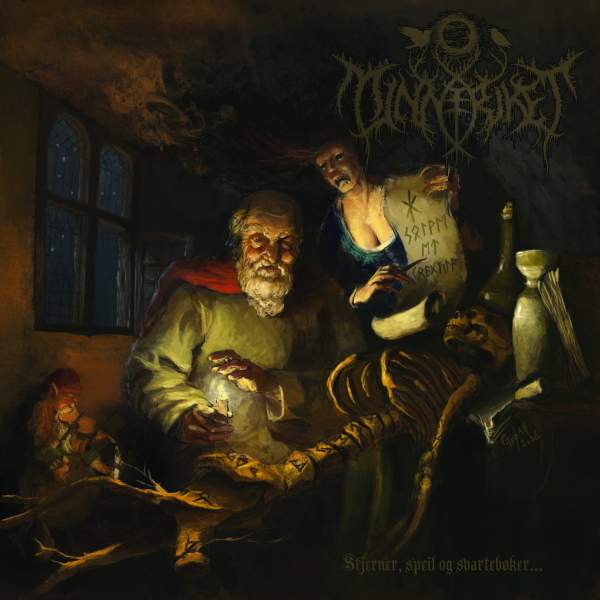 Stjerner, speil og svartebøker... might not seem like such a far stretch from Vargtimen, as it still cultivates the noisy, cold black metal atmospheres of its predecessor, but it is at once more 'musical' and multi-dimensional, a slight warmth beginning to creep in at its corners, and production that is a stone's throw beyond where the project was already at. Even the cover art is a major improvement over the logo-only boredom of the debut, and if you felt like Minneriket wasn't structured enough before, I think Stein made a quick pivot to something more familiar to those seeking out a more traditional black metal, but don't think for a second that he abandoned his experimental ambitions.
Such are present with the second track here, "Vinterblot", which uses the drumming to create a cold, martial, marching beat that intersperses into the roiling, droning guitars and cruel rasp of its creator. The songs seem a lot more adventurous this time around, with elements that were not at the fore now arriving...for instance, the rumbling distorted bass in "Of Storms and Sorrows", which actually spits out some pretty catchy lines that are slathered with all these weird, broken beats, enigmatic industrial noises and such. "Jærtegn" is one of my favorites of these first two albums, it's got an unnerving sense of warmth and light to the floe of chords, and throws in everything from crackling storms, weird tones that sound like deep chimes or organs, and all manner of shimmering noisy guitars. Other cuts like "Totemkriger" take this atmospheric exploration and apply it into a more direct, blasting, warlike experience, and "How to Write Love in the Stars" (great title) adventures far further into pure ambient territory, which Stein really does excel at here...
So if you can't already tell, this effort is dramatically and artistically superior in just a year's time to where Minneriket had already been, and ample evidence that there might be some legs to stand upon, since there's really no limit to the sounds this guy is going to jackknife into your skull. The absolute-zero-temperature temperament of the debut was but a cold spark, where in this sophomore album the flames of imagination have bloomed, begun to consume the firewood and fill the hearth. Still creepy enough to freak you out, but then lays your head on a pillow and does its impression of a soothing before it starts stabbing you again. It's far from perfect, and who knows what the goal is with such an esoteric project, but it's clearly inspired.
Verdict: Win [7.5/10]
https://www.minneriket.com/
Friday, December 4, 2015
Spectral Lore - Gnosis EP (2015)

Of these two diversional EPs (thus far), this is of course closer to the Spectral Lore you have made previous acquaintance with, at least in instrumentation. But the spaciousness and simplicity of the guitars, drifting and dreamlike, generally inhabit a more atmospheric, background realm on the earlier half of the track list, than the raging tremolo picked excellence and aggression I associate with records like his excellent Sentinel. That DOES play its part, threaded through the odd and extensive "A God Made of Flesh and Consciousness" along with the heavier drumming, but it's not the rule of thumb early on. There are points of pure folkish writing with a psychedelic bent ("Averroes' Search"), clean guitars and looser percussion instruments, and even a minimalist ambient backdrop to such strings on the closer "For Aleppo", which is nearly 10 minutes with the same synth wave struck in the background, enough that you might be driven mad if not for the classical licks being sporadically brushes across the monotony. Probably my favorite piece was "Gnosis' Journey Through the Ages", with some really great melodic hooks and a sense of urgency and majesty that isn't prevalent in some of the other tracks.
Overall, though, Gnosis really functioned as intended, as a support for the listener's contemplation, and is best experienced either through stillness or some other activity in which the motor skills will veer one way, and the imagination the other. It was a curious choice made to keep what vocals you can perceive as sparse rasps buried in the mix...the lyrics themselves are fairly substantial, but it's as if the audience is presented with some existential test to apply them to the songs him or herself. They certainly sound sick when "A God Made..." escalates into a primal explosion, and in that specific spot it might have benefited to crank them up, but it's the clear intent that they never dominate the instruments, and rarely participate, so their exile from the foreground is understandable. Now, having a predilection for spacey electronics and synthesizers myself, from Tron to Tangerine Dream to Mass Effect, I'd have to say that I was more absorbed by the previous EP, but Gnosis was still a compelling excursion to tide us over until the next 'proper' full-length, a welcome contradiction of an experiment achieved through somewhat traditional riffs both acoustic and electric.
Verdict: Win [8/10]
http://spectrallore.bandcamp.com/
Thursday, December 25, 2014
Til Det Bergens Skygenne - Vandringen II (Lynnelandskap) (2014)

Previous recordings, while simplistic, were very consistent and felt a little more prepared than the material on this, which really feels as if he set up a few aesthetic parameters and began to unwind, layering in the varied synth textures to create something a little more alien. This was not unlike the parallel development of another of his projects, Yearner, although I feel like The Second Howl was a much more frightening and unusual effort, while this is honestly pretty smooth in parts. The three tracks create an overarching ebb and flow of psychedelia pointing straight at the 70s, a decade in which the keyboard was being developed with so many new tones; with the caveat that some of the grimier indulgent tones, beats and ambient swells were not in fashion during that time, and these tunes (like "Part III") definitely have a tendency to simmer into a climactic point. Fuse that sort of nostalgic miasma with colorful, spacey imagery kind of like you'd find as the backdrop to various antiquated science fiction shows and you'll find the appropriate headspace from which you can properly appreciate the hallucinatory terrain Vranevorn is digging through.
For much of the playtime, I felt as if I was floating weightless through some strange Limbo where the weird tones and melodies created a sense of serenity that was occasionally being marred by the more obnoxious little sounds that occasionally present themselves. The synth lines often feel playful or communicating with one another. The stark, sparse interruptions feel like astral garbage scows sifting through the puffy, purple emptiness for emotional salvage. But this is my own hyperbolic reaction to the stuff...you may feel as if you're watching a patch of multi-hued mushrooms bloom, or in some forgotten underground space where you're watching fluorescent slow motion waterfalls. It does occasionally have its moments of gloomier atmosphere, generally when the keys are more minimal and deeper tones ring off into the emotional void, but in general I found this to be really consistent, trippy material which is not at all an unwelcome shift from the canon predating it.
Verdict: Win [7.5/10]
http://voldsomtapes.bandcamp.com/album/vandringen-ii-lynnelandskap
Monday, November 24, 2014
Yearner - The Second Howl (2013)

That said, it's equally evocative of a lot of obscure and strange imagery. The second track reminded me of late summers in my youth when I'd watch in fascination at moths fluttering around the bug zapper lights in my grandfather's back yard...but mashed up with spending an evening at S.E.T.I. listening to the radio signals from space. The third track has these distorted pads which almost create a form of percussion under the prime, buzzing melodies, and I found that this was easily the most glorious and memorable among the three, though once again it's more a mood piece despite it's more easily discerned 'riff'. There are also some points in that one where the haunted organs of the first tape return for a few seconds, almost like L.V. is switching radio channels and tuning in to his earlier visions. A weird self-awareness that emerges among all the roiling, fuzzy tones and experimentation.
While it was successful at reincarnating some old memories, and an intriguing listen, The Second Howl did not quite live up to its predecessor as something I'm going to want to break out time and time again, nor was it as strong as the rest of the Voldsom tapes I've been covering. But I wouldn't dub it a disappointment, because what I did like about it is how it almost seemed like L.V. was using this as a further launch pad for a project that involved 'grounded' technological feedback. Where Astral Order of Impurity was a veritable lunar lander or space station, this is more a soundtrack for a being lost in a labyrinthine landfill of ancient computer game cartridges, radar dishes, and other antiquated computer or arcade machinery, factory castoffs and all sorts of outdated paraphernalia. Strange, but sometimes soothing if you like a little challenge in your minimalistic ambiance.
Verdict: Win [7.25/10]
http://voldsom.net/
Friday, November 21, 2014
Yearner - Winternight (2013)

Not all of the tracks on Winternight are uniform in mood, but there is enough linking them together that by the end you've felt like you just wandered through some German Black Forest Odyssey during the snowfalls and lowest temperatures of the year. The organ tones here, especially in a piece like "Silent Nocturnal Snowfall", resonated with me incredibly well, as if Captain Nemo had been forced out of his undersea vessel and made to perform among the evergreens at absolute zero. It's chilling and also evokes a hint of nostalgia for cult Gothic horror films, and to be truthful would not make a bad accompaniment for some silent black & white replete with imagery that someone might have felt was pretty creepy in the earlier 20th century, or even today if they actually have perspective. These passages are played in repetitive waves, joined by antiquated synth tones which would have belonged more to a Tangerine Dream and/or Vangelis, which bring a little more of a Technicolor palette to the atmosphere, like whorls of deep purple or crimson snow erupting over a monochromatic landscape. This is really where the record transforms and transcends beyond the reality of a guy and a keyboard.
But Yearner also disembarks from this motif, with more dissonant, jarring pieces like "Obscurity" which have a more immediate, brooding horror appeal with some electronic pipe-like sounds that really freaked me out, or "In Days of Yore" where the synths feel more saturated and distorted beneath a more glorious melody...it wouldn't be out of place in some dreamy 80s film like Legend. "Winternight" itself has a slightly more Medieval folk/castle feel to it, adding yet another facet to the album's ability to successfully manifest fragments and scenes of the imagination. Combined with the murky, raw mix, all five of its tracks function entirely as intended and were a perfect mood-setter for a few brisk New England nights here in mid-November, though I definitely have the feeling I'll be breaking this out in another month or two repeatedly as I become increasingly surrounded in frigid whites and darkness. At 20 or so minutes, it never wears out its welcome, and probably more than any of the other tapes I've heard from L.V's other projects (Astral Order of Impurity, Til Det Bergens Skygenne, etc), grants a haunted, seasonal escapism.
Verdict: Win [8.75/10]
http://www.voldsom.net/
Wednesday, November 19, 2014
Astral Order of Impurity - Dimension (2014)

Dimension is a more cathartic experience than the prior tape, with a greater intrusion of dissonant noises and effects that inhabits its depths and become immediately more alarming, while the usual background tones themselves become even more innately alien and frightening. This is not always the case, and there are indeed a few lighter points in the first half of the 41 minute track which were crucial in setting this one up as an almost more asymmetrical 'cinematic' recording. A few hints of weirdness abound, but it all takes a slightly darker, more chaotic turn as you reach past the 20-25 minute zone, after a more ominous, subdued middle section with some subtle electronic or radio signals rattling off against the swelling background...I thought I even heard something like a guitar distortion pop into one ear, but I often lose my mind when I become so embroiled in a record like this that it wouldn't surprise me if my own mind was casting shadows. But, lo and behold, just like the alien bursts out of the victim's chest, or the space heroes realize that planet they just landed on is not actually a planet, or that the void is just in general not a friendly place...this one grows a little more haunting and fucked up, and it really pays off in the listener's emotions.
Again, material like this is the Anti-Beat. It's not going to get you laid, and if it does, well you've found yourself a keeper...either that, or someone who is going to probably kill you in your sleep (one eye open, friend, one eye open). It eschews the conventional structure of rock or even classical music instrumentation to more directly mimic the sounds of open space, technological equipment or even just what a human brain might 'think' it is hearing. You're not straining for the next harmony here, you're just dreading what might be around the next corner of a derelict extraterrestrial space-craft. L.V., the sole craftsman on this recording, is channeling his own trepidations of the unknown onto cassette, for a few brave souls to witness themselves. But the funny thing, people, is that this is ALL around you, always has been, and always will be. Stop to listen for a few seconds, ignoring the wagging of tongues, the invasive ring-tones, the grinding of construction equipment on every urban corner, and you may just hear it. Or, better yet, just let Astral Order of the Impurity do the work for you. Dimension is the music of Infinity, filtered through one consciousness trying to translate it into pure aural emotion. It's the better of the two Astral Order tapes I've listened through, by a small margin, granted, but it's at once both more sublime and horrifying.
Verdict: Win [8.25/10]
http://voldsom.net/
Monday, November 17, 2014
Astral Order of Impurity - Portal (2014)

Speaking of directions, Astral Order of Impurity depends on only one. Up, up, and away, unto the weightless distortion of space and time. Gravity be damned. Gravitas, on the other hand, paramount. One of the more recent projects of musician L.V., who you might recall from my coverage of Til Det Bergens Skyggene, a more rustic example of ambiance which some might brand ambient, others might dub 'dungeon synth', but struck through with tints of folk abandon and isolation among both the depths and surface world of the Known World. Portal is rather the opposite, a solitary, 43 minute, consistent excursion into what feels to me like an extraterrestrial plane. Perhaps resonating off the hull of some cyclopean World-ship cruising the void between galaxies. Or something your imagination might produce as a feedback loop during nostalgia for lunar landscapes, ancient science fiction concepts (pre-colorization). Free of the convention of percussion and other rock sacraments, the spacey synthesizer pads embark upon an oft empty, oft ebullient discourse. This is not a vacuum which entirely lacks in warmth; he is constantly supplanting the thicker, murky, fear-induced strains with cycles of more radiant non-melodic tones and effects that seem delightfully spontaneous.
I told you: deeply personal. One human being experimenting with sounds foreign to the herd-mind misconception of what music might encompass or become 'defined' as. That's not to say L.V. is the first cosmonaut out in this stretch of universe, but due to its general lack of rules and scripture, this stuff always feels fresh and unpredictable, even if that sporadic nature arrives in the form of subtler sounds than chaotic, blazing grindcore guitars or acid-trance crabcore keyboard harmonies. Mood music, absolutely. Not something you're going to appreciate much if you can't set yourself up to receive it. Park your posterior on a hill at night, stare off into the darkness, and come to terms with your smallness in the face of it all. Dream of satellite dishes signaling off into the interstellar range, where they most likely will reach nothing. The tape format only adds to that nostalgia, that horror, that antithesis to sentimentality which such cold and distant music revels in, but the real joy of Portal is how, upon the precipice of becoming lost and frozen forever, you'll experience this peel of light, a far-off sun erupting, and know that somewhere, someone is still breathing, dreaming. And goodnight.
Verdict: Win [8/10]
http://www.voldsom.net/
Friday, September 12, 2014
Colosus - Blestem (2013)

One of the grayest albums I've heard in ages, it patterns blackened tropes like raucous, distant rasps, blast and double bass drum sequences and roiling tremolo picked guitars into a landscape of utter misery that finds little redemption through melodic construction. What traces might exist are keyed to a few warmer chord progressions that feel like tints of sunlight penetrating a smoggy haze, and even those are smeared into oblivion by the incursion of bleak, dry passages where simple chords ring out through the emptiness, a suffering background cry will erupt or some other element woven into the record's pervasive sense of hopelessness and isolation. Riffs are never even remotely complex or individual, used entirely as means to a painful end and not inspirational in of themselves. Nothing you'd pick out of a lineup, but effective in the context Khrud intends here. The real highlight for me were the purely sweltering ambient segments, often occupying entire tracks, and occasionally affixed with a minimalistic industrial pulse ("Intuneric") which satisfactorily supports the haunting, sewer like resonance of the protracted growls, chords or other instruments of torture used to function as an unsettling, cinematic aesthetic.
Again, it's pretty simple stuff, and just as much a low budget horror score as a distinctly 'black metal' experience, so it's not one to invest in with the expectations that you'll be able to trace it directly to the usual Scandinavian suspects. In fact it almost feels like he's mashing up bleaker ambient death and black alloy as a sample set which he can channel through something like a minimalistic early Godflesh, only without the big grooves and charismatic grunts that crafted their legend. To some the effect will be none other than that of staring repeatedly at a decaying wall, one whose entropy is overt rather than subtle, lacking in the nuances of rare lichens or curious cracks leading to secrets beneath the surface. But I think that was rather the point of Blestem, an anathema to the guitar-fed strength of its parent genre, in that it just dumbs down everything into that barren atmosphere of the psyche which responds to the same cold corridors, concrete infrastructures and vapid repetition of the urban waste surrounding us. Sufferscapes. Graystuff. Brooding, meandering grime. With those all too rare glimpses of something greater...a cathedral...a monument...which quickens the heart just in time to flatten it once more into a sulfurous paste.
Verdict: Win [7.25/10]
https://www.facebook.com/Colosusofficial
Monday, September 8, 2014
Jute Gyte - Ressentiment (2014)

Let me clarify that, since that term might not mean the same to myself as other folks. This is not the soothing, pop-glossed sort of catchy, but droning, oddly ebullient passages of rhythm guitars that ingrain themselves into your conscience, dowsing it in their alien landscape while Kalmbach's bass lines seem to develop themselves along busy, industrious, factory floor lines, and his grainy vocal ravings remain rooted in the black metal tradition he has gone Kafka on, peaking with the passionate howls of "Worms rob the honeycomb..." near the close of "The Grey King" (and the disc). There are other traces of that lineage here, in the form of a few hyper-blasted passages in which the rhythm guitars transform into halos of whirring hornets, but Ressentiment works its best where it remains at a moderate or slower pace, with the jangling guitars or simultaneously driving/laconic chords who seep through that strange microtonal tuning. For instance, he transforms the opener from a surge of disheveled higher pitched warp-riffing to a slower roil accented by these incredibly effective cleaner guitar lines, the whole process sounding like one tragic mistake that turns out...isn't. It's that sense of constant collision between the listener's expectations and the direction he's steering his chord and note progressions which keeps the material constantly fresh and engaging, even if it never hinges upon the consonant comfort zone most rock and metal music dwells within. It's 'art metal', but in a finer sense than just splashes of colorful paint...
Jute Gyte is more like the work of a forgotten master, hanging in the corner of the gallery where most with only a superficial interest in the museum can just ignore it. Sort of like the classics he mines to represent the face of the music. You might also think of this as an Erich Zann transcribed into our shared, non-fictional universe (I know, that's a bold assumption on my part). Every few months, Kalmbach revisits that otherworldly muse which guides him, and commits visions of the unknown and obscured straight to the earspace of those daring enough to loiter about the Rue d'Auseil and experience it. On a base level, Ressentiment is resplendent ugliness set to gnarled, visually stimulating poetry, but the twisted mind can invert it right side up to something of both abstract melancholy and fractured beauty, reactions constantly being generated for me throughout the six tracks and 56 minutes of unhinged escape. Does it go 'off the rails'? Sometimes. Was Jute Gyte ever ON the rails? Oh, no. Ressentiment will prove no surprise to those who have come across and appreciated his previous output, but it retains the project's irreverent relevance in a sea of sameness. This album isn't going to convert the crabcore elite or anyone who drowns his/her blue collar sadness in an Alestorm record, but Jute Gyte remains one of our most creative and challenging American black metal extracts.
Verdict: Win [8.25/10] (silent hammers of decay)
http://jutegyte.bandcamp.com/
Wednesday, September 3, 2014
Reverorum ib Malacht - De Mysteriis Dom Christii (2014)

Essentially I ask the reader to imagine he or she is listening to a black metal act from the far side of some castle wall or other interposing object, while ambient passages fill in the whorls of wind or other natural embellishments. Only instead of the typical rasp vocal, some decrepit and twisted preacher is addressing a pestilence audience along to the robotic presence of a steady blast beat. You can make out subdued tones of instruments like organs being woven into the harsher tunes, while there are others like "III" which are purely roils of dark ambient textures whose effects lurk entirely in the dark, shadowed corners of the listeners' psyche. Bass lines are audible, and they do often burst into more morbid, evil sounding choirs of vocals more characteristic of the black metal genre, but in terms of structure, De Mysteriis dom Christii is written with the sole purpose of presenting an unbroken nightmare, an antithesis to the normal rock band practices of having the instruments front and foremost and letting the 'riffs' do the speaking. If anything, you could view this as 'riffless' black metal...the patterns are there, sure, but entirely buried by the choirs, synthesizers, and vile chants.
As such, it will not be for everyone...not that it's a complete deconstruction of the form but it relies far more on some of the accoutrements of the medium rather than that core instrumentation. That could be a point against it if it weren't so fucking unnerving and effective as this unwholesome screed, but here's the REAL rub...supposedly these guys became 'Roman Catholic Black Metal' a few years back, so it's entirely possible that this record is the most disgustingly wicked incursion of 'unblack' you have ever heard. But probably not fit for a Sunday Dinner with Auntie Grace. We're a long way from Stryper and Mortification here, folks, but regardless whether or not Jesus has now outfoxed the Serpent, De Mysteriis Dom Christii is a compelling experience for its masochistic, projected audience, a disc which ingests all the darkest colors of the spectrum and regurgitates them like a sermon from a crumbling cathedral sinking into a mire of utter darkness and despair. And remember this: I warned you.
Verdict: Win [7.5/10]
https://www.facebook.com/pages/Reverorum-ib-Malacht/121930327843631
Friday, August 8, 2014
Xytras - Passage (1997)

There are a few dissimilarities in track choice here, with a pair of tunes being translated instead from Exodus than Passage ("Tribes of Cain" and "Winter Solstice" replacing "Liquid Soul Dimension" and "Chosen Race"), and the entire shebang being performed with keyboards/synthesizers alone. That is correct: no drums, no vocals, no guitars, no bass lines, just Xytras performing the material as if it had always been intended as a neo-classical soundscape, a lost Castlevania soundtrack, something that works pretty well when you think of a pine-studded mountainside after darkness, just as well as the cosmic and philosophical overtures provided by the lyrics on Passage itself. At times Xy layers in a lot more of an orchestrated feel, generally in sync where that was created on the metal renditions, and others it focuses more on just the haunted castle pianos. Generally it's impossible for this to feel as moving and dramatic as the harder versions, but surprisingly in a tune like "Moonskin" ("Mondhaut") which was so piano driven in the first place, it tends to come across even more sweeping due to the selected pads giving it that bolder, operatic atmosphere. Xytras' playing is busy enough to serve as proxy to the missing guitars, but he actually doesn't embellish the material very much with added lines, something I actually regret as a missed opportunity...
The music does lose some of its darker edge, naturally due to the absence of the rest of the band, the loss of impact from those electronic drums, but a few cuts like "My Saviour" ("Mein Retter") do capture much of that same magic. Is it a little pretentious that the titles are all in German? I suspect that was part of the intent, since this is probably more serviceable to that Euro Goth/Goth metal scene that several of their post-Passage recordings catered towards, but it might have also been that Xy wanted to differentiate this even more from the album that more people were going to know. On the other hand, it's rather telling that this was pretty much the end of this experiment, and that when the band would branch out into ambient/electronic pastures in the future (Era One/Lesson in Magick #1) it would focus on original material initially written specifically for that. But on hearing this, you can definitely hear how Xytras formed the basis of composition for the heavier tunes, and if you love the songs as much as I do then at least part of you would be curious to hear how they turn out in another genre. Hell, I love this Samael album so much that I wouldn't mind hearing it in fucking MIDI...so, to summarize: not as good as that 'real' Passage, but if you enjoy lashing out at things as Simon Belmont, or sipping wine with your Lindt chocolates, it's at least amusing.
Verdict: Win [7.5/10]
Saturday, July 19, 2014
Empire Auriga - Ascending the Solar Throne (2014)

Sounds pretty cool, right? If you can subordinate yourself to its sense of escapism and sense of 'background' aesthetics to a bright nightmare, then this is certainly an improvement over their debut, but it does still lack somewhat in the personality department. Walls of distorted, heavily affected guitar are used as an atmospheric cloak to the clunking, minimal sense of percussion, as opposed to the riff-centric structures we associate with most black (or other) metal acts. The vocals range from distorted black metal rasps to more wailing, edge-of-perception haunted tones that seem to blend right into the blinding, fiery ambiance of the guitars. There is no tenable bass element to the music beyond some of the deeper drums occasionally resonating off into this or that speaker, but this is not really the sort of style that would benefit from it. No, tunes like "Jubilee Warlord" and "Are You Worthy of Gold?" feel more like you've just awakened from a cryogenic sleep in a post-apocalyptic survival capsule buried on the edge of a desert, and you nearly lose your sense of sight once the airlock doors open and you behold the fiendish radiance of the sun-stroked wastes...
And then "Waste" takes the sense of foreboding even further: dissonant, raw-as-fuck filtered chords giving the impression that this nuclear wanderer is being stocked by mutant scorpions who have yet to finish proving to mankind who is the new king of the food chain. I kept thinking of the film version of Zelazny's Damnation Alley when I listened through this disc, or Fallout 3, rather than the fields of colliding asteroids and glimmering celestial bodies the band might have intended, but I guess you also do get a small whiff of interstellar radio noise being broadcast through the uncaring void. At any rate, if any of the imagery I've painted in this critique tickles your curiosity, and you'd rather have such music crafted in an uncomfortable, repulsive means rather than that of melodious warmth and harmony, then Ascending the Solar Throne is probably worth the time. It's not too heavily industrial, more reliant on the stinging static of its guitar effects than on beats, so just expect something a little more loosely defined, which leaves plenty of terror for your imagination to fill in, rather than incessantly guiding your hand through a standard pop or rock song structure. I have a feeling there is better yet to hear from this pairing, but the sophomore is undoubtedly more effective and troubling than its predecessor and consistently caustic.
Verdict: Win [7.25/10]
Tuesday, April 8, 2014
Goatcraft - The Blasphemer (2014)

I bring this up, because this has been a field slightly lacking over the last decade, or rather it's practice has become more of it's 'own thing' and pushed to the periphery, since there's just so much of the raw and heavy stuff around that it takes an eternity to explore it to the edge and beyond. Enter Goatcraft, a Texan one man act which seeks to once again corral such edgy aural voyeurs into believing in something beyond the standard fuselages of fuzz and ferocity into a more ancient source that, if The Blasphemer is any indicator, is far from disappeared on any map. Judging by the wave of praise I've seen from this recording, it has surely been one of the more 'noticed' jaunts of its type in some years, and after listening through this, I can understand all the praise, since it's an extremely consistent measure of escapism that thrust my imagination straight back into eras of grandeur and antiquity many centuries before I was even born. To an extent, there is some degree of minimalistic composition redolent of the ambient records Varg Vikernes has released through Burzum (the last few of which have become progressively more boring), but The Blasphemer strikes just the right balance of New Age and classical aesthetics that so morbidly swell it with potential.
Essentially, Lonegoat's attack is with a piano and a synthesizer, nothing else is needed to embark on such ritualistic mantras of darkness. Haunted phrases of chords or solitary notes are imbued with glittering, dust like cathedral-spire radiance that feel like bells tolling a soul to Hell for all damnation. A spectral haze of simmering ambiance is misted along the backdrop like the morning vapors rolling off a river into some mourning, plague-stricken village and there are numerous layers of dark, resonating piano keys which feel like some grand horror opera being performed from the top of a black tower, cascading down the spiral stone steps into an empty courtyard below. As ominous as I am making this sound, it's actually quite surprisingly vivacious and busy at times, there's nothing lazy or exceedingly repetitious anywhere and only once or twice does he move away from a concise track length to something more bloated, and even then he will pack a composition with enough performance and raw talent to evict any possible repercussion of lazy self-pandering, useless weight or indulgence (the entire experience is just under an hour, where he could have easily padded it out to fill an entire compact disc).
The Blasphemer is also entirely raw, and his piano sweeps really bounce off the room in which you are listening through it. It doesn't feel highly digitized or processed like a Castlevania soundtrack, for example, and I'm sure this could transfer immediately to any live setting. The music isn't always immensely catchy, nor does it really evade centuries of classical piano tradition, after all it's highly inspired by William Blake's art and archaic soundtrack qualities; but as mood music it is so highly committed. Invested. And, for me, was rewarding enough that I'd recommend it, whether as a score you could impose over a silent horror film or just something to experience with a glass of whine during the onset of a thunderstorm, where the streaks of lightning splay out like visual accompaniment to Lonegoat's key-hammering. It's a rare thing to even attempt such a sound in the 21st century, even rarer to eschew the sheet-music and write it for yourself, so you can bet Goatcraft is something worth keeping your eyes on...for I have a feeling the man hasn't even written us his masterpiece quite yet. Just powerful, gorgeously packaged music for when a rasp, guttural or blast beat just hasn't proven malevolent or magnificent enough.
Verdict: Win [8/10]
http://goatcraft.net/
Tuesday, March 11, 2014
Neige et Noirceur - Gouffre Onirique et Abîmes Cosmiques (2014)

For the most part, though, I feel in listening to this as though I've warped back to around 1996 when the production on black metal records was still quite dark and distant but perfectly audible without overbearing levels of polish. The guitars here, largely driven by tremolo picked melodies over driving programmed kicks, wouldn't be out of place on the first Old Man's Child record or perhaps a better produced Nattens Madrigal, plus a little swagger redolent of Borknagar or older Marduk. But with this album, they're woven into this massive, nearly 60 minute tapestry of triumph and torment, given a lot of space to breathe in, and if you can slow your heart to keep pace with the stuff it's quite effective. Personally I was really happy with the ambient components, too, like the three-part "La Cavern de Glace" sequence which grows progressively more evil on the third movement, when dark chants and droning guitars arrive in a morbid conjunction. Spiritus' is great at coming up with these lower-fi dungeon synth moments where everything seems as if its cast through a black & white lens of creepiness, and I almost regretted that this wasn't just the dominant feature of the whole album...
I say that, because no matter how solidly plotted and well dressed the standard metallic songs are with their percussive backdrops and Spiritus' vile, snarled black metal rasping, many of the riffing progressions here do occasionally border on excessively repetitive and predictable in nature. There is some variation to pacing and he does throw a few more twisted, dissonant curve balls, just enough that it's impossible to write any one song off here, but there are certainly moments where the drifting nature of the songwriting grows a fraction more dull than I might have hoped. It's persistently dark, leering and soul-leeching, but ultimately a handful more unique and compelling riff selections would have made a great difference. However, on the whole I still must say I got 'into' Gouffre Onirique et Abîmes Cosmiques. It's not quite so profound as several of the other Sepulchral Productions releases I covered in recent months, but whenever I see the name Neige et Noirceur I certainly want to listen to what he's written, and am far from disappointed with this, ranking it somewhere between La seigneurie des loups (2010) and Hymnes de la montagne Noire (2012) in sum quality.
Verdict: Win [7.25/10]
http://www.zimondofin.com/neigeetnoirceur/
Wednesday, February 26, 2014
Jute Gyte - Vast Chains (2014)

You'll recognize the use of microtonal riffing if you've experienced last year's Discontinuities, only rather than repeating that album, he's interpreted the technique into a more unpredictable, angular geometry that throws you curve balls in almost every track on the album. Songs are divided into harsher passages of insectoid, bristling dissonance, or springier and cleaner riffs set off against distorted dementia, with the tempos fluxed between the faster black metallic rushes of his prior works and a slower, creepier miasma of impenetrable doom that is compounded by the fresh intervals being picked and strummed. I couldn't even begin to accurately compare this to anything outside of Jute Gyte's own body of work, but strange word puzzles like 'Philip Glass being filtered through the unwashed demos of the stranger LLN bands' seem to pop into my imagination as I'm listening. That this is a difficult experience goes without saying, he's never been all about the comfort of music but rather in seeking that comfort through unusual circumstances, and yet there is certainly a consistent set of traits (certain rhythm guitar tones, drum tracking) that fasten these Chains into a fairly cohesive album...or at least as cohesive as any strain of madness I've encountered.
Probably my favorite tracks were "The Inexpressible Loneliness of Thinking", which was like having a few gallons of effluvia dumped upon my head after being pumped through an Escher-designed sewer sytem, and "Endless Moths Swarming" which becomes so bonkers nearing the bridge that it's almost comical. In fact, this sense of black humor permeates the entirety of the disc, but not for cheap laughs, for unbridled horror. It would also be remiss to not mention how damned excellent the lyrics are...it's pretty early on in 2014, and I've often enjoyed Kalmbach's words as much if not more than the compositions they represent, but these are superb even among the esteemed crowd of his past releases, and the best I've read so far this year. On the flip side, there are definitely a couple riffs here that simply aren't ugly enough to live up to others, so there's a sense of clashing and contrast which doesn't always subdue the listener levelly. I also thought his raving snarled vocals were superior to the death grunts, as you can compare in the first tune "Semen Dried into the Silence of Rock and Mineral", but it's strange to say that these are the most sanity-tethered components of the album, which is just this tornado of disjointed nightmares whipping across the plains of Missouri. Recommended with the lights on, but without...you're on your own there, friends.
Verdict: Win [8/10] (solitude may rust your words)
http://jutegyte.bandcamp.com/