 Skymning had really found its lane with Artificial Supernova, and if anything, Machina Genova takes them further down that direction with an even more electronic, industrial sounding evolution of the death and thrash metal which formed the basis for that sophomore. The cyber tendencies have now crept deeper beneath the flesh, with electrodes pumping through the band members' veins, and yet they manage to do this without switching over to exclusively electronic percussion or losing the impulsive death/thrashing of the guitars. It feels like a band that adapted its electronic personality, rather than an electronic band that just decided to punch a few guitars into its recording software. And it's still bloody exciting, arguably even more so than its predecessor, since there's a simpler, punkish energy to some of the guitar riffs.
Groove metal, industrial metal, a little thrash, Machina Genova exists at the nexus with an interesting hustle and flow to its percussion, and guitars that center in a lot on chugging rhythms and then lots of quirky techniques above them to represent circuit boards, assembly lines or whatever other mechanistic vibes are going through their brains. The bass has a great flow to it, occasionally reminding me of the mid to late 90s Voivod stuff with Eric, and this has the most interesting drumming of their catalogue because it's so adept at emulating more purely industrial bands. Lots of weird little riffs on tracks like "Scrapleech" and "Swallow the Holy Piss" keep the record pumping fresh, but there are also a lot of more familiar, thrashing rhythms, as well as a few that might teeter a little too much towards the nu metal sound, but never more than, say, Prong did, a band that continues to have some parallels to these Swedes, only over a much larger catalogue.
This is a very good album overall; it might not have left quite the impact on me as its predecessor, but I will certainly never argue that this was successful at mutating them even further away from their roots in a positive direction which kept them distinct from their Swedish peers. It's certainly a nastier and more pissed off sound than Artificial Supernova, but still maintains plenty of atmosphere and a few surprises that will keep you guessing what's around its welded corners. It's a bit of a bummer that the band decided to call it quits after this was released, but I can never fault them for quitting while they were ahead...there are no disappointments in their discography, and I think the small handful of folks who would track such albums as this down will be quite thrilled with what they discover.
Verdict: Win [8/10]

Monday, May 8, 2023
Skymning - Machina Genova (2004)

Saturday, May 6, 2023
Skymning - Artificial Supernova (2002)
 If Stormchoirs was a sign of its times, then Artificial Supernova might be seen as AHEAD of its times. Since three years had already passed, I could hardly call this an abrupt shift, but the band members obviously looked around at the landscape and decided to forge ahead rather than remaining one in a crowd of melodic death metal scenesters from the country of Sweden. Granted, industrial or futurist elements in metal were hardly novel after the turn of the century, but for a band in that particular melodic scene to start incorporating more grooves and electronic elements in this specific was felt rather unique. Sure, In Flames, Soilwork, Darkane, all had a very contemporary vibe about them, not shying away from synthesizers and other modernizations, but Artificial Supernova had a way of sounding like organic industrial metal, that is, performed with the mechanic aesthetics to the beats, but with the normal array of instruments.
It's still melodic death metal at its heart, and tracks like "Shadowed (Astral Silver)" and "Exoskeletal X.T.C." still had some of their best individual riffs and guitar lines in that style, but even then they are tempered with some weirdness, like the bizarre pickup in the latter tune's bridge where the drums start to shuffle along and all manner of noises are thrown in. It's actually quite involved here, and the beats reminded me a lot of Prong when they had transitioned from gutter thrash into the industrial region through Cleansing and Rude Awakening. Skymning just remembers that the focus should be on the guitars, and thus this is an endless riff onslaught which just never really lets up, and always rebounds from wherever it tries to stretch the envelope the furthest. It's so well written that I can't think of even a moment or two here in which I started to lose interest, and despite being over two decades into the future of its manifestation, this one still feels fresh.
The production, too, is so much richer than on Stormchoirs, which clear and potent guitars, lots of nice effects filtered through the melodies like, and a uniform, machine-like step to the drumming which is the perfect seat for all the myriad awesome riffs. Vocally it's cleaner than the debut, but still using the rasped style with a few samples. The bass is much more important here, and really the whole mix kicks ass of even stuff like In Flame's Reroute to Remain which felt a bit too compressed. The Swedes had moved on to bigger exposure with a release through Candlelight and Blackend, and really I cannot tell you why this one didn't succeed. Perhaps the audience was turned off by its evolution away from the power metal-infused melodeath, but many bands at this time were exploring new ground, and not nearly as well as Skymning. Easily my favorite of their catalogue.
Verdict: Win [8.5/10]
Tuesday, May 26, 2020
Prong - Power of the Damn Mixxxer (2009)

I won't go that far in dubbing it a success, but what I can say is that Power of the Damn MiXXXer is at least far better than the atrocious Whose Fist Is This Anyway? remix EP from back in 1992. The mixers involved here seemed to give the tunes a good listen and try and extract the riffs, vocals and grooves into something almost dance-worthy that made sense. Granted, was anyone asking for an hour of industrial dance remixes from a band that had seen better days about 15 years before? Was a bargain bin KMFDM necessary when you could still enjoy (or endure) the real thing? Probably not, and this remains one of the more useless outings in the Prong canon, but there's no question that it was put together with some degree of care, with each of the original tracks being given its own shot at shining in this alternate format, and "The Banishment" getting two versions. Some of them feel like pretty generic rave beats with thrash guitars applied to them, but you do still get a little of the vague emotional impact from the choruses of the originals, even with those rhythmic differences.
One other thing I appreciated was that, having had problems with the production on Power of the Damager, a lot of that has vaporized here, as the guitars are given more cutting mixes, and in particular Tommy Victor's vocals actually sound far better here. A lot of the other things they added in like synth lines or industrial pulses are quite cut & dry, generic and don't show a lot of creativity if you've explored the techno or industrial genres yourself, but they'll do in a pinch. A few tunes like the title track get an even bigger evolution which almost feels like J.G. Thirlwell got to them, as in the original tune is abstracted more and its ideas translated more into the noisier synths and beats. This isn't necessarily a sign of higher quality, but at least Prong didn't want this all arranged to evoke too much monotony, you're getting a decent dynamic range, for instance the jungle mix of "Pure Ether" with the filtered, robotic vocals, quite a stretch from the original or even its neighbors here, but not ultimately that effective. So in the end, respectable, but I wouldn't say any of these were going to distract me from the better Prong efforts or any other EBM/industrial or electronica that I frequent.
Verdict: Indifference [6.5/10]
https://prongmusic.com/
Saturday, May 23, 2020
Prong - 100% Live (2002)
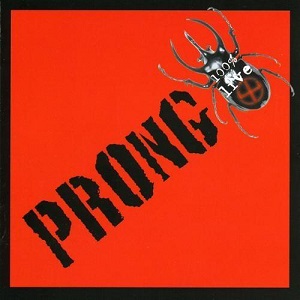
What I mean is that the track listing here, as presented to the fan, seems a bit too mellow up front, where you'd expect them to start off with some ragers and then get a little more dynamic as the sets progressed. "Rude Awakening" is an awesome song but it's a little too subdued to kick off a set from a band built on thrash, and then after that they launch into a chuggy tune called "Initiation" which was entirely new to us (they'd later change the name for Scorpio Rising), though it did build to a decent chorus that would have felt at home on the two studio albums before it, some nice bass lines from ex-Lizzy Borden player Brian Perry (who would not appear on any of the studio material). Proceeding into "Broken Peace", a track that doesn't quite work as well within the organic live environment as it did in the studio, there's a real sense that the band is kind of phoning it on or taking it a little too easy, not because they're cocking it all up but because of how they structured this. Even when they take on a more aggressive tune like "Another Worldly Device" it feels a little sluggish, the one real exception being "Disbelief" when they reach straight back to their roots and go hardcore wild, or "Cut-Rate" from Cleansing...in fact there's just a chunk of material near the end of the live album that seems more driven and ferocious than the rest and it stands out too much, including the finale, "Unconditional".
I think you can also notice small production differences in some of the material which is always the risk when you're not just pulling it from a single source, and even though the wilder closing tracks might seem less cleanly produced, they're so much more fun. Don't get me wrong, I like almost all the songs on this album in their studio incarnations, but the whole industrial/groove arsenal in their sound has never seemed to come across live as well as the classics which sound awesome. All told, 100% Live is certainly not a bad representation of their chops, but it just seems inconsistent in the context of a record that's you'd think was supposed to thrill the audience at their return. A better arrangement of the tracks would have done wonders for this one, as it stands I'll just be sticking to their studio works because there's not much reason to revisit this.
Verdict: Indifference [6/10]
https://prongmusic.com/
Friday, May 22, 2020
Prong - Rude Awakening (1996)

I absolutely loved the production on this one; whereas Cleansing was a bit more level instrumentally, this one is heavily saturated, fatter and really grooves along hard. Paul Vincent Raven provided the bass guitars for the second time, and his tone is awesome, these rumbling bass-lines which always enhanced all of Tommy's drudging, basic chug-laden riffs, and his more interesting squeals, pinches, melodic chords and other trickery that created such a well-rounded, exploratory sound. The drums feel a lot more electronic this time around, basically a blend of Ted Parsons steady mechanistic style and some actual programming, but as someone who was also playing around in an industrial band in the mid to late 90s I really enjoyed how it all came out. Sure, some of these beats are mighty basic, but when you listen closely you can hear all of these little beeps and gleeps and percussion effects that keep them interesting even when a few of Tommy's duller chug riffs are playing over them. At times this album feels like some dudes picked up a basic drum machine, pressed the pre-sets for some trip hop beats and then just let their imaginations splash all over that, and while it might seem crude or 'boring' to some, it forced Victor and company into creating some catchy riffs and vocal lines to help entrance the listener.
The vocals are the same blunt street-ready philosophy we'd always gotten, perhaps flirting a little bit more with rap or poetry in a couple of the verses but not too distanced from where they were on the 1994 album. I have to say the first three tracks on this remain some of my favorites in their catalog, from the jerky, slamming "Controller" that sounded like an industrialized Chaos A.D. outtake, through the insanely groovy and subversive "Caprice" and its adorable electronic melodies, to the more mellow, catchy, pop-like title track. Sure, it had a fairly awful spur-of-the-moment rockstar video courtesy of Rob Zombie, which does not at all represent the song's message, the album, or the band, but I'll try not to hold that against it since I've been listening to this one for almost a quarter century now and never gotten tired of it. These cuts do overshadow a few of the other tunes, to be honest, but even the weaker, less interesting tunes have some addicting vocal lines or effects which take my fingers off the skip button, and there are some deep, hypnotic grooves in cuts like "Without Hope" and "Slicing"; or a slight spin back to robotic thrash metal with "Mansruin", a tune likely to please that 90s industrial metal audience weaned on "Stigmata", "Ultra" and "Jesus Built My Hotrod". No surprise really that Tommy would go on to play with Ministry himself for awhile as Raven did.
It would be easy to write off Rude Awakening for the variety of influences tainting the band's original thrash concept, or because of its unfortunately parallels to the bad metal trends of its day, but it comes together really well, simplistic but engaging and memorable, almost like a automated factory version of Helmet, who were also trending hard at the time (and rightly so). Another of my favorite Prong albums, even long after its novelty had worn off, and I'm always happy to break it down off the shelf and go exploring through it again. Sadly, this would be the last album before the band would go on a sizable hiatus, before returning with something less creative and/or interesting, but in the interim Victor got to play with Ministry, and even Danzig, where he remains today in a more lucrative role.
Verdict: Win [8.75/10] (there is no kindness to waste)
https://prongmusic.com/
Wednesday, May 13, 2020
Prong - Whose Fist is This Anyway? EP (1992)

What's more, this is just bad...this is possibly the worst release in the entire Prong discography. The electro mixes are almost all awful, with few changes other than clanging and banging and annoyance that people would have only thought made for good industrial music in the early 90s. Okay, to be fair, sometimes they did, but the strength of Prong is the riffs, vocals and energy and it just doesn't benefit a track like "Prove You Wrong" or "Hell If I Could" to be fragmented off and repurposed like this. The latter is particularly bad, a series of boring beats and bass-lines that suddenly morphs into the proper guitar riffs and some heavily filtered vocals. Granted, that vocal effect might have been cool in the original tune, but here it just feels like a bunch of buttons are being pressed, and that's one of the critical flaws...'What would this part sound like if we added this effect?' is fun for dicking around in the studio with your buds, but later turning it into a commercial release in some wishful attempt to align with the KDMFMs and Ministry's of the world just isn't effective here. And ALL the alternate mixes of their original songs here are laughable at best, like the miserable 'Safety Mix' of "Irrelevant Thoughts", a song I happened to like a lot. And there are TWO mixes of "Prove You Wrong" which both suck...
Interestingly, they also remix their Stranglers' cover "Get a Grip (On Yourself)" so now it sounds like total nonsense, and then they add a cover of The Music Machine's "Talk Talk", which might be the best tune on here only by the process of elimination, but is otherwise mediocre enough that I'm happy they didn't soil Prove You Wrong by including it. They turn the song into a bouncing bore that doesn't do much justice to the original and certainly isn't interesting in context to the great material I enjoyed from Prong throughout the 90s. So basically this entire release is useless musically, a waste of 26 minutes. The cover image is kind of interesting, I like how they split the 'prong' icon into the three circles, but that's the most memorable thing about it. I enjoy the first five Prong albums a lot but this was a very unfortunate misstep which at one point had me dreading what might come after Prove You Wrong. Luckily, that turned out a LOT fucking better than I thought.
Verdict: Fail [2.25/10]
https://prongmusic.com/
Friday, November 17, 2017
Samael - Hegemony (2017)

That's both a good and bad thing, because while Vorphalack and crew are clearly intent on dressing up and expanding those aesthetics, there are numerous moments here where you'll feel as if you're getting deja-vu for a synthesizer or guitar progression, drum pattern or fill that you've already heard two decades ago. For the most part, they're coming up with new chord patterns, which works out really well in a tune like "Red Planet" which is a new take on the warlike space opera of a "Jupiterian Vibe" which will have you marching in similar step. Most of the melody in modern Samael music is provided solely by the synthesizers, which have the same martial, striking, sweeping feel to them here as they cultivate both a militaristic and Eastern sheen. It's up to the beats, lower end guitars and Vorph's distinct, eternally accented snarls to provide the metallic bedrock, and they do so well, with a lore more cutting, kinetic passion to them than you'd hear out of comparable hybrids of industrial and metal aesthetics such as those of the Neue Deutsche Härte persuasion. I also have to praise the bass playing here, from new member Drop, who lays out these awesome, fat, rolling lines that support the clamorous, choppy majesty in tunes like "This World". While the drum programming has long been a point of contention for some fans, I think Xytras does another great job layering in thick enough and 'real enough' percussion pads without abandoning the martial and mechanical coldness.
The lyrics these days continue the themes of social consciousness and social unity that they first embarked on with Eternal, but they're also willing to spark up a little pseudo-controversy with a cut like "Black Supremacy", and if you've seen the video there you'll probably have seen a lot of the responses. Hint: it's not really about what you think it is. There are also some self-referential pieces like their namesake "Samael", or "Angel of Wrath", the former of which is like a giant socialist shout out to celebrate the band's following, and their message. It's a little heavy handed, but not as corny as, say, Reign of Light; and it wouldn't be the first time, since it does fit the band's modernist, corporate or empirical vision and minimalist visual branding which manifests in both the sleek packaging and fattened new logo variant (which I think is an improvement). Samael is just one of a kind, and while I can promise that those who have shunned everything they've released since 1994 will find no end here to pulling out their own hair and seeking sanctuary in the shadow of some inverted cross where no keyboard dares to tread, I readily admit to having enjoyed the hell out of this.
A couple nicks and dents here or there, a few songs not pulling their weight quite as much as others, but they even manage to transform "Helter Skelter" into something of their own, and the bonus track "Storm of Fire" is one of the coolest on the album. They also don't pull back too far on the heavy spectrum, for example "Black Supremacy" would have felt right at home on Above. Hegemony might not ultimately emit the level of timeless material that Passage was built from, but it certain does a fantastic job of capturing its ebullient, storming magnificence.
Verdict: Win [8.75/10] (light and force have a name)
https://www.samael.info/
Wednesday, July 30, 2014
Samael - Eternal (1999)

But herein lies the catch. Despite Vorph's weird whispered and growled vocal lines through Eternal, which resemble pop and hip hop structures just as much as the gnarled, passionate black metal of his prior output...despite the increased importance of typified dance beats and synthesizer lines through which Xytras is attempting to bridge the classical and EBM fields....despite the fact that half the guitars on this album are merely low chugs or chords used to accent the beats...and despite the odd, raw production which would seem out of place for industrial/pop and was likely due to the band's novelty at blending these mediums, Eternal is a charming album. Yeah, it often feels like the band came up with the idea while enjoying a hot tub by starlight, in the Alps with some rich bankers' wives giggling over these artsy young studs they managed to wrangle, but there is this sentimental quality created through the contrast of choir synthesizers, reverberating electronic percussion, schmaltzy lounge organs/percussion (on a few tunes) and Vorph's 'Wait, we were recording that?', diabolic yet mouth-breathing presence that somehow transcends all the inherent flaws and musical faux-pas to produce something worthwhile...
Guitars. They're here, but divided into three camps. First: the aforementioned palm muting or syncopated chord phrases which are there to serve more or less in tandem with the other percussion (examples: the verses of "Ways" and "Us"), a technique you'd expect from a lot of industrial radio rock like Stabbing Westward or Rammstein. Second, and these are better, these floes of warmer and melodic chords, faster or slower, used to emotionally elevate many of the chorus vocals; they've got an alt rock feel to them, but definitely are one of the elements that were drafted forward from Passage. Lastly you've got a few living clever phrases like the creepy melody that comes into the verse in "Ailleurs" (or "The Cross"), and these are probably the most effective on the album, meaning I wish there were actually a few more. Missing are the brilliant, meticulous black/thrash progressions from the prior album, a blow that is felt by this listener, but in the end I can't rightly say that they would have worked with the overall feel and structure of the songwriting. Still, they hadn't voided the guitar as an instrument altogether, far from it, and the notes used here are at least more memorable than the two full-lengths to follow, even if their respective mixes put more emphasis on the riffs.
The synthesizers play an enormous role, largely through the choir pads which are used to give much of the album that cosmic, ethereal effect, like a seraph floating between planets with its glimmering sword out front. Probably a bit cliche, but Samael do them justice with simple but catchy patterns. In addition Xytras uses a lot of busier piano phrases which are amongst the most complex lines of notes on the album, and then they step even further outside with a mixture of 80s prog/New Age and cheesy techno-inspired sequences which occasionally sound like Tangerine Dream writing house music. It's all well and good for me, since I listen to a lot of that anyway, but others are just not going to be so welcoming of this stuff if their expectations were Blood Ceremony 2.0. They'll be even LESS welcoming of the weirder moments like in "Being" where the pianos get all saloon-bluesy with the goofy little electric guitar trills, or in "Radiant Star" where the organs make the intro feel like The Doors are about to stroll into a pastry shop on a Paris corner. I happen to love that song, the chorus is particularly timeless and emotional with Vorph's protracted growls, but it's pretty bizarre how they got from that point A to B and certainly was unique for 1999.
As for the beats, the more danceable nature of the writing definitely brings their artificial nature to the fore more so than Passage, an album that could have just as well been executed with a drummer, but lost no points for the slick programming. Usually they go big and industrial but there are a lot of subtleties here, electronic/pulse stuff hidden in both calmer moments and greater swells which does occasionally hover on glitch without the warping. Since they were at this time really into all the fire swinging cosmic carnival theatrics in their performances, there is definitely a bit of hippie drum circle aesthetic here, only it's represented electronically with some lighter percussion rather than the thundering of some tribal gathering. That said, when the band needs power, like the clashing accents to the chorus of "Together", they really come through, so despite the theoretical superiority this recording might have had with an actual human striking a kit, I don't have much of an issue that they chose to go this route again. Masmiseîm also sounds pretty electrified, with some bass lines that sound quite synthesized, but the simplistic grooves he metes out in tunes like "The Cross" are critical to contrast against that hovering nightscape of keyboard atmosphere.
Lastly, we come to the vocals, which are basically the whispers, semi-growls and rasps of the last album only seeming a little more laconic and poppy in their implementation. The guy's voice does have a hard time standing out against the more shining electronic aspects, and many could be forgiven for thinking the guy sounds absolutely goofy, but it's part of what gives the album it's sense of impossible charisma, since it runs contrary to most of what people love about a good pop or EBM band...a strong singer with an 80s penchant for choral melodies that engrave a tune into memory. Vorph's performance IS memorable, but incredibly flawed all the same, which was either a brilliant or stupid move depending on who you ask. A lot of the meters and ideas seem half-formed, but it is nice that he'll occasionally lay out a larger growl for balance. Lyrically, though, this further emphasis towards spiritual exploration and personal meanings, far removed from the evil occultism on their old material is a bit of a shock. The song titles are incredibly, efficiently Zen and the lyrics almost constantly attempt to uplift the listener with traces of Eastern mysticism and pacifistic enlightenment. It's almost as if they had a Darjeeling Limited moment somewhere between 1996-1998 when they were thinking how they'd follow up their masterpiece.
And that's about the best I can do, good readers. It's a unique album for sure, but one of those 'I'll allow you this one' deals for me, where I admired the band's transformation but wouldn't necessarily want to hear them try this again (which they sort of did, sadly). The first track "Year Zero" is pretty representative of the sound of the whole album, but it's actually the least interesting/memorable so I question its front placement when everything else is so much bloody catchier. That aside, I really liked the album. It's touching and heartfelt and all those sorts of things a Samael record probably shouldn't have ever been, but its combination of airy, raw production and its humanitarian, philosophical approach to industrial metal was one I really went for when the album released, and I still quite enjoyed it when listening to prepare for this review. Are the simplistic, repetition-focused lyrics meek? Sometimes, but just as often they're extravagant. Is it a disappointment after Passage? What wouldn't be? But if you're open to electronic influence, space raving on ski slopes, and listening to music that your girl/guyfriend might also dig on when you introduce it to them, then this might work for you. "Ailleurs", "Ways", "The Cross", "Infra Galaxia", "I", "Radiant Star"...all great songs... in fact only "Year Zero" is worth skipping.
There are no guilty pleasures.
Verdict: Win [8.75/10] (the move is fixed at the furthest point)
http://www.samael.info/Above/index.html
Tuesday, June 24, 2014
Samael - Solar Soul (2007)

However, the songwriting chops here seem to hearken to their glory days, and there are actually a few tunes on this one which I'd include with any career-wide highlight reel. It's still quite a bit cheesy in the lyrical department, recycling the 'let's all hold hands together' globalist hippie garbage promoted so heavily on the prior few albums, almost like this band of former Swiss occultists had suddenly discovered Krishna, or tantra, or universal unitarianism, or whatever. But at least the music here serves up a serious beating when matched against the electroid detritus of Reign of Light and Era One... The guitars still bounce back and forth between the inspirational hooks and chords of earlier works and the vapid dumbell chugging of the most LCD industrial metal you can fathom, but there is far more effort placed in the context of harmonies and other melodic structures. It's a busier album than Eternal, for example, and I really like that the guitars were reasserting themselves as a riffing force rather than passive accompaniment to the beats and synthesizers. Remarkably, it still adheres to that sense of Romantic escapism which defined that album as so unique at the end of the 90s...
...to the point that I really feel like, if you stripped off its production and just analyzed how the songs played out, it's like an amalgamation of tracks that were left on the cutting room floor during both the Eternal and Reign of Light sessions, but with a refined production that itself is stronger than either. There are a couple dragging, lame tracks where they err on the electronic side a little too much (like "Western Ground" or the Rammstein-in-the-Orient vibes of "Quasar Waves") but they also beat you over the head a few times, foreshadowing the aggression level of Above ("On the Rise", or the chorus to "Valkyries'"). The synthesized horns smack of Reign of Light and Passage both, the vocals are largely in the style they had been since 1994, but once awhile they'd surprise me with a tune that follows in the 'spirit' of a precursor, but adds a new twist in the keyboard pads used, or the direct construction of the rhythm guitars. For instance, "Olympus" seems like a callback to "Jupiterian Vibe", but the guitars are nearly as interesting, more so than something like "Ave!", which isn't so compelling, or the prior decade's "Tribes of Cain" which was obviously a less inspired rehash they didn't want on Passage itself due to the redundancy it would create for the listener.
In the end, though, Solar Soul just doesn't go far enough into either a new direction or back into the past to really have made much of a difference. It thankfully and deservedly avoided the dumping on that Reign of Light took, but after perhaps a half dozen listens I recall shelving it and rarely having the interest in hearing it again when Passage, Ceremony of Opposites or Eternal were available to me. A tight album, which fixes some of that awkwardness which stunted its predecessor, and confirms to the more confused corner of their audience that they weren't going vocal electronica full-time (which a few folks might have feared when hearing Era One); and not unpleasant to listen to. In 2007, I might have ranked this a point or so higher, but time hasn't been the kindest in terms of keeping this set of songs moored in my memory banks, so it remains among their least visited albums in my collection, excepting the two before it. If nothing else, Samael seemed to be gaining ground again, instead of losing it, and the gradual incline in quality it hastened has since continued through Above and Lux Mundi.
Verdict: Win [7.25/10] (push aside yesterday)
http://www.samael.info/Above/index.html
Monday, June 23, 2014
Samael - Reign of Light (2004)

I'm not going to say this is totally shit, because there are a few saving graces here or there that render it a pretty harmless effort, but when I look back over the Swiss band's career, this is the full-length I am least likely to ever reach for on my CD racks. In fact, I sold it a few years after it was released, when living space started to trump my completist/collector mentality. By and large, though, this is an album where the band had seemingly reached the creative end of their evolutionary cycle, morphing into something akin to a caricature of the albums preceding it, and having very little new on the table apart from the slightly unwelcome (or rather unsuccessful) endowment of cheap electronics and the attempts at exotic, Middle Eastern and Southeast Asian influence to some of the guitars and synth lines, prominent in tunes like "Telepath", which are structurally the highlights of the album but do suffer from some poor compositional choices and goofy lyrical delivery. And those are really the two major banes of Reign of Light as a whole: lots of mundane muted guitar passages representative of the second rate industrial metal of the 90s and the Neue Deutsche Härte dance metal that Germanic bands like Rammstein were capitalizing on. Samael was always predisposed to fail at such heights due to the snarled, strange vocals of Vorphalack, so it's almost pitiful to hear them try...
A lot of the tunes are meant to make you shake your ass at the club, which would be fine if they somehow stuck out to memory, but sadly that takes the form of transforming the glorious synth tones so resplendent on records like Eternal and the immortal Passage and then applying them to these pumping beats and vocal lines that occasionally seem so ridiculous that they fall out of meter when Vorph tries to wrap them around the drums and keys. A few songs here, like "As the Sun" are outright fucking embarrassing...like early 80s Olivia Newton John workout videos given a grimy EBM spin with the nihilistic rasping of the deranged Swiss man. I'm not necessarily averse to such contrasts, having played for awhile in an industrial/extreme metal hybrid band where I'd growl over late night radio house synthesizers or such, but those were usually tongue in cheek situations; whereas Samael is dead serious, seemingly unaware of how absurd they sound. You see, the reason why this record became such a quick 'sinker' is that it does actually have a few clever guitar riffs, at best recapturing that universal, unusual industrial metal warmth of Eternal, but when you break everything down, there are probably only 2-3 tracks worth sparing, if we could somehow change the lyrics...
Yeah they are pretty uneven here. I was willing to buy this newfound, smug, life-embracing happy happy Samael for one record, and one record only, but here it just becomes ridiculous on a cut like "On Earth" where they ramble off a long list of cities (presumably those where their fans reside) and attempt to bind the entire human race together in an orgy of sentiment. So, like that awful scene in the Matrix sequel where the Zionians were having a vast, multicultural passion-rave of release, all colors and ages of bodies roiling together in the sheen of aspirant supermodel sweat. Only the Fluke tune during that scene was far better than this song or really anything on this album. It's just fucking goofy, man...what happened to the "Jupiterian Vibe" or "Baphomet's Throne"!? I mean you know a band's running out of ideas when the lyrics consist of a series of 'shout outs', and there are all these other songs about 'our vibrations' and 'our souls' and how 'we keep growing' in our new world and all this other ambiguous philosophical pap that sends the hearts a-flutter, or in my case the heart a-shitter. Fuck, "Reign of Light" itself has some of the most cliche and excremental lyrics you'll ever see in posi-metal. Perfect for those who think Theater of Tragedy's electro hardpop records were anything more than catchy club rock (to be fair, those were really damn catchy...this is not, at least not often).
The cleanliness of the mix only serves to make Vorph sound even more goofy when singing a lot of these, whereas Eternal had the smokescreen of sounding a bit more raw and spacey, and Passage was brilliantly poetic, angry and humanistic. This is not a disc entirely void of its hooks, and I like a few of the guitar melodies as they appear in the bridge of "Moongate" or the "Jupiterian Vibe"-like "High Above", which alongside "Telepath" represent the trio of highlights here. The ethnic female vocals are put to sparse, decent use and the mix of programmed drums, multiple atmospheric levels of keyboards and guitars are very evenly balanced, but really even the best songs seem like retreads of the songs on the two albums before it, only friendlier for the whole family. Half the material is just as corny as the vocal-half of the Era One/Lessons in Magick #1 double-album which was released later by Century Media (but written around the same time as this material). And, really, if any of this sounds even remotely interesting, just go straight for its successor Solar Soul, which has a much harder hitting guitar presence alongside the vocals, but still features the same fancy for the exotic, Eastern synthesizer lines while feeling slightly less awkward overall.
Verdict: Indifference [5.5/10] (hungry for life again)
http://www.samael.info/Above/index.html
Saturday, June 7, 2014
Samael - Aeonics - An Anthology (2007)

Sure, it comes packed with a big pictorial booklet and was assembled in collaboration with the band, but it's nothing more than songs picked off previous products, and in many cases not even working together in unison. For instance, I can't envision how their electronic/experimental stuff off Era One/ Lessons in Magic #1 necessarily fits in with the rest, being that it wasn't originally going to be put out under the band's name, and it's surely not going to give a prospective listener an accurate picture of what the band is generally all about. There are loads of amazing songs here, don't get me wrong, but "Moonskin" and "Rain" are best experienced with Passage, and the same goes for the rest. By taking and transplanting these few tunes from their original contexts you are almost teasing the hypothetical that they're 'best of', which is not necessarily the case for the Passage, Blood Ritual or Ceremony of Opposites material and these are all albums that need to be experienced in full to properly appreciate. Even Worship Him deserves that level of attention, so I feel confident in saying that Aeonics doesn't even have enough heft to serve as a door stopper.
It's also a missed opportunity, because instead of just squeezing a career anthology onto a single 80 minute disc, they could have had a 2-3 disc treatment, with perhaps an album of all the band's demo content, a live set, a collection of covers, electronic/symphonic remakes of older tunes (like the disc Xytras did of Passage without the metal elements), or even just remastered or recorded songs that bring the earlier, crude stuff up to speed with the latest material. Granted, purists tend to loathe such things, and I'm often one of them, but ANYTHING except photographer credits to exhibit that some effort was placed into this, some love for the band's fans, going above and beyond to give them something extra...a true and proper celebration of the Swiss band's career, which was, at least for the first decade and change, a truly wonderful and magnanimous musical evolution. But, no, we've got a product that might have just been some label intern randomly handed a stack of Samael CDs and told to pick out and randomly distribute tunes into an arbitrary track order that I assume was meant to fabricate some 'emotional' strength...but really doesn't anymore than my IPod 'shuffle' function. I do like the artwork and the booklet, its sleek and stylish and oh so metro-Samael, but what if this had just been a new album, dropping the 'subtitle' of 'An Anthology' and presenting us with Passage II (they'd do this later, but one can imagine). Anyway, enough of my pipe dreams...if you have any intention of buying this, strike yourself in the temple hard with a blunt object. Otherwise, I shepherd thee back to sample and/or purchase the first five albums and leave it at that.
Verdict: Epic Fail [.25/10]
http://www.samael.info/Above/index.html
Friday, June 6, 2014
Samael - On Earth EP (2005)

"On Earth" itself is a direct continuation of the style from Passage and Eternal, mid paced, darkly and cosmically industrial; only Vorph's vocals are more pronounced and robotic. Like much of the album it hails form, the guitars are more or less regressions towards patterns the band had already written for the prior full-lengths, even if the precise notes are different, there's a lot of reliance on heavy, simple chords that follow the beat. This also suffers from the 'worldly syndrome', like they basically list off a bunch of cities in which their fans live, so we can all just be a big and happy fucking family. What the FUCK, Samael?! Why did you have to go all hippy on us? One world? Our world? What is this, a lost Michael Jackson tape? At any rate, the lyrics basically abolish any real chance of me taking this tune seriously, but if not for that then it would be a semi-serviceable Passage outtake that would have felt as if it were scrapped for other, genuinely excellent songs. I'm not averse to that positive, Romantic undercurrent Samael tapped into for their 21st century stuff, but it doesn't really excuse the shoddy and underwhelming songwriting.
As with the "Telepath" treatment on the prior EP, the remix of "On Earth" here is laughable at best, not danceable enough for the Euro EBM/Goth metallers who might care, and not harsher enough for the long since lost Samael fanbase off the first few albums. "Auf der Erde" is a German lyric version of the title track, and while it might benefit from the vocals sounding less dopey to those who can't speak the language, it's otherwise the same (i.e. the cities listed off). So really the only hope for the disc is the cover of Depeche Mode's "I Feel You", and in this too they fail, because hearing Vorph's sustained growls over an excessively industrialized rendition of the original with some spacier sounding guitars is incredibly goofy. Where Moonspell did a pretty kickass cover of "Sacred" that I still listen to, Samael's attempt fails to ever really launch, even if the pairing does make some sort of sense. But as lackluster my reaction, I would be remiss not to admit that this was the most entertaining point of the EP...the video for "Telepath" is included, but is nothing more than Vorph standing around, looking 'cool'...ugh. Anyway, the cover image is tacky (with that gold tinged logo...), the music is not good, just put it on the demolition list along with its predecessor.
Verdict: Fail [2.5/10] (dancing with the hidden tribe)
http://www.samael.info/Above/index.html
Thursday, June 5, 2014
Samael - Telepath EP (2004)

I'll go into the studio tracks more with a review of Reign of Light, but "Telepath" more or less tries to grasp at the mystique of Samael's brilliant Passage record (and its followup Eternal) but apply it to a more directly danceable beat, which ironically has a bit of a Gothic/Middle Eastern mashup feel to it adorned in Vorph's salacious grumbles and some baseline chugging. Ironic because you'd expect that out of the song called "Inch'Allah", but wait...that track does it too, only the throbbing beat is affixed with some of the synthesizers the band used so well on Passage. The issue I have here is not simply one of style...I was fully willing to follow this Swiss band almost anywhere, but only that their sense of exploration has been dampened, cheapened for the Euro-goth in the corset on the dance floor and no longer a poetic light on the edge of an infinite span of darkness (i.e. Passage). The riffs in these two tunes are quite lacking, with or without the vocals, as presented, and they seem to have slowly gone from truly compelling guitar lines to banal bouncing chugs circa Rammstein. The remix is so bloody uninspired that I had long forgotten it was even here...
This was all mixed with pretty cutting edge audio and it might hold some appeal for that reason, but since the material is very much redundant with Reign of Light, a 'sinker' of an album which I for some reason enjoyed for a few months and then totally turned traitor towards, I can see no viable benefit to owning it beyond the aforementioned desire to bark out Vorph's lyrics yourself. The lyrics to the tune "Telepath", which I'll complain about at length elsewhere, are the sort of insincere, implausible sorts of 'positive outreach' affirmation ravings that you'd expect from a self-help tape, and sound incredibly cheesy coming from a band that used to sing about Satan and horror and evil on their first few discs. But I'd forgive that if the music was good...it just doesn't hold up, and not solely because of the aesthetic choices, but because the majority of the riffs and vocals are mundane and have little of the emotional gravitas I once felt so strongly from their music. Avoid this, and if you happen to see a copy of the digipack out in the wild, give it a swift kick for me.
Verdict: Fail [2.25/10] (format our comprehension)
http://www.samael.info/Above/index.html
Thursday, May 2, 2013
Aborym - Dirty (2013)

Italians Aborym have always interested me, since they seem to strut along the razor-thin line between these two: occasionally summoning up some inspired progressions, but just as often subsisting off some groan- inducing cyber rave bullshit circa Combichrist, Marilyn Manson, whatever. Granted, the latter can be entertaining if done well, but that's just not always been the case here. While their debut Kali Yuga Bizarre remains their career highlight for me, thriving off an apocalyptic, ritualistic foundation that was a more novel concepts in its day, I've found a lot of the intervening material (four albums worth) to be rather inconsistent in quality. Dirty, the group's sixth full-length, was a study in contrasts from first exposure. The surreal, inverted city skyline on the yellow background gave me the impression this might have been a fully electronic outing, perhaps by way of Autechre or Aphex Twin (there IS a song here called "Raped by Daddy", so that might have just been mental association with "Come to Daddy"). But, by and large, this is business as usual, a mix of the dichotomy of components I mentioned above.
Dirty ultimately amounts to a nightmarish landscape infusion of acoustic and electronic sounding drums with a heavier emphasis on blast or 'gabber' styled beats, denser chugging, power chords, or tremolo progressions on the guitars that quite often play second fiddle to the atmospherics, and wretched black rasped vocals that unfortunately often give way to some weak, clean singing. Which, in no case, ever really enhances the music or gives me any respect for the band's eclectic intentions. Several of the lyrical choices here are just too goofy to stomach, like the higher pitched, nerdy repetitions of 'Fuck you' that adorn the bridge sequence in "Irreversible Crisis"; but the vast majority of intonations here are drenched in Malfeitor Fabban's decrepit, impetuous drawl which resembles Agathon on the older Gloomy Grim records. The synthesizers definitely run the gamut from wave-rave pads, to chopped and craftily syncopated surgical patterns, to more of a freakish, sweltering post-modern orchestration. You can tell a lot of effort when into their structuring, and to evoke a suffocating sense of both factory floors and gas-lit dystopian streets, which is sort of the point.
The industrial sounds are well plotted to create a mixture of harder edge IDM and old school assembly line atmospheres, which are then slathered in the meatier, opaque pummeling guitars. Truth to be told, as I went through the first disc a number of times, interesting patterns emerged. "Across the Universe" and especially "Bleedthrough" impressed me, but "Dirty" itself lapses into some pretty memorable, crashing grooves. Then you've got a song like "Face the Reptile" where some of the speed and forcefulness is alternated with a more haunting, dissonant field of notation that gives the listener some space to revel in his/her horror. Though I would not say that this was a 'standout' record in term of catchy guitar lines, they're at least properly fixed to the electronic rhythms, so it feels as if they were all composed simultaneously rather than arbitrarily tossed onto a beat as an afterthought. Bass lines are loud and probing where they need to be, and the mix, while hostile and abrasive, is rich enough that you can detect the subtleties of the electronics. A lot of folks will dislike the choking level of detail on principle, but it's working as intended.
Alas, I just can't stand the clean vocals anywhere on this album, and it just doesn't seem like the sort of work which required anyone's 'Inner Goth' to rear its ugly head. I would have been fine with just the rasps, growls and maybe some ear-splitting screams. It also doesn't help that the two reworked pieces on the bonus disc, "Roma Divina Urbs" (from the debut) and "Fire Walk With US" (from the sophomore of the same name) remind me of how much more I liked those albums than this one. Riffs and atmosphere are perhaps less harried, but immediately more evocative of the dark mental spaces the band inhabits. Not that there's an incongruity in how they got from 'there' to 'here'. No, it's a natural progression, but one could say they haven't evolved a whole lot since the second or third effort, and that the experimentation which initially distinguished Aborym might have reached the last stop on the line somewhere in the mid-00's. This feels as if they've become a bit comfortable with the rampant, metal-injected techno-trauma, and thus it doesn't exhibit the eclectic, uncanny variation you know they are capable of.
The cover choices on the second disc are, in fact, diverse, but also some pretty safe choices. "Hallowed be Thy Name" has an interesting first verse sequence where they basically introduce Iron Maiden to a Dance Dance Revolution platform with pulsing, sweeping synthesizers, but after that transforms into a fairly normal 'extremified' rendition. Nine Inch Nails' "Hurt" is given a straight forward, if somewhat more orchestral and dramatic treatment, and it might be the one place on the album where the cleaner vocals don't make me cringe, with the caveat that they're aping Trent Reznor closely. Aborym also delivers us an interpretation of "Comfortably Numb" which is slightly more acidic and psychedelic due to the enhanced use of electronics over the original, but the interplay of vocals and instruments simply isn't as smooth and effective as Floyd did it. Don't get me wrong, it's cool that the Italians have such broad influences that they want to share, but aside from one-time curiosities these tunes don't provide much lasting impact, and the reworked originals do not necessarily supplant the older versions, even if the production feels more fluid.
In the end, Dirty definitely was not the disaster it might have been, but there are a few obstacles which hindered my enjoyment. If you're a devotee of electronic/extreme metal bastardizations, and seek heavily layered, textured and nightmarish material to dance your life away, you might find enough exhilaration here to make it worth the while. The album's like an oil rig: imposing and unnatural, with lots of working parts and rusted foundations and surfaces, and that alone is interesting enough to explore. But coming away from the experience, did it dim my perspective? Leave a scar on my psyche? Thrust me into the dystopian dreams I so often encounter through the ciphers of music, film and literature? I can't say that was the case, but to the Italians' credit, at least they dumped a lot of planning into its design.
Verdict: Indifference [6.75/10]
https://www.facebook.com/aborymofficial?ref=ts
Friday, February 10, 2012
Celtic Frost - Prototype DEMO (2002)
 Prototype is both the strangest Celtic Frost recording and what might lamentably represent the biggest identity crisis in their history, but unlike the Nemesis of Power demo 10 years earlier, I can hardly blame it for laziness or lack of trying. Self released with gimmick guitar pedal packaging and brazen album title, it looks nothing like any of the band's backlog. In fact, if not for the Cold Lake icon in the right corner, the 'CF VIII' scrawled across the bass of the pedal, and a few of Tom's vocal lines through the heavier tunes, it would be quite difficult to qualify as a true Celtic Frost release, but more of an extension of Warrior's work in the industrial metal outfit Apollyon Sun in the later 90s. That said, Tom's mainstay was no stranger to experimentation, and so I can't say I was highly surprised when I first heard this. Only that it hadn't arrived sooner.
Protoype has a more sleek, modern production than anything Warrior had written to date, and the substantial track list leads me to believe that it was intended as some 'missing link' full length to fill in the gaps of the band's history. Sadly, though, it's quite thoroughly awful, despite the rather eclectic mix of ingredients. Normally I have no opposite to the inclusion of electronics, or even pop and hip hop elements to a heavier recording if they contribute to some sense of intrigue, compulsion or just some damn catchy songwriting, but here they seem misused as a tired set of cliches, a very 90s-esque 'open mindedness' that seeks to force an exhibition of the band's diversity. At its very best, the demo/album is competent and subtle with its external influences, but at worst it's a dire mockery of all good taste, tragically lame to the point that it takes on a bad, cartoon-like quality...
Let's just say that, from where this demo BEGINS, you have little to no idea how it will END, but we're not talking about unexpected thrills or 'twists' that one might deem pleasurably; rather an air traffic accident that initially seems as if it will cause only minor structural damage to a craft's landing gears but then ends up on the nightly news, hundreds of dead being pulled from the still smoking wreckage. Essentially, the first two tracks are a sort of 'trance' techno, with beats that loop alongside a modicum of glitch electronics, feedback and ominous, crunchy bass against the backdrop. The cyber rendition of the Beatles' "Helter Skelter" is quite interesting, and even if I don't dig how the lyrics grind across the heavily affected guitar samples and beeping noises, it was at least worth a try. "Totgetanzt" is an original, with even sparser, pulsing textures, sinister breath whispers and cheesy keyboard beats, but nothing as interesting as the cover ever occurs.
And then we come to the 'heavy' sequence of the demo, where drudging, muted guitars are affixed to drum machine and samples in a means redolent of Pitch Shifter, or maybe the late 90s Prong material with enhanced electrics. Warrior gets rather aggressive with his vocals on "The Dying I" or the occasional guffaw in "Human Dirt", but elsewhere he uses a sort of nasal, whining vocal that reminds me of Jonathan Davis from Korn. The lyrics are quite miserable through this portion of the track list, with a lot of generic call and response style chorus parts and generic 'what I am what I am what I am' ("Human Dirt") effortless bullshit lyrics that were a heavy symptom of bad 90s alternative rock, industrial, early metal core and groove/nu-metal. The heavily atmospheric electro rock duet "November" features Tom's whimpering alongside a female guest, and "Deep Inside" (one of two Apollyon Sun tracks that wound up here) is a passable trip hop tune with some psychedelic guitar swirl backing the chorus, but even the latter becomes incredibly cheesy when it hits the classical piano bridge with the girl whispers: 'deep inside deep inside'. Oh so sexy, guys! Not.
But, honestly, I'd take ANY OF THIS over what happens at the end of the demo, where it transforms from merely misspent creative energy into an outright abomination, as if a bunch of ICP juggalos decided to stick bananas in their wrestling thongs and then invade the recording session, bribing Tom with drugs to let them in the studio booth. "Get Wicked (dagger and grail edit)" is some weird interlude with a dude rapping in...French, I think? It's bad enough that we must suffer its reckless stupidity, but the guy actually has the audacity to include the phrases 'get down get down' in nearly the same breath as he cries 'procreation of the wicked'. At this point I am well on my way to caving in my face with handgun rounds, but Prototype actually gets WORSE, with the heinous and inane "Hip Hop Jugend", a hybrid of porn electronics, bad German Rammstein rambling, smutty 'ooh baby aah baby' female narrative and a bunch of manly Eurotrash shouts of 'Hip Hop Jugend' in the background.
Seriously, I dare anyone to listen through this song and then tell me again how miserable you think Cold Lake is. If you can make it through without cracking a smile or choking on a combination of laughter (at it, not with it) and vomit, then I certainly owe you a beer. But trust me, it will haunt you forever...the final nail in the coffin of failed ideas that permeate Prototype. As we all know by now, this direction was not one Warrior and Ain pledged to continue, its awkward and unnecessary mutation silently sealed away in vaults of agonizing regret that only a handful were so unfortunate to experience. Monotheist would later steer the band back on track, an acceptable compensation for 10 years of bullshit, but personally I'm not sure it could ever outlive scars like this.
Verdict: Fail [2.5/10]
http://www.celticfrost.com/
Tuesday, January 31, 2012
Umbah - Enter the Dagobah Core (2012)
 For whatever reason, my paths have never crossed with Umbah in the past. Unusual, since the project has produced a dozen albums to date, but we can't all hear everything, and I'm willing to bet most of these earlier works were small pressings, self-released with a limited audience in mind. If Enter the Dagobah Core is any indicator of their quality, then I admit I might have missed out, because not only is this a high strung, entertaining manifestation of cyber industrial death thrash, but comforting proof that there are human beings far stranger than I out there. The kind I typically tend to hang out with. The kind we could all benefit from. Now, autothrall is no square, but Enter the Dagobah Core is a humbling, eccentric experience which fuses the geek-chic of its creator into a harness of spatial, spastic, plastic and technical absurdity which gives the aesthetic impression of flying a TIE fighter into a Macarena party while huffing glue and gasoline.
I'm not exactly a stranger to Cal Scott, the project's sole member at present. Or rather, HE is no stranger to the scene. He once slung the six-string for the fairly enjoyable British death bangers Necrosanct, who produced a pair of sadly forgotten second tier gems in Incarnate (1992) and Desolate (1993) through Swedish imprint Black Mark Productions. However, aside from the fact that it flirts with the extreme side of the metal spectrum, Umbah, at least in this present state, has little to nothing in common with his alma mater. Enter the Dagobah Core is more like listening to Germans Mekong Delta while you're trying to perform speed runs of Mega Man, or a clusterfuck of Florida hybrids Atheist and Hellwitch with Devo. In fact, I don't think I've had so much fun with a cybernetic metal beatdown of this sort since Alf Svensson's Oxiplegatz. Or, more accurately, Gigantic Brain's Invasion Discography, but while that was more of an alien abduction grind outing, this is more like a man entirely off his meds, shredding and growling his way through some 16-bit future.
It's not total chipset video game death metal like the amazing Norrin Radd, so the guitars still play an important part of the picture. However, the architecture of the songs here is absolutely batshine insane. With "Whispers of a Dying Sun Part I" alone, the first three minutes of the CD, we've cycled through warbling, pulsing electronic noise to dissonant spikes of driving thrash, tense and complex electro freakouts, and even an EBM framework or two which would not have been out of place on a KMFDM record. Scott's vocals engage a wide, schizoid array of personas that range from the usual rasp or death grunt to a more Gothic, doped up edge redolent of The Kovenant or Marilyn Manson, to bursts of nasal paranoia or even pitch shifted narrative via Darth Vader. There are no rules to which he strictly adheres, and this creates a massive sandbox of personality through which he gets to explore through the lurching, chugging diatribes of "Cosmic Garland", Cannibal Corpse gone psycho-hyper-fuck of "Rackborn Skin Expulsion" or destructo dancer "Zombinods".
I swear, I heard such divergent voices here as an opera singer and a horse whinny. The entire 13 track progression of the album feels as if its almost always about to burst at the seams, succumb to its own energized clutter, but Scott hurls one interesting passage after another in your path, and I found myself unable to turn away from it. Each successive spin drowned me in the chaos, a whirlwind of electronic drumming and choppy, thrashing precision. There must be six thousand riffs on this thing, and while not all are incredibly distinct of their own volition, the rapid, surefire succession of their arrival is bound to drill itself into even the most A.D.D. addled cranium. On the flip side, this is not something you want to listen to if you're sporting a pacemaker. Or if you have epilepsy. A few songs are mildly calmer, like "Mad Zu Chong", but in general you're dealing with a strobe light of frenetic industrial trance excess.
It's not the perfect cure for a hangover headache, because admittedly the music is so frivolous and fun to the point that its own goofiness burdens the listener's ability to take it serious. Enter the Dagobah Core is too spurious, synthetic and ridiculous for its own good. Certified crazy. But then, that's rather the point of the thing. Subject matter ranges from the obvious Star Wars influence (the title track) to Germanic physicists ("Dr. Geiger") and Chinese astronomer-mathematicians ("Mad Zu Chong"), and you get the feeling this guy had as much a good time choosing them as you will have listening to them. I don't know just how wide an audience a record like this will find, but I'd recommend it to nearly anyone with the eroded mental health to appreciate it's flabbergasting charms, or anyone who might appreciate a Mr. Bungle remix of Illud Divinum Insanus which DIDN'T suck. Can you imagine that? Nerd on, motherfuckers.
Verdict: Win [7.5/10]
http://www.umbah.co.uk/
Monday, June 6, 2011
Pain - You Only Live Twice (2011)
 Amazing, the life that Peter Tägtgren's Pain has taken on for itself. I would have thought this dead in the ditch at maybe 2 or 3 albums, yet the project has arguably surpassed Hypocrisy in terms of its popularity in Europe. Not all that much of a shock when taking into account the style here: bubblegum techno metal with lyrics and titles that read like endless streams of pop cliches. But it's confounding to me that Tägtgren is so into this. A meal ticket? I can't say, since one would think that Hypocrisy and his production work/Abyss studio earn him a comfortable living. Either way, Pain is now seven albums deep, and You Only Live Twice is not about to rock the boat. The Tim Burton/9-esque cover image might be distinct compared to the backlog, but the music itself is generally the same its been since the sophomore Rebirth in 1999.
By that I mean a lot of keyboards and pianos serving up the central melodies in the compositions, while supported by chunky, processed groove metal guitars. Occasionally the riffs will bust out something more thrashing, or something redolent of Hypocrisy's more mainstream albums like Virus or Hypocrisy. Sometimes, the lines even blur as to which of the bands I'm listening to (as in the opener "Let Me Out"), but in general, Pain is known for the predominantly clean vocals. I think it's a bit hasty to call this 'industrial metal', since there are very few such elements outside of the synthesizers, which are more in line with the general idea of 'techno'. When Tägtgren is at his best here, he's able to create these driving, atmospheric moods through all too simple chord selections and the electronic graze of the keys, culminating in a somewhat catchy chorus ("You Only Live Twice" or the Sonic Syndicate cover "Leave Me Alone"), but even these rarely prove to possess much lasting depth upon repeated listens. Yes, a Sonic Syndicate cover...!?
There are a few breaches of protocol here which hardly go sunny side up, like the rocking of "Dirty Woman" which feels like Monster Magnet for a few minutes, or the even more Goth than usual creeping of "Feed the Demons". However, the rest are pretty straight driving Pain tunes with all the pageantry of your more commercial Gothic metal or pop acts (Theater of Tragedy after the turn of the century, a little Marilyn Manson, NIN, and so forth). Peter's vocals are all over the place. The guy can sing, but there are also grunts and snarls here which often cast a limp glow akin to those used in, say metalcore. I might not mind the music so much if the lyrics and song titles showed any predilection for thoughtful imagery or even the slightest fraction of intellectual stimulation, but apparently the intention is towards sugary, frivolous abandon with no real value outside of a half dozen bi-winning melodies. Not that the last few albums were all that great, but You Only Live Twice feels puerile even for Pain.
Verdict: Fail [4.75/10] (I need to break away from me)
http://www.painworldwide.com/
Thursday, February 10, 2011
Kreator - Renewal (1992)
 Perhaps it was my disappointment that it wasn't Coma of Souls II, but Renewal is an album I disliked for several years. Can I think back and unearth any other reason? Probably not, but everyone has a change of heart over something, and this would be one of mine. Renewal is the first in what many consider Kreator's 'experimental phase', a streak of efforts in the 90s upon which the band tried to reinvent and reassert themselves into the shifting medium of the metal realm, like the rest of their peers. Who could forget the abomination known as Neo-Destruction? Or Tom Angelripper's decision to punk it the fuck up with Sodom until he finally realized he should make a second band for that? Or Metallica becoming Creed?
By comparison, you have to admit that Mille Petrozza and crew let us off easy. Endorama and Cause for Conflict were certainly lacking, but their other side treks offered something unique. This album doesn't abandon thrash, it drags down into the fundamentals of the band's sound and glazes it with a depressive, sodden majesty ripe with quasi-industrial elements. Gone are the superb, intricate riffing sequences that dominated Coma of Souls, the go-to chorus sequences and the blistering speed. Renewal is a work of dark atmosphere, sociopolitical questions and expansive experimentation. The lineup remained the same, which is difficult to believe since almost everything but the vocals here sounds almost like another band entirely, so that leads me to believe that the entire group were on the same page as far as forging a departure from their earlier works. But at its heart, you can still hear the pulsing energy of the band's parent genre.
This is evident once you get into the bridge sections of "Winter Martyrium", a track that opens with an escalating slew of glorious sewer chords that cede into an almost hardcore charge in the verse. Around 1:30, you can hear the introduction of a brief, traditional Kreator style riff which might have sounded right at home in the Terrible Certainty environment. "Renewal" once again assumes a non-traditional intro, dense industrial rock, but it quickly transforms into this Slayer like, unforgettable riff sequence which is one of the heaviest and most effective the band have written to date. The bridge and chorus create a groove that morphs straight back into the song's dominant riff, and it's one of the best tracks on the album. "Reflection" diverges further, Mille whispering along some eerie guitars until the Prong-like industrial metal pulse of the verse arrives. "Brainseed" in contrast, is a surge of bombastic glory with a meaty and incredible riff that leads into the mosh starved breakdown, all cast in percussive noise elements.
It gets even more interesting with the doom laden elegy "Karmic Wheel". Once again, denser than expected riffing and Mille's clear barks create this intense, oppressive atmosphere, tribal drums and truly depressing lyrics. Another highlight for the reel. "Realitätskontrolle" is sheer industrial indulgence; "Zero to None" a thick, thrashing brigade with excessively crunchy tone and another central riff to die for, with perhaps a spark of the hardcore foreshadowing of their 1997 effort Outcast; and "Europe After the Rain" a progressive stormer which cycles creepy, clean guitars and bleak lyrics into a hardcore/thrash blitz beneath the lead, though this is my least favorite track on the album. "Depression Unrest" closes the album with ambient rock that evolves into punchy, industrial chugging. My second least favorite here, but not bad.
Once in a while, it's good to be wrong, and I'm glad I've given this album more of a chance as the years rolled on. In fact, the weaker closing numbers aside, I feel like this belongs among the band's best works. I enjoy it more than any of the later 90s efforts, more than Endless Pain and Violent Revolution, and lyrically it's quite interesting. The better tracks here are able to offer a glimpse into some post-industrial, dystopian world on the edge of a breakdown, titillating enough that you might want to live there, despite the smoggy skies and meager rations of sustenance that the survivors squabble over. Give it a chance; or if you, like myself, were initially dismissive of its curious evolution, give it another.
Verdict: Epic Win [9/10] (etiquette creates a cause)
http://www.kreator-terrorzone.de/