Showing posts with label jute gyte. Show all posts

Monday, September 8, 2014

Jute Gyte - Ressentiment (2014)

I'd like to afford myself the convenience of dubbing this or any other Jute Gyte album 'fucked up beyond recognition'; only by Adam Kalmbach's standards, Ressentiment is honestly a rather accessible experience, at least as much as anything else he's issued from the heavier half of the project's discography. That's not to say this is safe for family gatherings or airplay at a local retail outlet, but here he's reached a new height of broadening the scope of his dissonant, dramatic composition style to better intertwine the black metallic traits with a flood of caustic (but warmer toned) post-punk or post-rock experimentation which, unlike most of the inoffensive stuff out there on the market to bear that 'brand', actually lives up to the descriptor. The third in what I might incorrectly assume is a triptych of microtonal guitar driven efforts, he puts the technique to excellent use here, in the most unexpected of contexts...catchy songs.

Let me clarify that, since that term might not mean the same to myself as other folks. This is not the soothing, pop-glossed sort of catchy, but droning, oddly ebullient passages of rhythm guitars that ingrain themselves into your conscience, dowsing it in their alien landscape while Kalmbach's bass lines seem to develop themselves along busy, industrious, factory floor lines, and his grainy vocal ravings remain rooted in the black metal tradition he has gone Kafka on, peaking with the passionate howls of "Worms rob the honeycomb..." near the close of "The Grey King" (and the disc). There are other traces of that lineage here, in the form of a few hyper-blasted passages in which the rhythm guitars transform into halos of whirring hornets, but Ressentiment works its best where it remains at a moderate or slower pace, with the jangling guitars or simultaneously driving/laconic chords who seep through that strange microtonal tuning. For instance, he transforms the opener from a surge of disheveled higher pitched warp-riffing to a slower roil accented by these incredibly effective cleaner guitar lines, the whole process sounding like one tragic mistake that turns out...isn't. It's that sense of constant collision between the listener's expectations and the direction he's steering his chord and note progressions which keeps the material constantly fresh and engaging, even if it never hinges upon the consonant comfort zone most rock and metal music dwells within. It's 'art metal', but in a finer sense than just splashes of colorful paint...

Jute Gyte is more like the work of a forgotten master, hanging in the corner of the gallery where most with only a superficial interest in the museum can just ignore it. Sort of like the classics he mines to represent the face of the music. You might also think of this as an Erich Zann transcribed into our shared, non-fictional universe (I know, that's a bold assumption on my part). Every few months, Kalmbach revisits that otherworldly muse which guides him, and commits visions of the unknown and obscured straight to the earspace of those daring enough to loiter about the Rue d'Auseil and experience it. On a base level, Ressentiment is resplendent ugliness set to gnarled, visually stimulating poetry, but the twisted mind can invert it right side up to something of both abstract melancholy and fractured beauty, reactions constantly being generated for me throughout the six tracks and 56 minutes of unhinged escape. Does it go 'off the rails'? Sometimes. Was Jute Gyte ever ON the rails? Oh, no. Ressentiment will prove no surprise to those who have come across and appreciated his previous output, but it retains the project's irreverent relevance in a sea of sameness. This album isn't going to convert the crabcore elite or anyone who drowns his/her blue collar sadness in an Alestorm record, but Jute Gyte remains one of our most creative and challenging American black metal extracts.

Verdict: Win [8.25/10] (silent hammers of decay)

http://jutegyte.bandcamp.com/

Wednesday, February 26, 2014

Jute Gyte - Vast Chains (2014)

You know, one day I'm probably going to make a weekend out of revisiting these DVD-shelled Jute Gyte albums, and when I do, it's not likely that Vast Chains will rank as the favorite. Yet this is hands down one of the most fascinating and fucked up products he's produced, memorable not for that alone, but for Adam Kalmbach's continued ability to stretch at, and tear through those amorphous membranes of stylistic convention that so dearly require disintegration if extreme metal is to overrun the roadblocks it often seems to set up for itself. Perhaps the most accurate means I could summon forth to describe this would be as a grand disjunction of black, death, thrash, doom and post-punk aesthetics as translated by a deep schizophrenic so beyond treatment that he or she was locked in the asylum basement and nearly forgotten...only the Bizarro World of that situation.

You'll recognize the use of microtonal riffing if you've experienced last year's Discontinuities, only rather than repeating that album, he's interpreted the technique into a more unpredictable, angular geometry that throws you curve balls in almost every track on the album. Songs are divided into harsher passages of insectoid, bristling dissonance, or springier and cleaner riffs set off against distorted dementia, with the tempos fluxed between the faster black metallic rushes of his prior works and a slower, creepier miasma of impenetrable doom that is compounded by the fresh intervals being picked and strummed. I couldn't even begin to accurately compare this to anything outside of Jute Gyte's own body of work, but strange word puzzles like 'Philip Glass being filtered through the unwashed demos of the stranger LLN bands' seem to pop into my imagination as I'm listening. That this is a difficult experience goes without saying, he's never been all about the comfort of music but rather in seeking that comfort through unusual circumstances, and yet there is certainly a consistent set of traits (certain rhythm guitar tones, drum tracking) that fasten these Chains into a fairly cohesive album...or at least as cohesive as any strain of madness I've encountered.

Probably my favorite tracks were "The Inexpressible Loneliness of Thinking", which was like having a few gallons of effluvia dumped upon my head after being pumped through an Escher-designed sewer sytem, and "Endless Moths Swarming" which becomes so bonkers nearing the bridge that it's almost comical. In fact, this sense of black humor permeates the entirety of the disc, but not for cheap laughs, for unbridled horror. It would also be remiss to not mention how damned excellent the lyrics are...it's pretty early on in 2014, and I've often enjoyed Kalmbach's words as much if not more than the compositions they represent, but these are superb even among the esteemed crowd of his past releases, and the best I've read so far this year. On the flip side, there are definitely a couple riffs here that simply aren't ugly enough to live up to others, so there's a sense of clashing and contrast which doesn't always subdue the listener levelly. I also thought his raving snarled vocals were superior to the death grunts, as you can compare in the first tune "Semen Dried into the Silence of Rock and Mineral", but it's strange to say that these are the most sanity-tethered components of the album, which is just this tornado of disjointed nightmares whipping across the plains of Missouri. Recommended with the lights on, but without...you're on your own there, friends.

Verdict: Win [8/10] (solitude may rust your words)

http://jutegyte.bandcamp.com/

Friday, March 15, 2013

Jute Gyte - Discontinuities (2013)

Traditionally, I've not been the sort to ramble on about musical theory when composing reviews. Part of this is that a sizable chunk of readers might not have any idea what I was talking about if I were to count out the 64th notes or harp over the Mixolydian scale for a paragraph. The other is that, being separated from the Music Major since the mid 90s, when I swapped to another out of boredom, more the fault of the particular curriculum and professors than the subject itself, I'm probably rusty and would have to do far more technical research on the exact terminology being thrown around these years. Having said that, when vectoring in on an album like Jute Gyte's latest black metal adventure, Discontinuities, it would be criminal not to at least make mention of the techniques being employed, since they're representative of why the album is so revolutionary in its style.

Kalmbach's music has always been experimental and original in both structure and theme, but this time out, he's shifted over to a customized, 24-tone guitar, exploring microtonal intervals in note phrasing rather than the normalized 12 step semitone. Various other cultures (ancient and modern) have employed the practice before, in particular a number of 19th/20th century composers, but its use in rock music, and by extension extreme metal, is a rarity at best. I had heard a track from a Florida death metal group a while back (Last Sacrament) who were messing with microtonal composition, and while impressive, I felt like a lot of the rhythms did not heavily diverge from the standards of what I'd normally expect. Lo and behold, the guitarist for that band is the very same individual (Ron Sword of Sword guitars) who helped adjust Kalmbach's axe here, and it's a good thing: because through this novelty, Kalmbach has managed to reinvent his pre-installed vision into something even more unnerving and cacophonous. Having long been a fan of unusual, alternate tunings and instrumentation as applied to genre, the very notion of this is a thrill; even if it comes with some escalated trepidation due to my familiarity with just how disturbing Jute Gyte's music can get..

I've probably said it before, but this is basically a one-man Sonic Youth for the post-Burzum generation. The guitars fixated more on the former comparison, the vocals and shared love of ambiance redolent of the latter. This is an album which heavily explores textures. Warped, wonderful textures. From the thundering, droning inaugural progression of  "The Haunting Sense of an Unrepeatable Unidirectional Vector", you can immediately feel the difference in the chords as subtle bass grooves are wrought below them. There is still a propensity for sheer 'wall of noise' amplitude, especially in some of the faster, harder hitting sequences, but these are never given so much face time that they grow to any level of annoyance. Instead, they're measured off against jangling, cleaner passages of dissonant tranquility, and once in awhile he pulls off a truly climactic, otherworldly chord sequence: near the minute mark of the wryly titled "Romanticism is Ultimately Fatal" (best song title this year?) would be one example, or the hustling post-punk clamor opening "Supreme Fiction and the Absolute Fake", which turns out to be perhaps my favorite overall of the metallic tracks.

Ironically, while I often find his instrumental/ambient tracks highlights of his albums, this time around I found the titular "Discontinuities" to be the least remarkable piece among these seven. Instead of synthesizers, this is replete with murky guitar strums that trade the usual distortion for some echo, but though the notes change, and the middle of the album is the perfect placement to give the listener some rest from the surrounding chaos, it simply wasn't as interesting as its neighbors. The production is about even with prior releases. Bass lines are fluid and mesmeric, but obviously simpler than the quarter-tone guitar passages and bright shards of ear stabbing bedlam. Drums are tightly fit and mechanical, but I found myself so drawn to the unusual guitar phrasing that I only paid them cursory attention. Vocals are harrowing and impetuous, unfettered rasping which never seems monotonous or rehearsed; almost like someone experiencing acts of self-mutilation and being captured on a microphone. There is no sense of overly cautious syllabic structure, just deep and disturbing poetry being channeled via the suffering. No, it doesn't lend itself to the conventional, glorious dichotomy of verse/chorus songwriting, but it's fresh and mildly unpredictable (other than the voice).

Discontinuities is symbolic in title, because it does break from the slowly stagnating course of the previous albums, which were themselves pretty damn discordant and distinct. Jute Gyte will remain unlistenable to many, more to their narrow range of aural acceptance than through any fault of the music, but I honestly was surprised that the shift in intonation didn't render the music inhumanly annoying. There's a shocking sense of warmth exuded by even the most frenzied and insect-like polyphonic picking patterns, and though it might not be labyrinthine on a purely technical level, there's a natural complexity that builds while the mind reels and attempts to place the guitars into perspective. Uncomfortable? Of course. But in the clause of 'it if didn't hurt, it wasn't worth it'. Kalmbach continues to traverse genre boundaries as if they were mere hallucinations, and I do hope he continues to incorporate aesthetic divisions, implement nuanced instrumentation, and twist the knobs (and spines of the listeners). Another killer in a largely unbroken line of killers.

Verdict: Win [8.5/10] (flowing irresistibly onward)

http://jutegyte.bandcamp.com/

Friday, November 16, 2012

Jute Gyte - Senescence (2012)

Though I found it the least engrossing of the six Jute Gyte albums I've yet covered here, it speaks volumes that Senescence maintains that sense of driving discomfort and experimentation that dominates Adam Kalmbach's project. In terms of artistry, this disc continues to carve out some of the more poignant and frightening terrain in all of USBM, a dissonant monolith of isolation unperturbed by trend or accessibility. But I found my disappointment stemmed largely from the first three tracks (representing about 30 minutes of material), which for some reason just weren't hooking me like these records usually do, and then there were a few dry spells later on the album that returned to the same, numbing sense that I'd been here before, and that this particular path of composition might be drawing to its natural conclusion.

There is some trace of redundancy with the earlier Jute Gyte black metal albums, but I would say that this is perhaps the most consistent in terms of its dry, heaving, scorched earth affectations. The lengthy tracks tend to hover around a 9-10 minute duration and mesh together a weave of faster paced, dissonant grime and breakouts of drudging, bombastic chords, which is not atypical for this project, and strangely mirrors a lot of the lower tier underground black metal which uses a good deal of repetition and padding along to the drum programming. That said, where Kalmbach's work has always differed is in his constructions of chords, which bring a fresh, yet still harrowing nuance to the predictability often associated with your usual tremolo patterns or Darkthrone/Hellhammer grooves. As such it has almost always felt like Jute Gyte was some parallel development of black metal which came out of some long lost continent, that had lost contact with the world since the first few releases from Burzum, Ildjarn, or other tortured souls responsible for bringing this primal and repulsive instinct to the niche. Senescence is no exception to this agenda, it simply loses of that element of surprise inherent to its predecessors.

I thought the most unique and fascinating piece here was tucked away at the end with "Griefdrone", a mortifying afterthought which almost feels like something off Filosofem if it had been infested with an almost sporadic improvisation of dungeon synth/B-grade horror score keys to create a convoluted canvas of slowly elevating filth. Once that imminent wall of distorted girth arrives deep into the track, it's like a crushing weight being applied to the listener's throat, and it's without a doubt the most memorable of these tunes. The titular "Senescence" is another of the Jute Gyte instrumentals, but this time quite different than "Isolation", which is hands down one of my favorite cuts in his whole catalog. Sad, stripped guitars ring off into a folksy ambiance with a 70s glaze of synthesis for support, and this is yet another of the album's standouts. As for the more purely black metal material, it's "The World Falls Apart Into Facts" which struck me hardest, a 10 minute behemoth of nihilistic blasting, atonal spikes of descending tremolo melody and some incredibly breakdowns into pummeling chords or spatial clean guitars and asylum screams in the substantial bridge.

Otherwise, I felt like a lot of the other material, especially on the first half of the disc, seemed to blend together, if only because the riff textures just didn't seem so distinct as others he's written. I do like the weird, swerving current of bass that rides the edge of perception alongside the thundering chord sequences, but there were only a few passages of guitars, generally during bridges, that came out of left field. The lyrics remain a highlight of this act, especially in "Striated Rubies" and  "The World Falls Apart Into Facts", evocative snips of poetry that eschew a lot of the faux-occult grandstanding popular with the genre in favor of some relevance to civilization, mortality and the individual's relationship to nature. The vocals have ever been the least novel aspect of Jute Gyte, but they still pursue that genuine suffering once manifest by the outsiders of the genre (Varg Vikernes the strongest comparison). Ultimately, Senescence is an hour of measured savagery with a few exhilarating twists, but it didn't rattle my perceptions quite so much as its slightly more eccentric predecessors like Impermanence or Old Ways.

Verdict: Win [7.25/10] (oh, for any patent from oblivion)

http://www.myspace.com/jutegyte

Tuesday, May 8, 2012

Jute Gyte - Isolation (2012)

Isolation is the fifth album I'm reviewing from Adam Kalmbach's Jute Gyte, and I can say with certainly that I've yet to be disappointed. In fact, this is precisely the direction underground black metal in the States needs to take: textured, creative and intelligent without shunning the conventions that were originally conceived overseas by the genre forebears. Part of Kalmbach's charm does originate from his heavy investment in nuance and experimentation (a lot of albums under the Jute Gyte brand eschew the metallic ingredients entirely in favor of other styles), but really when you strip away the influences it comes down to his skill at bare bones sound architecture and songwriting. The guy can keep you engaged for often 9-11 minutes per track, even through the more repetitious sequences, and that's more than I can say for most trying their hand in this field.

Immediately, the poetic imagery of the lyrics and the driving depth of the chords to the opener wrap themselves about the listener's ears like a caul of warmth and carrion, tortured and desolate yet strangely alluring like a sunrise on a frosted, open plain. "The Hopelessness of Passing Time and the Melancholy of Unalterable Past Events" is one mouthful of a song title, but its fitting to the nostalgia imparted through the beautiful, somber and romantic trails of melody that are carved out over the denser fibers of the rhythm guitar, not unlike some of the more modern, progressive Enslaved records. The second piece, "Age, Separation and Cold" is at once more high pitched and dissonant, driven into the listener's brain over 9 minutes of blasting with breaks into slower vistas where the guitars continue their acidic reign over the steady, mid-paced drums. Isolation deviates further left of center with more of a post-metal deconstruction in "A Wind Upon the Open Fields", or the thrashing indoctrination of "The Cry Essaying the Waters", or the jangling post-punk belligerence of "The Irreality of the Past" in which Kalmbach evades the usual rasp in favor of a guttural aesthetic to his voice. Intense.

However, by far my favorite piece on the album is actually the titular "Isolation": a 7+ minute foray into pure, scintillating ambiance which is easily one of the best I've heard of its type lately. Through simple flute-like synthesis and airy textures, you're hurled into this sad, expansive terrain in which you feel as if something major is just about to happen. Perhaps the grasslands will flood with rain from a restless sky, or perhaps the earth will just rise silently and swallow you, but it's an incredibly effective and poignant means of escape. I feel like the only downside to this track is that it's so blindingly awesome that the rest of the disc almost seems pale by comparison, despite its own ingenuity. All I know is I've listened to this on repeat about a dozen times one afternoon, numerous times since, and I'm completely hooked. Granted, I'm a sucker for the stuff.

As usual, with any Jute Gyte release you're getting the great DVD packaging, simplistic natural artwork that truly reflects the aural environment contained within the music, and humble production values which capture all the grisly hiss of the black metal underground, incendiary guitars, machine gun mechanical blasting, and lush rasping vocals. There are a few points at which the drumming can become monotonous, and the curves of the bass lines are often inconsequential, but otherwise this is another floodgate of melancholic aspiration which deserves any earspace you might grant it. Past Jute Gyte recordings have, in truth, felt more eclectic and varied in nature, and I may not have been engaged by this quite so fully as Old Ways or Impermanence, but Isolation is worth having for the title track and the opener alone, the rest is just an added icing of pain, an hour of fitful release. It's time to start talking about this project with the same reverence once given to US underground mavens like Xasthur and Leviathan.

 Verdict: Win [8.5/10] (something so long dead)


http://jutegyte.bandcamp.com/

Friday, December 2, 2011

Jute Gyte - Impermanence (2011)

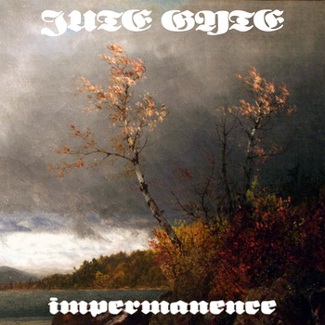
I could very easily see Adam Kalmbach's Jute Gyte project become a sort of Blut Aus Nord for the states, a consistent exhibition of both the black metal and ambient spectra which is wholly unafraid to join the two in a selection of marrow draining compositions. To date, he has danced both sides of the line, with several recordings that are fully in one camp or the other, but even so, external influences very often bleed into the stream of inspiration, and Impermanence proves no exception. The rustic, leaning limbs and autumn leaves of the cover would normally leave one in question of just what the DVD packaged album might aurally contain, and yet the title itself is married completely to the image, a portent that no living thing can sustain indefinitely, and that the dying itself imprints an fleeting and desperate beauty upon the retina. Or, in the case of Jute Gyte, the ear.

I've warned before that Kalmbach's records are not easy to access, and the constant holds here. Why, even in the very first track, "Meaninglessness and Waste", a rush of dense and raw, drum programmed blasting must be endured before one arrives at the more curious bits, like the wending, droning guitar melody and the alien dissonance in the rhythm guitar and bass tone. You will not find the sort of consonant, ear pleasing tremolo spurts you expect from the friendlier, Scandinavian exports, but rather noisy and drudging tones aligned more within the controlled discord of French acts Blut Aus Nord or Deathspell Omega, if not always performed at the same intensity. Or maybe a touch of Havohej. Where Jute Gyte excels, however, is in Adam's patient ability for the 'reveal' of the composition, how its bared teeth gradually part to expose a tongue which turns to the cadence of several musical languages. Several of the tracks on this album feel as if I'm watching a Lars von Trier film, awaiting the inevitable, always fucked revelation that makes the audience gasp in confusion or release.

Some of their opening credits consist of a more metallic nature, as in the aforementioned opener "Meaningless..." or the harrowing onrush of "Partial Wing", but then you've got exceptions like "The Wild Rain", which feel more like a canter of epochal sludge-punk dowsed in a guttural vocal dressing. Or "Hermit Haunter of the Lonely Glen", which is inaugurated by descending cycles of glinting melodies that lapse into the black/noise onslaught. A lot of the songs have these great, plunking bass patterns that erupt into some sodden progressive fog which falls somewhere in betwixt a garage Primus and undiluted Seattle grunge haze. But there are also some notable ambient passages, like the janky titular guitar interlude or the sinister, warped bridge of "The Old Hills' Indifference" before it storms into the unhallowed traffic of its oozing bass and ambient spikes around 5:30. The point is, with just about every single piece of music (excepting the title track), there is something waiting in the wings, something you might not expect...

And this is crucial in maintaining the listener's attention span. Most of the songs here are around 9-10 minutes in length, so to loop the same ideas endlessly would cripple their effect. Yet, Jute Gyte somehow never seems aimless in direction. The surreal, impressive lyrical imagery seems to compensate for the often one-track, tormented Burzum vocals, and while not every guitar pattern is captivating, they are never recycled beyond the point of no return. Something new is always around the corner, but the songs never seem excessively spastic or ADD-attuned. The production is feral and traumatic without actually hurting the ears like a Nattens Madrigal. In the end, I've found Impermanence to be the most impressive of Jute Gyte's works to date, further exploring along the axis of an Old Ways or Verstiegenheit without abandoning that same, isolate, outsider vision.

Verdict: Win [8.75/10] (swallowing all dimensions)

http://www.jeshimoth.com/jutegyte/

Wednesday, May 18, 2011

Jute Gyte - Verstiegenheit (2011)

Missouri's Jute Gyte continues to lead an impressive double life as an experimental/ambient obscurity and an adventurous black metal combo. Verstiegenheit is the latest evocation of the latter, following upon the poignant heels of prior efforts like Old Ways (2008) and Eagle Heart (2010). Wrought from a moral haze, sauteed in emotional escapism, and primed in a stark poetic discourse. You'll of course experience all of the baleful repetition and raw potency you'd expect from other 'bedroom' acts within the black metal genre at large, but Adam Kalmbach assures more than a mere mirror to the familiar nihilistic pandering, but layers of nuance and substrate that catch at the edge of perception like muted specters hidden in a watercolor painting.

From the onset, Versteigenheit operates under the deceit of a straight black metal affair than either of the other albums I've covered, "Gates of Day and Night" providing roughly nine minutes of grim, charging abandon. However, despite the monotony of the drum sequence, and the Burzum-like grated torment of Kalmbach's vocal presence, the choice in chords is incredibly curious, almost like a mesh of accelerated grunge and 90s noise rock rather than the bleeding Scandinavian miasma of oppression. This is further expounded within the next track, "Apparitions in the Woodlands at Dusk", in which a similar rush of pummeling chords are affixed to a hissing layer of distortion. This track is where the experimentation truly arrives, first in the mellow, muddled bluesy breakdown at 2:00, then later in the jarring rock riffs and curving bass-lines after 4:00.

Trust me, you've not heard anything quite like this before, and such strange hypnosis provides one of the compelling reasons that Jute Gyte deserves further examination aloft the saturated spectrum of underground darkness. Most of the tracks follow a comparable formula in that they are between 8-12 minutes in length, opening with steady rhythmic charges, but they've all got surprises in store for those who dread that ennui might set in. There are several deviations in the tonal ambiance of brief interlude "Church Not Made With Hands" or the resonant guitar instrumental "To Return and Revere the Desolate Places (Late Idyll)", but on the whole the pieces fit with a formidable, haunting balance. Verstiegenheit might require several exposures before it seeps into the listener's skin, but as usual, Kalmbach is not interested in accessibility, nor the cheap rewards of the easier road. This is impressive, important music, but it flits across the depths of the surreal and secret. It's not coming to you. You're going to have to chase it.

Verdict: Win [8/10]
(an echo from the ageless hills)

http://www.jeshimoth.com/jutegyte/

Wednesday, July 7, 2010

Jute Gyte - Young Eagle (2010)

Young Eagle is another excursion into the realm of the unholy impulse below the existence of all thinking beings, courtesy of Missouri noise musicians Adam Kalmbach. It is the 6th long player from the Jute Gyte project, and while a worthwhile successor to Old Ways, it actually expands upon those ideals and takes the aggressive maneuvering into new directions, untapped abysses through which a broader palette of atrocities are committed. For a great deal of its playtime, Young Eagle is simply not as noisy as its spiritual predecessor. The harsh distortion that once was the rule is now the exception, but Kalmbach's brutal delivery is carried out through other means on this 61 minute audio terrorist extravaganza.

Kalmbach maintains the early, unrepentant black metal influence, but here it is amped up through a generally faster execution. He's also come some way as a guitarist for this, and incorporates some nigh on technical noodling and busier rhythms, which make a very interesting dent on the poetic, smoggy din of the percussive landscape. The drums are patterned in a mix of straight rock, metal and varied patterns, and and there's a strong presence of the distorted bass here, which I barely noticed on the prior work. Young Eagle is a more potentially random experience, as songs will segue in and out of depressive, slightly distorted guitars-only passages or other diversions. It's still highly destructive, despite the fact its easier on the ears, and I'm reminded of what might occur if some avant-garde luminary like John Zorn danced on the precipice of black metal, rather than the Merzbow meets Burzum & Darkthrone feeling that permeated Old Ways.

The heretical floe of sewage begins with "See the Abandoned Throng", a rather straight black piece with chugging, strange bass and drums that often seem as if they're moving so quickly you can no longer hear them. If Transilvanian Hunger were re-written as a concept album about the abandoned caverns and sewers beneath and beside a metropolitan subway system, it might have come across something like this, though I doubt the Norse would have incorporated the schizoid guitar weaves and chugging patterns that break up the crashing forceful gale of the verse. "Glory at Hand" explores the dynamic contrast between slow, dirty guitar drone and grim, blasted hubris, with some sludgy rock rhythms added, for over 11 minutes, while "The Wine-Halls Are Crumbling", one of the albums best tracks, micro-manages dingy guitars, a muddied, subtle pipework of throbbing bass and the overall feeling that your brain is being extracted through your ears and nostrils by a very clever mind flayer who doesn't wish to tamper with your skull, instead saving it as a trophy for his lair.

In another stark contrast, the album moves into the gloom of a rolling ambient piece, "What a Bird Bore away Overwith clean guitars, soon layered in the cystic fibrosis of hell-scarred distortion winds, with some trippy, moaning vocals that I was not expecting. "The Might of Ash Spears" transforms from an acoustic guitar intro to a chugging, bizarre metal force, later affixed with strange electronic signals like aliens trying to break a communication satellite code. "Young Eagle" is pretty much a straight black rocker with some strange start/stop drumming and a melancholic, off-kilter guitar melody that arrives above some distorted, retch inducing vocals. "The Flower and the Chain" explores a jarring, desperate piano line with an unnerving mix of subtle dark ambient architecture and summery sounds of nature.

The lyrical talent here remains impeccable, and perhaps superior to that found on Old Ways, though the imagery being conveyed has the benefit of grasping from a wider collage of images both beautiful and frightening. Many noise artists or noise/black artists do not even attempt to incorporate lyrics into their composition, much less good ones, so Jute Gyte remains a treat to the imagination, an added dimension that elevates the listener to a rapture of both sound and word. Yet some of the statements are noticeably subtle, and gentle in their passing:

In winter we make the spring. In summer, the harvesting. I feel the nothing accumulate as days go by. I feel the weight of every passing sun and moon. In autumn we search and store. In springtime, we wanted more.

Though some of its contents are superior to the previous album I've listened through, I did find Young Eagle a touch less consistent. Several of the tracks are brilliant and breathtaking, like "The Wind-Halls are Crumbling", "What a Bird Bore Away Over the Deep Ocean", and "The Flower and the Chain", or for the aggressive fare "See the Abandoned Throng" and "Glory at Hand". However, "The Might of Ash Spears" and "Young Eagle" had a few minutes there that I could have lived without, where suddenly the album felt a lot less interesting than I'd expect of Jute Gyte, largely due to some mediocre metal riffing tucked in there. Still, for an album that is largely diverse and experimental, it rather holds its conflicted aural imagery together well, and still worth purchasing. What it might lack in coherence it compensates for with an increase in sheer musical skill, and the inclusion of the pianos and more ambient range from other, non-metal Jute Gyte efforts is welcome. Combined with its curious packaging (DVD case, lyric sheet, minimal black/white text and cover image) it makes for another exquisite journey into a nexus of corrosion and rainbow light.

Verdict: Win [8.25/10]
(the cruciform shadows of nuclear angels ejaculating manna from the heavens)

http://www.jeshimoth.com/jutegyte/

Jute Gyte - Old Ways (2008)

To many untrained ears, black metal music is already noise enough, crossing the line from comprehension to confusion. Part of this is an unwillingness to accept extreme climates in which art can find a center, and part is simply the natural, visceral shock to such elements being streamlined into the brain with such seemingly inhuman pacing and energy. To those well indoctrinated in the form, sometimes the traditional rock band instruments are not enough, and thus we've seen a wealth of black/noise artists spring up since near the genre's very inception. Pioneers like Sweden's Abruptum or the USA's Havohej have given way to a landscape of solo and paired projects worldwide, and of these, Missouri's Adam Kalmbach has to be one of the more interesting I've encountered as of late. Hit output through Jute Gyte spans a range of styles. Some of the albums pursue a more purely experimental, ambient texture, while others lap at the bloodspring of primal black metal in the vein of Darkthrone and Mayhem and take their aesthetics into an even more grisly territory than the woodlands in which they were born.

Much of Old Ways, Kalmbach's third full-length release through this project, carves a simple but destructive path through a carnal and uncomfortable territory. The raving guitars and rasped vocal lunacy are gowned in veils of hideous distortion, industrial-like drum beats, and strange psychedelic segues into bass and noise samples that make me feel like Attila Csihar, Skinny Puppy and Merzbow are hosting a housewarming party together, with your ears as the appetizer. Like much primitive black metal, repetition is key to the music's hostile, drowning breech of the listener's defenses, but Kalmbach is wise to shift it up as often as he does. There is of course a barrier to entry in place for the unsuspecting listener: the intensely saturated hiss of the distortion will provide much pain until you can latch onto the underpinning rhythms. It's like a musical release via smokescreen, but glimpsing that beauty behind at this or any other angle, through any obstacle is almost sweeter than a clear, sunny day.

Old Ways is comprised of seven acts performed in just over an hour, and I'd recommend you partake of this for the long haul, since the relative consistency of style will easily hypnotize the errant cerebronaut for that period. Several of the songs operate in fairly straightforward, archaic black metal territory with the added advent of the noise functions, like the openers "Waves" and "Teeth", but others take some liberties. "Round" incorporates segments of processed guitar noise, swollen dark ambiance and broken industrial rhythms against periods of necrotic surge, while "Interlude" is all out mystical twanging strings and freaky synth tones that remind me of something Muslimgauze might create. "Peace", one of my favorite pieces on the album, is a slow, damning burn with periodic, cautionary lapses into this fuzzy, doomlike rhythm that almost awakens the listener from the cobwebs of stupefaction to a rapt awareness of his environment. "Snail" provides another interesting guitarscape below tortured vocals, and the extensive finale "Death" is 18 minutes of rampant, plodding hostility, a cryptic black haunt in a gargantuan, rusted junkyard through which electronic roaches skitter and feed upon the last strands of life and human nutrition.

I might also point out how much I truly love this man's lyrics, a conceptual procession that details the struggle of organisms with such an infusion of blunt poetry that they almost exceed the music in ghastly effectiveness. The song titles are all quite minimal here, proof of their existence in a pattern, but some of Kalmbach's prose is truly bewitching:

A pale dwarf-wrath keels over, fatally injured. Mouth gaping, revealing long, curved and yellowing hook-like teeth, it vomits a chunky white substance with the texture of curdled milk. It foresaw this long ago, but now cannot believe. Crimson patches darken a miniature black cloak. Small hands clutch at the brumal air.

No, folks, we are not in Norway anymore. A project like Jute Gyte both compels and disturbs me. The former because I so enjoy the rewards obscured within its oppressive borders, and the latter because I know so few people out there will be able to form the connection to its strange, abstract beauty. Through the Jeshimoth imprint, Kalmbach has offered an attractive if minimal packaging which I found highly appealing. The CD is placed in a DVD shell, with a simple black and white cover and a lyrics sheet tucked into the booklet flap. He does this with a lot of his releases, and though they occupy a little more space than a standard CD, they look very flush together and impressive. I might add that the DVD presentation does more than simply gather dust, it offers you an almost theatrical insight, like a Luis Buñuel picture, a conflagration of sounds and distressful imagery, only here it is delivered through Kalmbach's unhinged control over the chaos and struggle of existence. This is yet another of those works that can change you in increments, as I'm sure it has changed its maker, and worth entertaining if you favor the more experimental extremes of black metal music which in its some of its most incendiary personas reside (Abruptum, De Magia Veterum among numerous others).

Verdict: Win [8.75/10]
(a gentle hum: negative space)

http://www.jeshimoth.com/jutegyte/