Blacksoul Seraphim has been honing its brand of Gothic doom for years now, often infusing it with other of their influences like black metal, so the latest release, Profane Devotions comes as somewhat of a stylistic surprise. The band has stepped somewhat out of its comfort zone here with a focus on groovier, traditional doom riffs of the more direct Sabbath variety as channeled through their prodigies like Trouble, Pentagram and the like. That said, they haven't committed entirely to this edgeways evolution, retaining a lot of their core characteristics like the deeper male Gothic vocals, female backing vocals, organs, keyboards, and the polished, rigid, professional production style which is honestly hit or miss when you're exploring a more dirty, down to earth spin on the dooms so heavily prevalent in stuff like stoner rock. Again, this is not exactly trying to journey that far away from the band's earlier output, so what you're left with is a unique contrast.
A lot of pros here, but a few cons for me. The rhythm riffs are well-written and catchy, especially in "Doom Junkie" and "Bedlam Harvest", evoking that primitive, bluesy savvy you can trace back to the late 60s and 70s as Iommi and company were hitting their stride. Familiar, perhaps, as progressions of this style often are, but even then I think Blacksoul Seraphim does a damn fine job of keeping the actual structures of the verse riffs into chorus or bridge sections compelling enough that you can tell they've paid attention to how these mechanisms function and then translated them into their own tongue. Much of the musicianship is good on the whole...the drums keep the both the grooves and the choppier start/stop patterns in check, the bass sounds good and fat in the mix, and the way the synths are layered in against the riffs and vocals is balanced just right to enhance their power without any threat of intruding or outshining what is most important. The mix on the EP is quite good, which is no easy task when you're blending together the varied vocal styles and instruments here. It might even be too tidy, but again this band is not intentionally trying to sound as throwback as a lot of their peers, so there was little chance this was going to sound like a scratched vinyl from 1968 in a waft of cigarette fumes.
The lyrics are also quality, which is old hat to these guys, a mix of introspective despair as well as the hovering Lovecraftian influence that has long fueled them (and their former project Sorrowseed). But where I started to disconnect with this material is in the vocal choices. Now, to be clear, none of the vocals here are actually bad at all, if I were to isolate them from the whole they'd sound fine. The shouted, higher male vocals in "Doom Junkie" were quite good with the music, and where the male and female duet vocals were pretty well done. However, I just didn't jive all that much with the lower vocals over these groovier riffs...in the past, when the band was playing with a more stolid, Gothic architecture to the songs, these fit more smoothly, but here they tend to drag down the grooves. I also wasn't a fan of switching over to the female lead vocals on "Priestess of the Deep". I reiterate, it's not that the voice is bad, or out of key, but somehow they seemed too constrained, too safe over the riffing, where I would have liked to hear her go a little wilder, which she actually does closer to the end of the song, enforcing my point. One other nitpick for me was that the lead guitars were a mixed bag, especially in the bridge "Priestess of the Deep" where the solo felt a little too sporadic and didn't go anywhere special musically.
In fact, apart from the core riff during the verse, and the decent lyrics, I just wasn't all that into the second song. Not a deal breaker, mind you, but it just stuck out a little in an awkward way. Ironically, if you were a fan of their earlier albums Alms & Avarice and Hymns for the Vanquished, you might actually dig that one the most. I was, but I didn't, and overall it limited my enjoyment here. Now, to be clear, this is not a full-length, but an EP which is dipping its toes into the waters of another branch of the genre they original set out to explore. Not a massive departure or experiment, but enough of one that some growing pains could be expected. To that extent, I think their riffs prove that they're capable of wrenching out those soil-encrusted doom roots. I was nodding my head appreciatively through almost all of them. But I'd like to hear them go dirtier, crazier, more hazy and psychedelic, soul hammering. A little less of that meticulous marbled Gothic structure and a little more raw, devolved freakout would go a long way with this strain of doom.
Verdict: Win [7/10]
https://blacksoulseraphim.bandcamp.com/
Showing posts with label blacksoul seraphim. Show all posts
Thursday, November 7, 2019
Sunday, April 10, 2016
Blacksoul Seraphim - The Persecution Hymns EP (2016)
Blacksoul Seraphim's material provides a callback to a niche of Gothic doom metal which is not only increasingly obscure in general, but even more rare from the New England region. The duo of Joshua Carrig and Rick Lowell has been chipping away at this stone effigy for the past four years, already producing two quality full-length efforts, and The Persecution Hymns seems to continue that streak with minor progressions which capitulate to their prior aesthetics, yet round out the sound to an even more professional and mature level. Though this EP is a mere two songs clocking in at under 20 minutes, there is quite a variety of content within, and each of the tracks creates a narrative contrast which flows with that of the titular characters it portrays.
"Sunsworn Knight" is the opener, a somber and emotional piece of beautiful doom which shifts through a palette of tempos, rather than settle on nearly nine minutes of repetition and redundancy. Brighter chords selections, and the restrained use of pianos accent Carrig's vocal performance, which hits a nice angry stride at the climax of the verses, a potent spin on the stylings of Yearning's late Juhani Palomäki or Moonspell's Fernando Ribeiro. Female vocals are incorporated tastefully behind the lead vocal line, while there is a major improvement with the bass-lines, which offer something slightly different in the choice of grooves and fills that strengthen the composition. Lowell's own beats and fills are confident and consistent, a drummer who is just as comfortable blasting along as he would be grooving, never content to just play metronome, so there is always this sense that the song is about to go nova, and while that never completely manifests, there are definitely segments where some of that energy transforms into a payoff.
On the other hand, "Pureblood Demon" is a more contemplative lamentation, with a guest narrator giving the listener some background through an elegy worthy of Bal-Sagoth only a little more serious in tone. Then the deep intonations of Carrig's clean take over, eventually leading up to some of Lowell's crumbling gutturals which strike at just the right time, ascending back into a glorious apogee where the male/female duet returns like a lullaby set to cathedral doom and a faint trace of organ. Blacksoul is simply not the predictable, garden variety of Gothic doom which rests on its laurels for endless cycles of nothingness, but a vibrant and tragic take on its constituent genres. In fact, there are numerous flourishes of progressive, black and melodic death metal here, so I hesitate to even narrow it down. This pair doesn't care to restrict themselves to any one in particular, so why should the rest of us?
Granted, this is not an admixture of genres for everyone in 2016. It's not for pizza thrashers or closet Vikings who came into metal through rhythm-based video gaming. It's pretty Euro, and I think that's where you'd find the lion's share of its potential audience. But if you do find yourself reminiscing for those late 90s or early '00s recordings which populated the rosters of labels like Napalm and Holy Records, or if you enjoy Isole, mid-era Anathema or the less crushing My Dying Bride material, then this could certainly prove worth your time. It doesn't just completely settle for the dusts of nostalgia, but offers a slim ray of hope that such styles can continue to be etched away at, continue to evolve towards the future. That's not to say it's blindingly original or ambitious, but it's also very, very far from lazy. It's flexible. Fecund with possibility. The value of just these two songs rivals that which I derived from the entire debut album Alms & Avarice, which was no slouch. A great access point, and an even better launchpad for future efforts.
Verdict: Win [8/10]
https://www.facebook.com/BlacksoulSeraphim
Labels:
2016,
blacksoul seraphim,
doom metal,
gothic metal,
massachusetts,
USA,
win
Thursday, March 5, 2015
Blacksoul Seraphim - Hymns for the Vanquished (2015)
At the risk of sacrificing some consistency, Blacksoul Seraphim's sophomore Hymns for the Vanquished expands upon the latent versatility that it's predecessor hinted at several times, thus having evolved the duo's overall aesthetic to one that is more adventurous and even less predictable than it was before. A strong Gothic/doom metal backbone perseveres, providing many of the stronger tunes throughout the hour of material, so those who explored and enjoyed the debut won't necessarily be too put out; but the band also sends further black metal feelers along a path towards the members' other band, Sorrowseed; to the extent that style seems to occasionally take command of the proceedings, albeit imbued with pianos and other graceful melodic components that keep it well beyond the bounds of the the necro black metal medium.
An apt comparison might be that it hybridizes the more melancholic, classically inspired doom of bands like Isole, Yearning and Draconian with the 90s Gothic/black of groups like Siebenburgen or Hecate Enthroned, only with the caveat that some of the rhythm guitar chords during the faster sequences have a flowing, shining texture to them which reminds me of a lot of Norse stuff circa the mid-90s (The Olden Domain, etc). These are constructed to convey a sense of warmth rather than dissonant strings of icy, evil tremolo picking, as in the first cut "Exalted Genocide" which is probably the most abrupt and blatant example of this departure, to the point that one might even be wondering if this were still the same band beyond Joshua Carrig's clean, crooning vocals. However, once the spacious, sweeping grandeur of slow-goers like "The Sightless Hero" and "Barren Martyr" arrive, we start to experience a closer semblance to Alms & Avarice, with a slightly more studied, contemporary focus on solitary guitar melodies that are tasteful, never abused to the point that they seem forced or tacky.
In fact, the structure of the individual tracks and the album as a whole does seem mildly more varied and progressive than the debut. Vocally, the contrast between Carrig's sustained intonations and drummer Rick Lowell's fulsome rasp works where it appears, though there remains an emphasis on the former style, which is only natural since it feels more attuned to the somber attitude expressed by the riffing. Occasionally the volume seemed a fraction high on the vocals, not enough to obscure the riff textures, but enough that they lost a little weight beneath. The drums are bloody impressive, for where a lot of European bands in this style exhibit a minimalist approach to the languid beats they feel the laconic rhythms require, Hymns for the Vanquished is anything but lazy. Lowell embellishes even the barest of riffing passages with forceful fills ("The Vessel", "Infernal Harrowing", etc) and takes nothing on his kit for granted, which really lends to that sense of measured risk the band seems to embark on with the recording. Bass lines are solid, felt beneath, but this is still an area in which Blacksoul could stretch itself for a better, busier balance against the pianos and rhythm guitars. The acoustic guitars, pianos and viola are tasteful, whether used as accompaniment to the harsher elements of their sound or striking off on their own in the sweltering climb of instrumental "Eleemoosynary".
Did I like the disc quite as much as its predecessor? That's a very good question, and at its most invested and engrossing, I would say this slightly edges out Alms & Avarice. But I also felt like this had a more piecemeal vibe to it where individual songs were slightly more disparate in relation to one another, unified only by the final production sessions. The first album just felt like this giant, stone slab of Gothic/doom metal, whereas the few flirtations here beyond that space marginally detract (but not distract) from that stolid sense of purpose. Ultimately, while they are very close in quality, this one fell just a hair's breadth short. Yet the lyrics are still very well written, Milton-esque, often amazing. The production is for the most part clear and potent, and there are plenty of moments of both savagery and grace to have kept me coming back. Simply put, there are few if any other bands in this area (hell, this country) writing anything quite like this, so if you pine for those very 90s or early 00s where bands thrived on the margins between these particular stylistic constraints, Hymns for the Vanquished is worth checking out.
Verdict: Win [7.75/10] (our liberty became our torment)
http://www.mortemcadaver.com/blacksoulseraphim.shtml
Labels:
2015,
blacksoul seraphim,
doom metal,
gothic metal,
massachusetts,
USA,
win
Friday, May 30, 2014
Blacksoul Seraphim Interview
Interview with Joshua by Autothrall.
New England is such a diversified womb of metallurgy that some of the best often slips through the proverbial cracks. An endeavor to right this situation brings me across the path of Blacksoul Seraphim, one of our rare Gothic/doom metal outfits, and the prodigy of one Joshua C. (aka Morte McAdaver of local black metal act Sorrowseed). Eclectic, well spoken, professional and devoted beyond mere words. The debut Alms & Avarice is some of my favorite material he's written, and I wanted to discover out just what lit this solemn fire...and so was humored.
Auto: Was the concept behind Blacksoul Seraphim conceived prior to Sorrowseed, or was there a natural inclination towards writing slower material to contrast with the general speed and lethality of the other band’s black/death metal style?
How much time do you put into lyrics as opposed to writing the actual guitars and keys? It seems you have a comparable investment in them to someone like Dani Filth, steeped in the dialect and verbosity of English/American masters of poetry and fiction, from Wordsworth to Poe? There’s a sort of antiquity there I really enjoy. Do you feel like the lyrics are often given the shaft in extreme metal?
Oh, absolutely with the shaft. I’m very critical of lyrics, and they are often the hardest part of a song to write due to my high (or at least peculiar) standards. Unless a song is meant to be cheesy/corny/stupid, or the songwriter’s first language is not English, I can’t excuse terrible or vapid lyrics.
Now that you mention it, I think Dani Filth is one of my main influences...
As for how much time I spend writing them, I’d say probably too long! I review the words repeatedly in my head, reviewing them against the rhythm of the song (which also may or may not be fully written), altering things as necessary, making sure I’m not repeating myself or selling myself short, etc. In short, I am very neurotic and obsessive about lyrics.
The themes behind the debut record are fascinating, sort of an anti-Milton vibe or an inversion of Dante’s Inferno or Purgatorio. I know you’ve probably gone on at length about them, but could you share a summary of this vision for the readers? Are there any particular literary sources which inspired the idea, and do you plan to continue to weave the theme into future material, or will newer songs follow a separate and/or disparate concept?
Actually, I don’t often speak of the album concepts; I like to wait until asked by inquiring minds such as yourself and your readers! I am honored that you find the themes fascinating.
The entirety of Blacksoul Seraphim’s material is essentially the world viewed through a fallen angel’s eyes. He is meant to represent hope, but this becomes his torment as he is constantly filled with despair at the sight of the mortal world and what it has become. He cannot truly connect with us, nor can he express modern concepts as we do, but he does see the evils and corruption that pervade our society, and wishes to inspire humans to rebel against these ills and devils.
Literary sources include, as you mention, Dante’s Inferno and Milton (Paradise Lost), but also the Bible itself. There’s always been this elegant morbidity to Christianity that I’ve appreciated (just like all the other cool goth kids), and it seemed all too appropriate to use their traditions and imagery in this project.
My main source of inspiration, however, is the news. Seeing how complacent people are with the perpetual corruption of elected officials (who are unequivocally owned by wealthy donors and/or corporate parties), the lack of compassion in the face of tragedy, and the addiction to sensational, insignificant stories and advertisements...it all makes me sick to the point of writing angst-ridden music.
Have to hand it to you, I loved how the deeper vocals meshed in with the material here, very melodic but stern, giving the listener the impression he/she is irrevocably doomed, which is rather the point. I felt like a peasant listening to a witch-finder’s sermon in the old English countryside. Did you have to train your voice a lot for this, or did it come natural after the Gothic style you performed in Pandora’s Toybox?
Funny enough, when I first set out to do a gothic rock band, I was all geared up to do my best 69 Eyes impression. Naturally, Pandora’s Toybox would end up becoming a more silly and theatrical thing where I used whatever over-the-top voice was appropriate for each song.
Growing up, I was often in chorus classes throughout school. We sang lots of religious pieces (despite not being church-affiliated), and I loved singing these solemn, though sometimes overly elaborate pieces. I suppose in this way, I was trained to sing this kind of sonorous, despondent material. As opposed to the Toybox, Blacksoul Seraphim seems to be the return to my “choir roots.”
Also, there are occasionally these grueling, excellent growls used sparsely? Were those by the guest vocalist Matt Smith, or yourself, and do you think you’d be open to including harsher vocals more commonly in the future (regardless of who performs them)?
Matt Smith did the harsh vocals on "Plague of Pawns", along with the guitar solos. He seemed perfect for an angel of sickness, and I highly recommend checking out his project, Faces of Bayon. The only harsh vocals I do are the sibilant growls, and I tend to reserve those for when I want the listener to feel haunted.
The newest material has more harsh vocals on them by my drummer and friend, Rick Lowell. He unleashes his fury in the song “Exalted Genocide.” When the music calls for a more stentorian style of male vocal, he more than cuts the mustard.

How was it working with Clay Neely of Black Pyramid, who recorded the first record and also contributed the drums? He did a pretty pro job, especially considering that Blacksoul has a more archaic/antiquated Gothic/doom sound than his mainstay. Is that a relationship that might continue onto the next full-length, or will this be more self-produced?
Clay was, and continues to be awesome. I loved working with him. Very patient guy, punctual, and gave great feedback. He has since moved to Georgia with his family and, far as I know, has not been involved in music production since last year. I actually didn’t know it was him until I first set foot in the studio and recognized him as the Black Pyramid drummer. Once I realized he was in one of my favorite doom bands, I was certain that we’d work well together.
While I would have relished the opportunity to have him produce this next Blacksoul Seraphim endeavor, distance prevents that from being possible. But I do have another excellent producer helping me on this: Benjamin Jon of Stillwork.
You’ve brought on a new drummer, Rick Lowell, who also plays with Sorrowseed. Will this change lend itself to a broader dynamic range in the newer Blacksoul Seraphim material that we’ve yet to hear, or will the core creative process revolve around the same tempos and aesthetics?
Rick is more the metalhead than I am, and he does occasionally influence me in a heavier direction. Suffice it to say that new Blacksoul Seraphim material does include some faster songs with some French black metal influences (hooray for Alcest), and one song that pays homage to Enslaved. However, Rick understands what the project is about, and we’re still mostly building off the same dynamic of the first album.
Blacksoul Seraphim has a very inclusive presence through social media, with you debuting new tracks (uncut or finalized) for fans to experience as they’re written and recorded. I’ve listened through a number of them and they’re quite good, arguably even catchier than on the debut. What inspired this decision? Do you think it might cripple some of the mystique fans feel for a new album as a ‘product’, or will you hold back just enough material to keep us guessing? Or will these come out as some sort of compilation and then you’ll have an entire new album above and beyond them?
Thank you! We wanted to go with a monthly release approach (though reality getting in the way has made that occasionally miss the mark), and keep people apprised as possible.
In terms of mystique and being a product, I am at the point where I would rather just be honest with my listeners. Advertising is simply not in my blood, and I’d prefer people just have my music and enjoy it on their own terms. If money is given, that’s wonderful and I am grateful, but reaching hearts, minds, and ears is more important. With that being said, I am all for just releasing the songs as they become presentable. The only thing I hold back is the “final” product for download, since I’d rather ensure that listeners are able to keep the highest quality I can offer.
For now, we will be releasing songs each month as we are able, and once I’ve run out of ideas, time, and/or money, we’ll release it via digital download. Incidentally, I offer CDs to people at shows for free, and while Alms and Avarice is sold globally through digital distribution, the CDbaby and Bandcamp downloads are free.
You worked with Hillarie Jason, a local photographer/artist for the cover image to the debut, which was both memorable and fitting to the lyrical vision; you also use another illustrator for each of the preview singles, and several others for the Sorrowseed discs. How do you track these people down, are they within a circle of friends & acquaintances or do you hit up places like Deviant Art?
For the initial Sorrowseed album for Extinction Prophecies, I did ransack DeviantArt for Brett MacDonald, but otherwise, I have met artists through mutual friends and contacts. Hillarie I met at shows, and I believe Lilith of Sorrowseed hired her to photograph a show at the Oasis in Worcester. Rebecca Meyer has done the recent artwork for the new songs.
I’ll probably pick your brain a lot more about Sorrowseed at some other time, but I noticed you had a guest spot on Nemesis Engine from Andy LaRocque, who recorded and threw a lead up on one of the tunes. Have you considered tracking down a feature like this for Blacksoul Seraphim? Maybe Leif Edling of Candlemass, or Hamish/Andrew from My Dying Bride?
That would be amazing, though I fear the cost. Andy was very prompt and professional, but he was expensive, and unfortunately, his name did not seem to lend much to the promotional process of Nemesis Engine. While it does feel wonderful to have a favored artist as part of my own work, the expense is considerable. However, if and when I do write a new Sorrowseed record, I plan on asking Devin Townsend.
Massachusetts, and New England in general, seems a relative hotbed for a number of niches in metal and hardcore, but your projects bear a distinct and somewhat more European feel to them, what with the Gothic imagery conveyed. Here a lot of the fans/bands seem to have been bitten by the old school 80s/90s bug, whether that’s thrash, black, death metal or old hardcore. Has this created any notable conflicts or sense of alienation? When listening to this project in particular, I picked up a lot of vibes similar to Candlemass, Yearning, Draconian, Isole and My Dying Bride. Would you be thrilled by the prospect of a tour there, or a label deal with Napalm or some other imprint sympathetic to the Gothic/doom style?
I would be ecstatic beyond words. I’ve resigned myself to the fact that my local area and most of the country doesn’t really have much enthusiasm for my style, and have entertained pipe dreams of achieving success in Europe, whether it’s a tour or just being distributed and promoted there by a label. Should the opportunity ever come, I would gladly take it.
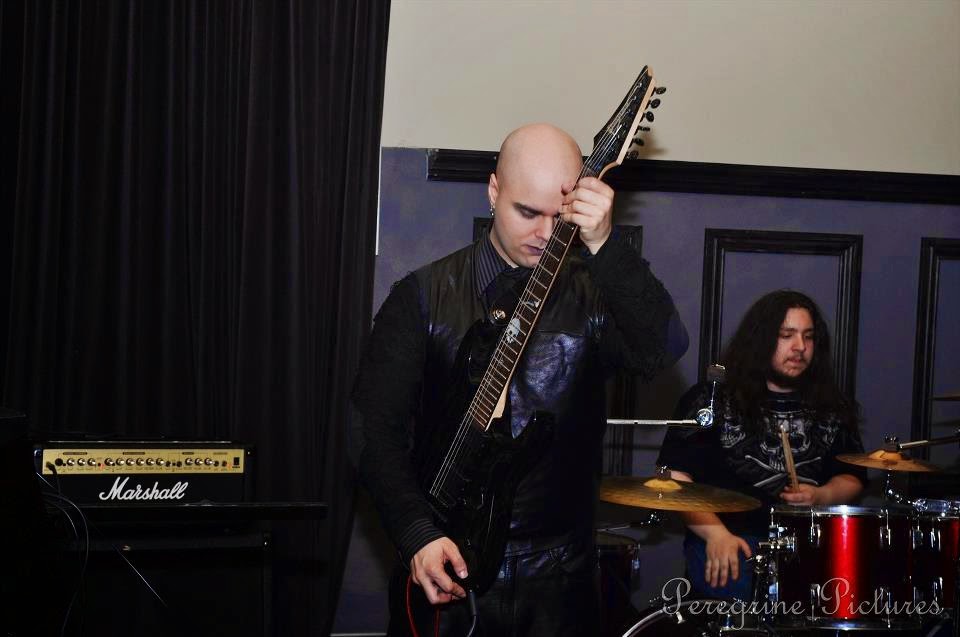
Speaking of which, you’ve actually performed live with this material, if I’m not mistaken? Is there a current complete lineup which could perform a gig on call? How was the reaction to that from an East Coast audience, did people stare slack-jawed and incomprehensive at the brooding eloquence of the vocals/lyrics and the graceful, riff and key-based doom which relies less on a fat/stoner guitar tone with down-tuning, and more on actual musicality?
I have performed three Blacksoul Seraphim shows to date, and will be performing alongside Sorrowseed in September at Ralph’s Diner. Folks tend to just ignore Blacksoul Seraphim performances, likely regarding it as background music. Those few that listen have given positive feedback and great compliments. But yes, incredulous stares are often the best for which I can hope. If, however, there have been people who have appreciated it in silence, I am grateful. And besides, I love playing and singing the material, so the crowd needn’t feel obligated to indulge me.
Much gratitude for taking the time to speak with us! When do you think we’ll hear the full follow-up to Alms & Avarice, and is there any other news for the near future?
Thank you for this chance to be heard! I rarely have my brain picked, and someone has to clean out these cobwebs.
If I have my way, the next album will be available by the end of 2014, but we will see. I don’t like to set deadlines, since they occasionally get in the way of something being done correctly and to the best standards.
In other news, I’ve mostly been laying low, gathering resources, and relaxing however I can. Music is a stressful thing, and the scene(s) often only compound the ideal. I’ll be more active when I’ve figured out a new game play to approach this faltering and over saturated industry.
Gaze upon Blacksoul Seraphim at Facebook.
Experience Alms & Avarice through Bandcamp.
Labels:
blacksoul seraphim,
doom metal,
gothic metal,
interview,
massachussetts,
USA
Saturday, December 21, 2013
Blacksoul Seraphim - Alms & Avarice (2012)
Full disclosure: Gothic doom metal is not a niche to which I can claim an inherently consistent reaction. One might say I was 'polarized' when it came to many releases in this field. I do not believe all My Dying Bride releases are created equal. I've revered a few of the older Candlemass records, and have since they were released in the 80s, but have muddled and mixed reactions to most of their later output. Groups like Isole and Draconian have by turns blown this mind and put it to sleep. I find that, like several other categories of doom, there's a hazy line between what is authentically crushing and saddening and what is strictly a boring slog through saccharine poetic doldrums, landscapes of ineffectual emotional effluvia which I wouldn't be able to relate to if I was an 19th century wannabe lyricist drunk off absinthe and hanging around in graveyards. It goes without saying, but songwriting and sincerity are just as valid and important here as they are anywhere...stringing together a few predictable Paradise Lost chord patterns and then dressing them in pianos or operatic female vocals is not, in any way, automatically fucking heavy. Like any other subgenre of a subgenre, you'll have albums which successfully take you to their own space, and others that spend a lot of time crowding the predefined boundaries.
Alms & Avarice is, gracefully, more of the former and a lot less of the latter. To be clear, I was not always blown away by this debut, and frankly the pacing and arrangement were not always my cup of tea, but like the Massachusetts mainstay of several of the members (Gothic/black metal outfit Sorrowseed), the attention to detail, production values and overall effort placed into this record are never shy of professional. First and foremost, the record passes the pseudo-Turing test I apply to most doom records: the songs themselves are not treacherously long and boring, or confused into thinking that they NEED to be to create some genuine artistic license in this particular medium. The riffs aren't insanely original or inspired, but they flow fairly seamlessly through solemn monoliths of sorrowful structures that absolutely remind me of those first times I heard a record like Epicus Doomicus Metallicus...Sabbath at heart, always, if their music were being viewed through a medieval lens more akin to the eponymous Theater of Tragedy record. Lyrically these are paeans to the corruption of man's institutions through the eyes of a fell angel, and I think that is absolutely a proper sort of concept for a record such as this. What's further, there are moments of variation inserted through the 48 minutes of content that help divert the record away from tearswept monotony, such as the bass solo "Dust Merchant" or the great guitar instrumental "Tarnishing of the Crown" which is arguably the most majestic riffing of the whole shebang...
The major creatives here are Josh Carrig (Morte McAdaver of Sorrowseed) handling most of the guitars and vocals, and Thomas Cyranowski on the keys. Drums are provided by Clay Neely of stoner doom sect Black Pyramid who also produced this disc with the gloss and clarity of nearly anything you'll find on the Napalm, Nuclear Blast or Candlelight rosters overseas. Having heard Carrig's voice both here and in his more Gothic/vaudevillian act Pandora's Toybox, I have to say this is his best performance, with a soothing and even tone that doesn't quite plumb the depths of a Peter Steele or Fernando Ribeiro unless he's doing a more narrative passage like that of "Virtue and Vermin" where the lower drawl accompanies the moody piano lines and rhythm guitar chords. Granted, there's not a huge range to the singing, but you could think of him as a more level alternative to Aaron Stainthorpe without sounding like he'd just overdosed on heroin. The death growls often present in this style are thankfully absent, as are the ethereal female guest spots, so I actually like that they were presenting a unified vocal front rather than the cliche 'beauty and the beast' techniques that were mastered long ago in the 90s and rarely useful ever since. No Leaves' Eyes swill here, just a spiritual numbing set to the studied, centuries old vernacular of the lyrics which read just as strongly as those of Sorrowseed. I also found Cyranowki's pianos and keys refreshing in their complacence to never over-contribute and let all the guitars and drums drive the experience.
But really, Alms & Avarice will live or die by its riff construction, and here you get a pretty broad palette of traditional Euro-doom melodies with some more trad-metal stuff redolent of bands as wide as Opeth and Iron Maiden. Nothing is repeated needlessly unto oblivion and there's only a single song here ("Psalm of Insurrection") which even remotely flirts with 'padding' (at over nine minutes), and that is saved by one of Carrig's more brooding, baritone vocal performances and a sweeping sense of momentum like a great shadow passing over a marble-strewn, ruined courtyard. The bass-lines sound decent if not themselves all that compelling, and Clay's drums fit the musical mold with effortless ease, offering slight fills but largely constricted to that sense of steady pacing that best fits the doom. I'd also add that, while few of the actual guitars might sound innovative to anyone with years of listening to this genre, they're 'busier' than what you'll hear in a lot of comparable bands...probably at least on the same level of Tristania and Draconian in how they eschew the endless tirades of lamentation by the less creative. Loads of melodies throughout give this slab of despair a ceaseless sense of hope, a few errant golden rays piercing the darkened din of cloud cover that scream: 'We can change, we can love, we can live', in rather humorous opposition to Sorrowseed's more apocalyptic disposition.
Ultimately, Blacksoul Seraphim is one of the classier Gothic/doom outfits from the States that I've heard, or at least the New England region, and very much recommended to fans of the more polished My Dying Bride output, earlier Anathema, Isole, Draconian, Swallow the Sun, While Heaven Wept, even a little Candlemass. This is not an album to approach with expectations of the utter bleakness you'd find in Mournful Congregation, Shape of Despair or Evoken, due to the lighter outlook of the melodies. While I could define some of the atmosphere as loosely 'funereal', this is by no means funeral doom, nor does it thrive off the grubbier grit of sludge and stoner rock aesthetics. It's not a sepulcher sinking into the swamp's edge, but a proud block of obsidian in a public boneyard. A few flower arrangements show up through the year, the weeds are clipped and the surface of the stone polished; and while it's not flawlessly engraved, or the most memorable memorial you're like to find, it is certainly built to endure the elements, and in places, to triumph over them.
Verdict: Win [8/10] (the citadel, sick with material bliss)
https://www.facebook.com/BlacksoulSeraphim
Labels:
2012,
blacksoul seraphim,
doom metal,
gothic metal,
massachusetts,
USA,
win
Subscribe to:
Posts (Atom)


