 Urm the Mad was the first Protector album I managed to come across out in the wild, and I recall being thrown off a little at the beginning moment of "Capitascism". A horror synth transmutes into a plodding hard rock riff, which was way less intense than I was expecting. That soon changes as they roll out some thicker, darker rhythms and a blast beat, or whatever the equivalent of a blast beat was for 1989 in what was still largely a thrash metal band. We were off to the races, but I certainly struggled at being impressed with most of this at first. This is absolutely where the death metal vocals become dominant, which sounded great over the simpler neck-jerking thrash rhythms; Martin just had this brutal sustain which created an impact with ever lyric he barked out, but the music itself isn't anywhere near what a Death or Pestilence was up to at the same time, and it's still written in a ballistic mesh of Teutonic, West Coast and the Arizona-like thrash I mentioned I heard on parts of Golem.
The dynamics remain intact, as the band will shift between a plodding, almost thrash/doom vibe in a tune like "Nothing Has Changed" with its swaying rhythm and slightly spongy distortion circa Hellhammer, to the more mid-paced rhythms which remind me more of Sacred Reich, Exorcist or Hallows Eve, and then lastly the faster barrages where the riffs can almost resemble a bit of vintage grindcore. Not a lot of riffs stand out individually, even for 1989 they didn't sound too unique, and there still exists some traces of their earliest work where they let the end of riffs ring out before transitioning into a burst or vice versa. On the other, the drumming is damn tight, with a speed and intensity to the blasts that was somewhat rare for its day, and the leads are really good, whether they're more melodic and structured or just being used as wild sound effects to create a windy hostility that blows across all the workmanlike rhythm guitars. I felt the bass on this record didn't stand out as much as Golem, it's audible and functional but doesn't poke out as much as it did there.
There's also another throwaway short track, the noisy grind explosion of "Molotow Cocktail" which is less than a minute, just some chaos that doesn't wrap up the disc in any memorable or meaningful way. So my first impressions of Protector weren't the highest accolades. The cover art was cool, the logo stood out to me from other thrash or early death metal acts, the title is awesome (again with that dark fantastical vibe), the vocals were gruesome enough to warrant the death/thrash tag, and there's a purity and atmosphere to the material which is synonymous with its era. Over the years, I've come to appreciate it for what it was, but truth be told it's the record I'm least likely to revisit of their earlier 1987-1993 run and it's just eviscerated by so many of the other beasts of '89 like Consuming Impulse, Altars of Madness, Leave Scars, Realm of Chaos, etc. If you love the production and construction of extreme metal at the tail end of the 80s, maybe a prelude to the style Sodom would explore on Tapping the Vein, then this one's worth a listen for sure.
Verdict: Win [7/10] (The cloven one will rule)
https://www.facebook.com/Protector.666not777

Tuesday, January 6, 2026
Protector - Urm the Mad (1989)

Monday, January 1, 2024
Annihilator - Alice in Hell (1989)
 It's never my intention to 'prematurely' shit all over a band when I'm revisiting their discography with somewhat fresh ears, since the goal is ultimately to give some second chances, maybe be surprised by a few records that I gave short shrift or overlooked. However, by my own recollection of the teenage thrashing 80s, Canada's Annihilator must have been one of the biggest premature ejaculations in all of the metal scene, shooting its wad loudly and proudly early on, and then entering a long refractory period through which there have only been brief periods of newfound potential and hopeful tumescence. It's a shame, because Alice in Hell was a pretty huge seller after its release, and the band became a top-second tier commodity among nearly ever metal fan I knew. Even those whose sphere of interest fell only into the more mainstream 'big four' of thrash, or arena staples like Priest, Maiden, and Ozzy, had seen the video or picked up this record. Certainly Jeff Waters and crew were on the precipice of major success...
With a slick, dexterous debut like this one, it's not difficult to understand why. While not every song was written on an equally memorable plane, the highlights tend to outnumber the dullards, and even the cuts which slack behind will have a few surprise riffs buried throughout. Waters is easily the star of this show, one of the more 'complete package', fully realized axe-men in the niche outside of Mustaine or the Hannemen/King coalition. Chops for days, performed cleanly and meticulously, with the ability to fire off competent if not immortal lead guitars anywhere. There's a precision and technicality to his playing that certainly placed the band within the 'tech thrash' niche without resorting to excessive, inane wanking, and I'm especially impressed with some of his lofty, harmonized syncopated melodies. Jeff can certainly throw-down at a moderate pace for the mandatory neck-jerking that fueled so much of the late 80s thrash, but he definitely has a bit of neo-classical edge to his shredding which oozed class, and most of the rhythm progressions here stuck and stayed that way so they're instantly recognizable even 35 years after the album first dropped!
He's also got some pretty good damned bass-lines on this disc, and besides Blacky of Voivod this is probably one of the better Canadian albums to deliver that reliable low-end. Ray Hartmann's drumming is hardly up on the level of Lombardo or Hoglan but it's snappy and energetic and sounds great in the mix to support Water's particular thrashing fits. More surprising is the sinister edge of Randy Rampage's vocals, coming over from the worthy punk of D.O.A. to deliver some snarling highs, some pitch, some nastiness, one of the better cross-genre performances I've ever heard, probably a shock to those who knew him from the simpler basslines and songwriting of his mainstay. He's awesome here and for my money perhaps the best vocalist that ever fronted this group, which I never would have expected. He's like a Great White North parallel to Holy Terror's Keith Deen, and I think a lot of the riff-writing here also mirrors that West Coast band, but it's more polished and accessible and I think that explains so much of the appeal this record had.
The showcase for this record is certainly the one-two punch of the "Crystal Ann" acoustic intro and "Alison Hell" itself, which together with the cover artwork conjure up a dreamy nightmare redolent of a lot of the popular 80s franchises, like a Nightmare On Elm Street or Lady in White or Hellraiser 2: Hellbound. The title track is easily one of the best thrash tunes of its year of release, still timeless, with some epic spiraling harmonies that plummet you down into its creepy namesake scenario while showing off the estimable talents in Jeff's repertoire. Everything from the little guitar shrieks, to the higher pitched vocal howls or little operatic break in the bridge just screams of success, and the lead sequence in there reminds me very much of Andy LaRocque's style in another breakout Roadrunner act, King Diamond, whose album Conspiracy the same year is a pretty good comparison. A few other standout moments for me were the clinical Deception Ignored-like melodic break in "W.T.Y.D.", or the unforgettable "Burns Like a Buzzsaw Blade" and its cringey sex lyrics, but there are really no stinkers in this lot...
Instead, a few tunes just fail to live up to that opening, while still remaining competent entries into the genre as a whole, and it does create a bit of a lopsided excitement where the 'Side A' shines a lot brighter than the 'Side B', or at least that's how I thought of it for years when I only owned the cassette. Having said that, Alice in Hell still feels pretty relevant today, a record that had all the potential to enter that space dominated by Megadeth and Metallica. Ambitious enough without going too over the top, unique if not terribly original. It also, sadly, stands as one of those early creative peaks in the medium; I won't say there is too steep of an immediate decline, as Never, Neverland provided at least a moderately catchy, meat & potatoes thrash experience, but I don't think any of the subsequent material comes close to my appreciation for this debut. Again, I hope to be proven wrong as I re-explore the decades of Jeff Waters' dedication to this craft, but Alice in Hell is a hard act to follow.
Verdict: Win [8.75/10] (No one listened to your fears)
https://www.annihilatormetal.com/
Monday, February 14, 2022
Devastation - Signs of Life (1989)
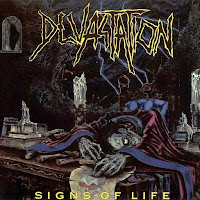
That's not to say it's perfect; it's wild but it does occasionally suffer from a sameness to the faster tracks that begin with the explosive "Eye for an Eye", one of my faves on the album, and the hardcore-like tint to the vocals definitely gives this a partial crossover feel, albeit with the more structured riffing. But almost all of the mid paced parts or evil Slayer-like breakdown riffs are pretty awesome, and there are a few good riffs in the more frantic passages too. Leads here are still not so memorable, but they freak out much better than on Violent Termination and sound far better in the mix. The drumming is far more coherent and intense, and the bass remains nice and thick to pulverize alongside the rhythm guitar madness. The vocals here are the biggest improvement, like I said they've got a punkish/hardcore feel to them but unlike the debut, the patterns he is spitting are far more aligned with the energy of the instruments, and he's mixed just right against them. Really, though, the whole band had leveled up and the one lineup change was well worth it.
Signs of Life also has my favorite production of their three albums, angry and fresh but still pretty clear, and comparable to other fast and nasty thrash records like Swallowed in Black by Sadus. This is the one which feels the most timeless to me, even sitting here writing this, I'm feeling the same affection for it as I did in those critical teenage years. It's no masterpiece, but one of those perpetual cult classics that deserves its spot in your tape/CD/record rack. And while it's not as short as Reign in Blood, it's only about 33 minutes, so it never ever gets the chance to wear out its welcome, the band just shows up, destroys and dizzies you to your thrashing satisfaction, and then takes a bow. One of the biggest turnarounds in all of thrash metal; they came up to bat, took their first strike, and then hit a home run, or at least a triple, and carried the bat with them, smashing all the basement in the face as they hurried on past.
Verdict: Win [8.25/10]
Sunday, May 23, 2021
Rage - Secrets in a Weird World (1989)
 Secrets in a Weird World might not be my #1 top choice within the extensive and impressive Rage catalogue, but this is by far the album I think was most underrated, the one I thought could have achieved a high level of commercial success had it been given the exposure that a lot of lesser metal and hard rock albums were near the close of the 80s. In the age of flashy guitar heroes, it just makes sense, because Manni's playing here is the epitome of power/speed metal: intense fast riffing, great leads and melodies, and youthful passion that sometimes feels likes ramming you off the side of the freeway and then forcing you to watch as a bunch of other vehicles in the chase fly by. But it's also chalk full of great hooks, memorable Peavy shrieking, and loads of depth and creativity when compared to a lot of earlier 80s heavy metal.
The cover of Sergei Prokofiev's "Opus 32 - Nr. 3" is a brilliant little piano number to herald the flood that is "Time Waits for No One", a total scorcher and one of the very best Rage songs, witch riffs so good that 15 year old me used to sit in his basement lair and play them over and over and his little Peavey 10-watt amp (COINCIDENCE?) and congratulate himself when he'd figure one out. The screaming vocals were in full effect and I loved them, and the leads were well beyond me and even a little messy, but charismatic. And that's the thing about Secrets, it's not just this wall of force that gives you whiplash, but it has a sense of lightness and even humor about it ("Talk to Grandpa") that makes a nice contrast against some of the more dead serious subjects in the lyrics. But yeah, the first 'side' of this album was an absolute juggernaut, with four tracks that are caged lightning...I mean the riffs, vocals and choruses to "Invisible Horizons" or "The Inner Search"? Ridiculous. And "She" actually sounds like a tune that might have been on Perfect Man only with the slightly more wind-washed production that separates this album from that. Again though, Manni's playing in that one is ferocious, and its another tune that highlights a lot of the desperate, throw-caution-to-the-wind vibe to the power drumming and Wagner-Banshee wailing.
In fact this record goes nine tracks deep where I'd give it a perfect score, "Light into the Darkness" one of the most smile-inducing emotional good vs. evil power/speed tunes you'll ever hear, and the aforementioned silly number "Talk to Grandpa" still delivering the goods with a very unorthodox subject matter about mediums and seances, which is kind of fitting to the 80s era in which stuff like Ouija boards and Poltergeist was so huge (I guess it still kinda is). It's not until the 9-minute finale "Without a Trace", where the shine comes off just a fraction. Still a good song with an interesting arrangement and a number of cool parts, especially the vocal lines, but if I'm in a rush this is the one I'm definitely going to skip, there's a point where it hit the bridge and its felt as if its just gone on for too long. And that holds the album back a bit from perfection, also a little bit too snappy of a snare sound throughout that I think could have been mixed just a little better, not taking anything away from the performance itself. Minor issues, and Secrets in a Weird World is still Rage in its peak performance phase, at least for this early style they crafted in their first decade. If you can grab a version with the actual artwork and not the band photo, do so, but at least this is a decent photo with the guys exuding a kind of cool confidence at how much they know they just kicked ass. Because they did.
Verdict: Epic Win [9.5/10]
http://www.rage-official.com/
Saturday, May 8, 2021
Helloween - I Want Out Live (1989)
 In 1989, as a steel-struck teenager, I was so hyped up on Helloween that I bought this live cassette the instant I first laid eyes upon it it. I can still recall digging out that $6.99 from my pocket paper route money, happily slapping down on the counter at Record Town in my local mall, striding proudly forth with my new-fangled quasi-mullet and thrusting it straight into my Walkman. It might sound like some stereotypical scene out of one of those awful TV shows or films that tries to thrive off nostalgia for the 80s, but in fact it was our reality back then. At the time, I didn't have a high opinion of live albums per se...Unleashed in the East pretty much brought me into the genre as a tyke, and Live After Death was still in a regular rotation, and when I looked at the track list here I thought it was a little skimpy, but fuck it, this was one of my favorite bands to emerge from my #1 label of the era, Noise Records, I absolutely worshipped at the feet (stalks?) of the debut EP, the first three albums and the Judas single, and I was going to follow them through thick and thin on all their major label adventures, and back again. And I always have...
I even remember at the time knowing that this one was put out under another title overseas, and I think the track list is edited just a bit different, and there's a cool cartoon cover of the band playing live, damnit all if I don't like our version a little better. I believe in Uncle Pumpkin. Well, I listened to this about 3-4 times and then quickly delegated it to the tape rack right beneath Keeper of the Seven Keys Part II, remember those old tape racks where you'd have to move all the tapes each time to keep them in alphabetical and chronological order because you were a huge dork that didn't plan well in advance? I guess it was just me. At any rate, I found the sound quality on this totally acceptable, maybe a fraction clunky in some of the mix, but for the 80s it definitely was clear and professional enough, I had just decided that I'd never listen to this at any point over the studio works that I so adored. It's now about 32 years later, and I'm breaking this thing out for the first time, and the memories of the experience seem to have phased me more than the recording itself.
The distribution of material here is largely on the initial Keeper duology, probably because they wanted to focus on songs with Kiske vocals and promote their RCA material, but they do manage to close out the B-side with an epic rendition of "How Many Tears", and if my ears aren't failing me it even sounds like Kai is doing some faint backups along Kiske's impressive take on it, and the bridge with those airy, open guitar harmonies sounds fucking fantastic. The guitars and drums sound tight, you get a fair helping of Markus' lines in there, and the leads really scorch. Stage banter is fun enough for what you get, silly schlager melodies, definitely sounding like some Germans a bit nervous to get out there in front of the international audiences (this being recorded in Scotland and England), and I don't think any of the tracks stands out as weak at all, from the silly "Dr. Stein" to title track, which was obviously the hotness at the time. Even in my High School, where only a select few of us hanging out on Headbanger's Wall near the cafeteria even knew who names like Armored Saint, Running Wild and Celtic Frost belonged to, almost all of the glam, Ozzy and Metallica-addicted student populace knew this damn song and walked around humming or singing it all the time (of course they all heard it from MTV).
Listening to it so much later, I rather think I missed out on giving this one some more spins when I was young. Helloween has had such a massive legacy since, with a lot of changes, but this brings back the innocence and amazing potential I once felt for these Germans...potential which they mostly lived up to, mind you. I don't know if it's on the level of Live After Death or Live Without Sense, two of the rare lives that I listen to on a fairly regular rotation. There's just not much meat on the bones of this one, but I promise I won't wait three decades before it shows up in the queue again.
Verdict: Win [7.25/10]
https://www.helloween.org/
Monday, March 8, 2021
Onslaught - In Search of Sanity (1989)
 Although there wasn't terribly much of a stigma attached to the third Onslaught record when it dropped at the end of the 80s, it's an album that has been unfairly maligned through the decades; if not outright hated by thrashers and fans, then at least placed in the mediocrity box more often than it deserves. Like many, I found it quite the shift from Power from Hell and The Force, transitioning away from the more cult thrash and influential proto-death metal of those releases into a sound that was a little more fit for a time when the thrash genre was becoming more involved, complex and frankly interesting...as much as I love the basic, rudimentary classics of the genre, hearing a band like Artillery or Coroner or Deathrow crank its potential up a few notches was more than welcome. Teenage ears seeking fresh sounds, not repetition of what Slayer, Possessed, Exodus and Metallica had already mastered in their primes.
Artillery is probably the most apt comparison, because In Search of Sanity has a sort of power/thrash hybrid feel to it redolent of those Danes' first two albums, Fear of Tomorrow and Terror Squad, if not the brazenly brilliant riff-gasm that was By Inheritance. This one is definitely characterized by its longer, more ambitious riffing structures, a superior balance of melody and aggression to its own predecessors, and last but not least the addition of Grim Reaper crooner Steve Grimmett. I was particularly curious to hear what Steve would contribute once I took note of this lineup change, for as effective as the vocals were for the earlier, harsher, more direct albums, I'm not sure that would have worked as well alongside the guitars here. He doesn't sound too different than in his alma mater, and strangely I think it's those more melodic phrasings that add a lot of depth to the hammering, juggernaut riffs which owe as much to West Coast US thrash metal to anything else. Groups like Heathen, Defiance, Metallica and Testament are great comparisons to the processed, bottom end feed of the muted guitars, or perhaps better yet this is in the same mold as fellow Brits Xentrix on their first two discs.
When I was younger I remember being swept up by the rather robust track-lengths, which never became boring even with the 5 minute instrumental opener, or the 12+ opus "Welcome to Dying". There's always something catchy waiting around every corner, and throughout each of the arguably bloated pieces, Grimmett is casting out another melody. He uses a lot of sustained notes which are a cool contrast to the busier guitars beneath, which are just constantly chugging and driving along courtesy of Nige Rockett and Rob Trotman. The leads here are pretty good, always controlled and never arbitrary or long in the tooth, and I also thought Jim Hinder's bass sounded pretty good, especially where it got a starring role like the verses of the cover of AC/DC's "Let There Be Rock", which I remember being another of those respectful and semi popular tributes of the 80s similar to Realm's "Eleanor Rigby" or Testament's "Nobody's Fault", the band making it something of their own rather than copying the original too closely. The drums are also pretty good, snappy and straightforward but tossing in a good cadence or fill here or there.
Over 30 years later I'm still digging both the momentum and construction of this record, and along with its two predecessors I still consider it the highlight era of the band's career. While newer Onslaught albums are met with a good deal of critical acclaim, I find them to be rather generic, if not awful. For the same reasons I'm not that into modern Slayer, Rob Dukes-fronted Exodus and Warbringer, I just don't find them to carry the same level of personality as they used to. In Search of Sanity might indeed not have the cult, battle jacket-worthy credentials of its forebears, and perhaps it's worth it to even go back to this one and think of it as a separate band entirely, but if you enjoy the well-crafted, accessible thrashings of the later 80s then I think this one easily meets the demand, even when it goes a little long in the teeth. In fact I'm almost a little sad that I didn't hear more of this with Steve in the roster.
Verdict: Win [8/10] (lies taint the mirror)
https://www.powerfromhell.com/
Sunday, February 28, 2021
Rage - Invisible Horizons EP (1989)

I could go more into the title track when I cover its full-length album, but this is just a glorious cut with some low-down, mean and intense riffs that escalate into Peavy's climactic, anthem-like chorus lines. He was in full form back then and could hit every note necessary, and by the time this dropped he had even managed to shape his pitch to something a little less uncouth and shrieky (although I was a fan of that too). I remember first hearing this track on the local University radio show in advance of getting my own cassette copy of Secrets and I was utterly fucking blown away, and the song still rules today. This lived up to all the mastery they displayed on Perfect Man, but in a way that I found would be even more accessible to those who thought that album was over the top. And not to mention that breakdown groove at around 2:20 which sets up the killer lead. Again, as I'm visiting this I just can't believe that music like this didn't catapult Rage into the top echelons of heavy/power metal fame at the close of the 80s. The band was every bit as infectious as Iron Maiden, Helloween, and Judas Priest of the time, and in terms of the musicianship you could argue they had even more finesse.
The other tunes have no chance to live up to that, but they're still quite decent, "Lost Side of the World" being the one that I believe was tacked onto the original CD release as a bonus track. It's a moody, sweeping piece with some nice leads, maybe too many leads, but I feel like some of the progressions in the tune had sort of been done better on other Rage tracks and you can see why the band and/or producer found it to be filler. "Law and Order" is the more fun of the B-sides, definitely giving off more of an Execution Guaranteed or Perfect Man vibe with the frilly shrieking vocals and gang shouts, especially when he breaks deeper into that wild chorus. Still not a top flight track in their discography, but I'll crave listening to it once in awhile, lots of fast bass lines in there and some nice, slicing riffs and another cool solo from Manni. On the whole, though, despite the amazingness of the title track, this is just another glorified maxi-single without too much to recommend. You just don't need it these days as you can hear the extras on a more substantial product for your dollar. For a year or so it scratched a bit of an itch for more Rage, but today it just seems like another record label attempt to scrap together a couple more bucks for a vinyl and CD.
Verdict: Indifference [5.25/10]
http://www.rage-official.com/
Sunday, May 3, 2020
Prong - Peel Sessions EP (1989)

The trio's choices leaned heavily on Force Fed, their most recent album at that time, with "Decay" and "Senseless Abuse" represented, while Primitive Origins is present through "In My Veins". The final selection was pretty interesting, "Defiant", which would be the B-side on the "For Dear Life" single to promote the forthcoming Beg to Differ. It's a passable tune, one can see why it wasn't rhythmically interesting enough to make the album itself, but what really surprises me the most is how it sort of set the tone for all the material here, which comes off cleaner and tighter than you'd expect from the band's first two official releases. On the one hand, it shows Tommy Victor and crew were quite proficient and professional in the live arena even at this point, and on the other that the direction of their material would be using a punchier, more polished guitar tone. Although the songs sound fine in this context, I do admit that they lost a bit of their edge and volatility for me, but then again live sounds offer differ for many bands; there's simply a small chance that you'll always be able to reproduce the studio conditions in either a live venue or live broadcast.
I do think the bass line suffer here a little, drowned out by the snap of the drums, that pugilistic guitar tone and the Victor's McGruff the Crime Dog vocals, but otherwise it all sounds pretty smooth, the playing nearly perfect to the studio recordings. I doubt I'd ever go to grab this when I prefer the more uncouth Force Fed versions of the songs, but it's cool to hear "Defiant" as I have never owned the single it appeared on. This is another of those releases which has been out of print now for going on 30 years, and so today it serves largely as a collector's item and tribute to Peel's legacy of having on great bands which he saw something in, many of which have gone on to steady or illustrious careers despite having little to no coverage in more mainstream access media outside their genres. It was a little more exciting when it came out, I remember grabbing all the cassette versions of these when I could find them, but few of them had anything I didn't already own from the bands on their albums.
Verdict: Indifference [5.75/10]
https://prongmusic.com/
Monday, September 24, 2018
Rostok Vampires - Transylvanian Disease (1989)

Transylvanian Disease is essentially a hardcore punk album, very heavily influenced by the Misfits, as you can tell by the happy, predictable punk riffs wed to the pained, howling, Glen Danzig-a-like vocals and gang shouts. The difference is that, contrary to what the cool cover artwork implies, the lyrics and song themes don't seem terribly rooted in horror. Perhaps a little of the imagery conjured in the lyrics of a few tracks, but largely this is a mix of the personal non-conformist punk shtick with some social and political lyrics, such as "Faith" which covers Islamic extremism, or "Gun" which might be a criticism of firearm ownership, though the lyrics are fairly minimalist. So right away we've got this huge thematic disconnect which only breeds some degree of disappointment, after seeing that illuminated graveyard, dark trees, and thinking this was somehow going to be some creepy crossover. Just know this in advance, it looks a lot cooler than it sounds. Now, having said that, the Rostok Vampires debut is actually not all that terrible of an album, if you're into the punk and hardcore sounds of the early to mid 80s and seek out records that followed along that path.
The album opens with a screaming sample and then breaks down into a drum-driven, groove which frames some stock rock chords and weird, atonal leads, all before the inevitable circle pit thrust with the raving vocals that places itself somewhere between the Misfits and Minor Threat. The guitar tone, drums and general atmosphere are actually quite good, it sounds snug with its times and that automatically lends itself to a sincerity a lot of genre fans really crave. The songs don't seem like they required a whole lot of thought to conceive, split between some energetic muted hardcore riffs and punk 101 chord progressions, but there's at least a little bit of fire lit beneath these Germans, a little more anger and rawness, rather than the kitschy drive-thru horror vibe of Danzig, Doyle and crew. Bass and drums are about as frantic as this genre got back them, and you certainly get the impression that if this were played on a stage in front of you there would be a whole lot of mohawk-slinging shit kickers whipping their leather jackets and spikes around. Although once the lead guitars break out, and there are several whipping around, a few of the true might have gotten confused.
The Vampires seemed comfortable in this sound, but apart from a few slightly darker riffs or breakdowns where the tunes seem to mutate towards more 'core or metal, it's just not a set of songs that have really stuck with me whatsoever. I would never pick this one out of a lineup against the Misfits, Ramones, Black Flag, Seven Seconds, The Exploited, Agent Orange, or any of the other early punk and hardcore that I often find myself spinning through the decades. They offer a little more than some shallow impersonation of the American and British scenes, to be fair, but really didn't seem to have hit their stride at this point. Coupled with the missed opportunity for some creepy, atmospheric, unique Euro punk or hardcore that really embraced the horror theme that their moniker and album title imply, it was quite a disappointment when I at last got around to listening to it. I'd easily recommend heading straight for their heavier, thrashier albums like Torment of Transformation and Misery, but if you're super invested in that 80s heavier punk sound then you could do worse than Transylvanian Disease. Just keep the fangs and fake blood in storage, because this album does.
Horror-meter: Two out of ten pretty gravestones.
Verdict: Indifference [5.5/10]
Thursday, April 20, 2017
Airdash - Vengeance Through Violence EP (1989)

Vengeance Through Violence is a three-track vinyl EP released between their second and third records, Hospital Hallucinations Take One and Both Ends of the Path. Or, more accurately, it's a single for one of the tunes off the former album, the title track, packaged with a couple of tracks that are unique to to the 12", or at least one of them is, and another appears to be re-recorded from one of the band's demos. These guys played a style of thrash pretty typical for the time, with meaty riffs that kept busy while hinting only slightly at the technicality other acts from Europe were employing at this same time. I like the brash, raw but brutish tone of the guitars, the winding mute patterns of the title track that keep my head banging up to the chorus with it's excellent gang shouts. But I'll be honest in saying that it sounds a hell of a lot like Belladonna-fronted Anthrax, only with the rhythm guitars more firmly planted in the late 80s Exodus camp. There are plenty of minor differences, but the overall sound is very much an American, urban street thrash rather than the Teutonic brilliance or savagery, and that works for me, because "Vengeance Through Violence" is actually a solid cut.
"Blow Under Belt" is similar, but the guitars patterns here make it feel more like a party thrash version of something that might have been left on Master of Puppets' cutting room floor. Maybe a little Whiplash, Xentrix, or if you can remember the East Coast band I.N.C, it cultivates that sort of silly atmosphere with the way the guitars break up in the chorus. Not a terrible track, but less robust and effective than the first. Sadly, "Cable Terror" with its staggering verse riff progression isn't much of an improvement; despite a great gang shout in the chorus, it just doesn't hook me overall, and I'd even say the production on these two doesn't seem as good as "Vengeance...". In the end, we can figure out why this EP wasn't named after one of those, or why they didn't wind up on the full-length, but I can certainly say that if you're feeling the material, then it wouldn't be a bad idea to check out ANY of their three full-lengths, since it's not a far cry from even the debut Thank God It's Monday. These are hardly top tier, or even B-tier records, but if you're nostalgic for the purity of the scene's underground in the 80s they're nothing I'd scoff at...just make sure you head for whatever you can find from Stone or A.R.G. before bothering.
Verdict: Indifference [5.5/10]
Tuesday, October 29, 2013
Helstar - Nosferatu (1989)

In fact, in covering the 'horror metal' theme lately, I've often complained about how particular records failed to approach their subject matter with anything bordering on an appropriate atmosphere or aesthetic, that they never in fact feel chilling or frightening like their original inspiration. Nosferatu is an unusual exception, in that succeeds despite this lack of scares. The only thing 'terrifying' about this music is the players' acrobatic ability to fly up and down scales to the point that it can impose a sense of vertigo or acrophobia on the listener, but what I truly enjoy is how it lends a credible degree of majesty to the Bram Stoker masterpiece. It's a little confusing that the cover art seems to imply that the theme is centered around F.W. Murnau's follically impaired Nosferatu film, when lyrically its based more on Dracula itself, and possibly various other movie adaptations (like the 1979 flick, which is wonderfully sampled); and I also don't always subscribe to this notion of 'half-concept albums', which I'll get more into later, but for at least 20-25 minutes of this album, provided the listener isn't too intimidated by the constantly complex, noodling riff progressions, Stoker's archetypal antagonist is transformed into this culturally sophisticated entity through Helstar's musical vision, and it's truly a unique treat.
That this record is ambitious is an understatement...gone are the majority of the paraphrased post-Priest or Maiden riff cycles you'd expect, replaced by twisting and winding scale patterns whose veils of proficiency are occasionally parted for some kick-ass, storming power/speed metal surge like the verse riff in "Baptized in Blood". It's as if the Texans arrived from some parallel evolution of the form dated straight back to Mozart or Beethoven with only a cursory influence from the Downing/Tipton or Murray/Smith combos, and only faintly cognizant of Iommi. Best are the points at which the delicate, dextrous picked scales are integrated directly into the verses, such as in "Sleep, Perchance to Scream" where they contrast wonderfully with James Rivera's emotional delivery. Shred-nerds are thrown several bones here, especially the brilliant instrumental "Perseverance and Desperation" with its lush classical acoustic passages and arching solos, and I can fondly remember this being one of the few harder metal records that I and some friends introduced to our Musical Theory class, junior year in High School, which managed to impress all the Vai/Satriani/Rhoads fanatics who represented about half the class. I managed to turn a handful onto Deception Ignored, too, but the colder clinical atmosphere there wasn't as huge a draw as the more accessible, familiar classical overtones of this.
To pull this level of intricacy off, the guitars are mixed with a very thin, but warm and clean tone which reveals each harmony with a crisp and effective clarity. Lots of delicious, mute picked sequences with scale fills that flow seamlessly into each loop. The drums are also somewhat emaciated with a lot of snap and pop to them, the kicks dialed back a little but loads of great fills that fill in whatever blank spaces remain from the dazzling onslaught of the dual melodies. Jerry Abarca's bass lines do take a backseat to the rhythm guitars through much of the content, though he's equally capable and complex, and if you listen closely you're hear that. It's just that the music is already choked with such busyness that to have him performing disparate layers of fills might have resulted in too mindbending a structure. As it stands, this is just accessible enough for the more traditional speed/heavy metal fan while earning its thrills for the musician crowd that was so heavily drawn to it. However, the more the band rages along into pure power metal momentum, as in "Harsh Reality", his lines seem to materialize more forcefully. Plus, Jerry's also pulling double duty here, responsible for some of the pianos and synthesizers that are occasionally incorporated in good taste.
As good as the musicianship is on this disc, what really ties it all together is Rivera's performance which brings a heightened sense of urgency and tension to the 'action' of the plot, vampiric or otherwise. If you asked me to short-list 10 of the greatest melodic singers in US metal history, James would be a goddamn guarantee, and I'd be happy to punch anyone who claimed otherwise in the nose. He's not some technical marvel, perhaps, like Halford, Tate or Dane in their primes. He's not always 'perfect' in execution, but it's actually the wavering pitch of his delivery, the minor flaws that make his voice so memorable. He never fails to sound excited here, and the result is that the narrative force becomes equivocally exuberant...like actors portraying Harker, Dracula and Van Helsing shouting their lines across the theater so all can hear. Don't get me wrong, the man is capable of pulling out some smooth, melodic and 'safe' lines, but it's that frenzied fragility of his pipes that really push this past the limits. Not unlike David Wayne, Bobby Ellsworth or John Oliva, there's a real pain there, it's simply expressed differently. All I can say is that, in an age where so many power metal voices have become vapid and uninspired in their pursuit of pitch perfection, Rivera was and remains a treasure. I might not be able to pick out a Fabio Leone or ZP Theart from a lineup (not that they're bad), but James fucking Rivera? I'll know that voice anywhere. The man is fantastic.
A Distant Thunder has almost always been the pinnacle of Helstar's full-lengths in my estimation, since it was just so forceful and the marriage of potent, complex classical riffing with the subject matter in "The King is Dead", "Tyrannicide", or "Abandon Ship" is a spectacle, and it took the hints of brilliance from the first two records to an entirely new level. That said, there are some evenings in which you might catch me swaying towards Nosferatu's favor. Certainly the subject matter is perfect for this sound, but I will also point out that this also leads to the album's greatest flaw: Helstar half-asses the vampire theme, which encompasses only the former half of the record and then seems to skirt off into some real-world issues, all the rage in the thrash and power metal of the later 80s. I'd have had no problem with that on the earlier outings, but Nosferatu deserved 43 minutes of Transilvanian unity, coherence to its subject matter. You could probably squeeze a trilogy of albums out of Stoker's tale, so 10-11 tunes (including interludes and instrumentals) would have been a breeze. It's simply too distracting to have the lyrics to "Harsh Reality" hammering at me after being taken to this shadowy, enchanted fictional realm. 'Why is the world so fucked up?' feels quite out of place after the tragic magnificence of Count Dracula, and ultimately the Stoker tribute ends up seeming rushed.
"Benediction" and "Harsh Reality", which kick off the non-Dracula arc, stand out a little too much, the former for all the gang shout arrangements, which are, to be fair, also present on some of the theme tracks to a lesser degree. Both are good songs with some killer moments, but they do feel like rougher outtakes from A Distant Thunder and lack some of that fragile eloquence dominating Nosferatu. "Swirling Madness" and "Aieliaria and Everonn" do fit the aesthetic better, the first being one of my favorite songs on the album, but I wish they were lyrically streamlined to the concept. In the end, the record just doesn't feel complete, and whilst this might seem a nitpick in the age of .mp3s and most of mainstream media/culture not giving a shit about the actual format of a 'full album', it definitely holds Nosferatu back from its full potential. Beyond that, though, this remains a timeless and kick-ass exhibition of metal at its finest hour: when it strove for something greater than what had been presented before. Hey, I got no problem with blue collar, down to earth 'eavy fuckin' metal...I've got my shrine to Lemmy like anyone else. But don't forget, when those guys started doing that, it WAS, in its own way, forward-thinking and innovative. Helstar, through the 80s, were a band who honored that rich history by forcing at the limits, and records like A Distant Thunder and Nosferatu a just reward, deserving their legacy. Which is, of course, the reason that unproductive six-year gap to Multiples of Black was such torture, and the end product such a shocking icon of dismay and suckiness...but that, friends, is a horror story I'm not yet ready to deal with, so I'll stick with the bloodsucker.
Verdict: Epic Win [9/10] (you are the victim I've chosen)
http://www.helstarmetal.com/
Thursday, October 3, 2013
Rigor Mortis - Freaks EP (1989)

Hell, Rigor Mortis was arguably one of the better 'second tier' US thrash records to hail from anywhere other than the East and West coasts, due largely to the guitars and vocals, and I'd even go so far as to say it had a profound if subtle influence on future decades of extreme metal. Many death and black metallers I've encountered have never even heard the thing, but there were not a lot of speed or thrash acts at the time playing with the acrobatic picking technique quite like Scaccia. In fact, I'd say he was so far ahead of his time that most extreme metal groups today don't even compose their tremolo lines with such fervor...he can twist them into a groove, bolster them into a lead sequence and could truly explore the concept of 'speed' itself. I guess without the blasting and constant double bass patterns so critical in the evolution of death and black mediums, Rigor Mortis might be taken slightly for granted while Gene Hoglan and Dave Lombardo are forever lauded, but surely Harden Harrison is a wild bastard playing on the more aggressive end of the thrash spectrum with loads of near-blast beats, constant fills and even having some fun with a cowbell, appropriate to the track "Cattle Mutilation".
The vocal position here had shifted from Bruce Corbitt to a guy named Doyle Bright, and while he doesn't have that same darkness to his bark, he does a pretty vicious impressive mix of Corbitt and other thrash frenzies like Ron Rinehart of Dark Angel. Casey Orr's bass lines here are perhaps the only department in which I actually consider Freaks a step-up from the debut. Sure, the guy's not going to receive the same level of attention as Scaccia, but he is literally fucking flying along those notes, and the relative thinness of the rhythm guitar in the mix ensures his constant presence and mildly muddled tone. Rigor Mortis is at its core about velocity; endless momentum, and this EP is no exception. It's produced cleanly and efficiently, with the vocals barking the loudest, and leads also blaring, but the rhythm instruments each playing off one another seamlessly. This is drag-strip horror metal, with exponentially more tremolo patterns than chords, and even at its slower points like "The Haunted" its still bustling along with great confidence and exploding squeals of guitar notes that dazzled just about every guitarist in the 80s that heard them, yours truly included.
Unfortunately, at least for me, the songs here simply do not have the resonance that gems like "Wizard of Gore", "Bodily Dismemberment" and "Condemned to Hell" from the debut had. I bought this when it was released and quickly forgot about it, perhaps because there was just so much better coming out at the time. In the intervening years I've gone back to it several times, but to the same underwhelming reaction. I find it nearly impossible to remember any of the riffs and notes, because honestly they're a little dull by comparison to their forebears. It's 'high speed boredom', to be sure, but pretty much victim to the same reasons a lot of death and black metal records won't gel with me decades later: lack of inspired, original, and evil patterns of notation that glue themselves to the memory and never un-stick. Tunes like "Freaks" and "Cattle Mutilation" might be perfect for fans of premature ejaculation, who just want something fast and mean and to get the whole experience over with, but there are never any interesting twists or licks waiting in the depths, apart from surface recognition of the members' dexterity. I never feel like the 'knife is in my hand' as I did with "Bodily Dismemberment". I don't feel like a psycho anymore when I hear this. It all comes down to that.
Hell, there's actually nothing 'freaky' about any of this if you've already heard the debut album. The songs here just seem like outtakes that weren't catchy enough to include among their betters. Rhythmically there aren't many interesting progressions, and hell even the "Six Feet Under" instrumental seems like a warm up exercise for the musicians with a little too much repetition. The lyrics are alright, and Bright's presence can hardly be held responsible for the lack of compelling songs (at least on this release), but I felt like Mike's note choices here felt a little dry; and thus I didn't hold out much hope for the inevitable sophomore Rigor Mortis vs. The Earth, which in addition to the lamentable songwriting, likely suffered from the 'thrash fatigue' of the early 90s and the fact that the band had been kicked to their third label home in three releases. Freaks is certainly superior to that, but it's just not that exciting beyond its visceral construction. Yeah, it's faster and arguably 'sicker' than Haunting the Chapel or The Eyes of Horror short-players, but there are single songs on those ("Chemical Warfare", "Confessions", etc) that stand out more than all 5.5 of these cuts combine. So, back on the shelf it goes, not nearly the curiosity that Mark Ryden's cover image suggests.
Verdict: Indifference [6/10] (hide your disgust as they greet you)
https://www.facebook.com/rigormortis25
Tuesday, June 11, 2013
D.A.M. - Human Wreckage (1989)

So...what was left of the pie for D.A.M. ('Destruction and Mayhem') to gnaw upon? Just a few chunks of apple or peach at the bottom, scraped up with a dull and rusted fork and swallowed with a stale pint. Now, I'm not trying to make the case that these gentlemen were incompetent by any means: Human Wreckage is comprised of the standard, serviceable sort of thrash you'd find in many urban/suburban neighborhoods in both the States and Europe throughout the 80s. Most of us had a handful of local bands on this level in either the demo stage or getting their first label break before the wave broke with The Black Album and grunge, but D.A.M.'s own bit opportunity placed them among giants, or rather, giants-in-the-making. So I guess I must state up front that some of my unfavorable reaction to this record was colored by expectations I held for what was easily my favorite label of the time. There was a particular standard of quality I imagined for all efforts under the Noise banner, with the possible exception of some of the borderline hard rock/metal light releases. Yeah, there were disappointments, like Cold Lake, but these were 'after the fact', poor decisions made by the artists and their management that had the misfortune to follow masterpieces.
But with a band like this, it seems like Karl-Ulrich Walterbach and crew might have just randomly chosen a tape out of the slushpile (sheer speculation, for all I know they were the object of a bidding war). Human Wreckage is composed of incredibly bland 'street enforcer' thrash with a distinctly New York feel highly reminiscent of not only Anthrax (Among the Living, State of Euphoria) but occasionally some of the hardcore/thrash crossovers like Cro-Mags or Leeway. The standard practice here is mid-paced, palm muted rhythm guitar progressions configured into 90% completely predictable patterns, with only the rare exception to appreciate. Everyman thrash in redux. Fist pumping, 'plain Jane' riffs that have almost no inspirational qualities which are often accelerated into basic tremolo picked speed/thrash sequences which are just as dry of compelling notation as the mosh parts. No superb melodies inherent within the rhythm guitar riffs, and almost no capacity to incorporate wicked sounding minor riffs to create anything despotic, threatening or evil. So it's 'street thrash' without the meanness. About the best you could say for the writing is that they're pretty good at tacking on a little atmospheric lead here or there to spare the listener from utter boredom...
This was a Harris Johns production, so the guitars are going to rule the roost, but obviously not one of the better records he worked on. Clean, but at the same time, sterile. The drums have dreadfully little power, generally just slim snare-driven beats over the mid-speed stuff and then occasionally a clumsy and ineffective semi-blast when they speed up, the kick having all the character of a plastic bucket. Bass guitars thump along with all the presence of a salaryman passing you on the subway, effortless echoes of the rhythm guitar, almost like a pale shadow of Frank Bello without the muscle and personality. Attempts to 'dress us' Human Wreckage with classical guitar intros ("M.A.D.") and interludes ("Vendetta") fall flat on their faces since the material they setup is just so drastically uninspired, and a whole lot of weight is left on the vocalist's shoulders to entertain us. And the guy tries, using a bitter layman inflection which shifts between a mid and higher range, spinning a bit of acid and vitriol in there that reminds me of a lot of second tier Teutonic thrashers' accents, with a bit of Bobby 'Blitz' Ellsworth influence for good measure, and some gang shouts to back him. Definitely a loose cannon, and a lot of his lines outright suck, but one gets the impression that with better music he would have become much more unhinged and entertaining.
Most of the lyrics are far from terrible (though the chorus of the title track tries hard), but just combing over the song titles seems like they just lifted them from other bands' names or song titles, and it only adds to the generic quality that has plagued Human Wreckage for going on 25 years. A drooling teenage Noise fanboy, I picked this up for the label association alone, and it was one of those tapes I put on my headphones and then quickly shelved, thinking that perhaps I just wasn't 'getting it' and I could go back to it later. Turns out that wasn't the case, this is just really banal thrash that might give Sabbat's Mourning Has Broken a run for its money as a sleeping aid. A few tolerable tunes like "Terror Squad" and "Aliens", but even those lack the big hooks and choruses that I did then and do now continue to demand of this genre. D.A.M. obviously enjoys performing thrash metal (otherwise they would not still be at it), but sadly Human Wreckage was straight-to-the-bargain-bin shovelware. The surplus of a beyond-saturated signing spree.
Verdict: Fail [4.25/10] (pumping your body with all that shite)
https://www.facebook.com/DAMmetal
Thursday, June 6, 2013
Charged - In Vice (1989)

...and In Vice is clearly honoring that influence, especially in the formation of charging guitar riffs embedded with the dense muted picking. Tracks like "A.C.N.R." and "Firedancer" sound more or less like outtakes from those very albums, only given a bit of fiery radiation circa later 80s Nuclear Assault, and rougher sounding, everyman vocals more reminiscent of other Metallica-inspired thrashers like Boston's Wargasm and Meliah Rage or England's Xentrix with a fraction more of an impish/crossover splatter. In fact, this is quite like a composite of Why Play Around?, Kill to Survive and Shattered Existence, and anyone heavily into those records would probably derive the most enjoyment out of Charged's well-meaning but ultimately unambitious effort. That it sank so quickly into the slushpile of the sub-genre doesn't really surprise me, since few bands after '88 were really able to cash in their chips for an enduring legacy in the medium, and this was on a small label with zero promotion (I at least don't recall reading about it or seeing ads in my magazines); but In Vice captures the time and place of its inspiration well enough that I'd easily trade in a bunch of half-rate teen thrashers of the 21st century aping Exodus and Anthrax for another listen. Hell, the fact that it's a 'one and done' effort for the Finns gives it a sort of fatalistic appreciation, like you're discovering it in an attic of broken or abandoned dreams.
Hi-octane, meaty speed/thrash riffing progressions rule the roost here, void of any real technicality but primal and pulverizing as they always were, and tunes like "Surprise Kills", "A.C.N.R." and "Surgery" are admittedly viral enough to flood the valves with teenage testosterone, especially the last of the three which has some cruel guitar tails/fills redolent of Vio-Lence, Destruction, Death Angel and Whiplash. They often break up such 'rush' rhythms with some more scalpel-liked melodic picking, harmonics or spotty cleaner guitars to provide a busier atmosphere, though they tend to shy away from notable leads which in my opinion can lead to an emptiness at the center of a 3-4 minute song moving at such velocity. The bass and snare drums are fitful and forceful, with the cymbals hovering just above the rhythm guitar and hardly stressful on the ear, just a 'ssssshhh' here or there that creates a percussive reverb. Bass guitar lines, on the other hand, are thick as swill, especially on a piece like "Inquisition" where you can make them out the most, yet they're not prone to carving out the most interesting strings of notes and are too often subsumed by the rhythm guitars. As for the vocals, I rather enjoyed the production, they have just enough filth to them, and some reverb that helps waft them up into the record's rafters where from where they mock and caution the listener.
For all purposes, In Vice is also a well structured effort where the speedier pieces are broken up by some mid paced pure headbangers like "Firedancer" and "Metal Eyes". They even experiment with a slower and moodier, but no less riffy 'epic' number in "Twisted in Vice" where the vocals are occasionally layered to create a more hazy atmospheric effect, though in that very same song some of the drearier lines sound like ass. In general, the note progressions are reasonably hashed out, I just think they suffer from a severe lack of creativity, and aren't good enough to stand out when bands like Slayer, Megadeth, Metallica, Paradox, Deathrow, Coroner, Artillery were producing such top notch, interesting material. If you were to line up Charged against, say, Rust in Peace, or By Inheritance, the more intricate and exciting guitars of those would make this look like a wheezing marathon runner nearly unable to cross the finish line. My enjoyment of In Vice started and ended with its nostalgia factor: this isn't bad by any means, and with additional years and records' worth of development they might have made a name for themselves...but it was just too late in the 'Golden Age' thrash cycle, and neither the band cared (splitting up after the album) nor anyone else.
Verdict: Indifference [6.5/10]
Monday, June 3, 2013
Angkor Wat - When Obscenity Becomes the Norm... Awake! (1989)

Which, as it turns out, is no great loss, because Angkor Wat was hardly the best band of songwriters in their field, and neither of the albums was particularly impressive then, nor have they aged well now. When Obscenity Becomes the Norm... Awake! is a clear example of the tepid third rate thrash metal which was clotting up the genre in the later 80s. Flirting with a hint of hardcore punk, nurturing a few fits of technical thrash prowess, but never committing to extremes of any one direction, it's just decently executed and performed material which was like to send a few local necks into their braces. When Obscenity Becomes the Norm...Awake! was a functional and very occasionally fun debut with some clear parallels to both the West Coast and Arizona scenes, almost like an evolutionary link between Excel and Atrophy, and more likely to appeal to fans of similar outfits than, say, the more vicious Germanic thrash and speed metal, or Dark Angel and Slayer. Come to think of it, there weren't a lot of huge bands in this style out of Texas with the obvious exception of Pantera (Cowboys from Hell era) that struck much of a chord beyond the Lone Star state line...Rigor Mortis, maybe, but Angkor Wat were only slightly better known than Gammacide, who were frankly better.
At any rate, this album is characterized by its punchy, clear rhythm guitars and for a louder and fatter bass tone than I'd generally have equated with the genre. Riffing is hardly creative, centered in on a lot of mid paced muted sequences that twist into open chord, hardcore flavored patterns, with some touches of more traditional heavy metal. The actual texture and note selection in the rhythm guitar reminds me a lot of Excel or D.R.I. ("Emotional Blackmail", "Died Young", etc.) but the songs don't entirely flow as well as Thrash Zone or The Joke's On You, instead interspersing very average headbanging passages with clunky rhythm changes or dainty but useless little leads that have a heavy blues/rock & roll flare. There are moments here where I felt like I was listening to a poorly conceived sibling to the Crumbsuckers' Beast on My Back, like if the New Yorkers were moonlighting as this other band and writing music far below their station, but every so often a rhythmic passage with burst out here that shows they weren't completely slacking. Part of that comparison comes from the gravelly splatter of the vocals, pinched and constipated but quite angry, a dead ringer for guys like Chris Notaro ('suckers) or Brian Zimmerman (Atrophy) but lacking the support of great songs.
I felt like the album might have benefited from a killer lead-in track, but "Something to Cry About" is not something to write home about, a concoction of mediocre, bouncing guitar progressions and predictable bass-fills which don't really add another necessary dimension. Unfortunately, even when the band is experimenting with a variety of riff styles, like in the closer "Circus of Horrors" with its clinical barrage of guitars, there is just nothing catchy to come away with. Angkor Wat was far from the most monotonous of its genre, but the dynamics never setup or capitalize any memorable ideas. I'll hear a half-interesting pattern of notes succeeded by several dull guitars, and most of the songs don't feel fully gestated. The production is admittedly good enough, at least on par with anything by Cryptic Slaughter or The Accüsed (who also played with a similar sound) but both of those bands were filthier and more exciting. Lyrics here are pretty relevant for thrash or crossover, covering typical subjects like televangelists ("Emotional Blackmail") and social apathy/ignorance ("Under Lock and Key"), but not exactly through masterful prose. When Obscenity Becomes the Norm...Awake! was bound for obscurity because it simply had nothing to offer that couldn't have been found elsewhere in more kinetic and compelling quantities, and thus even the exposure of being part of the extended Metal Blade family wasn't going to plead its case.
Verdict: Indifference [5.75/10]
Tuesday, January 22, 2013
Believer - Extraction from Mortality (1989)

That's not to say Believer's debut was a masterpiece by any definition, and in fact it leaves something to be desired, but even this early, they were performing a brand of thrash quite rare, and remaining so. Musically this felt like a veritable tornado of semi-technical riffing aesthetics redolent of what bands like Destruction, Mekong Delta, Vendetta and Deathrow were writing over in Germany, only supplanted into a muscular momentum familiar to West Coast US acts like Testament, Exodus and Heathen who were offering us a more progressive, or more pummeling variation on the laws set by a Master of Puppets. Vicious, busy, and abusive sequences of palm mutes and triplets drive much of the action, and the guitars are mixed with a soulless and unapologetic certainty which is sure to induce fits of headbanging. The leads aren't great, but they're definitely practiced and clinical in nature, like a poor man's Alex Skolnick; the setback is simply that they're rarely so memorable as those strung together on a record like The New Order, Master of Puppets or Rust in Peace. One couldn't argue that a lot of thought was put into this selection of tracks, but apart from a pure visceral level, I've never been able to connect with them. Extraction from Mortality was no 'hit generator', at a time when more proficient and complex albums by Artillery, Deathrow, Coroner and so forth were able to provide both instant accessibility and accumulated depth through repeated listens.
Ultimately, I remember this more as a setup for its successor Sanity Obscure than anything else, because that sophomore was able to take this existing blueprint and fashion it into a superior set of songs. The lack of distinct bass lines (or bass presence in the mix) definitely drops a possible dimension from its appreciation, and thus so much focus is spent just on the guitar patterns and the angered vocals of Kurt Bachman. In the case of the former, there are a handful of cuts like "Unite", "Tormented" and "Extraction from Mortality" itself which manifest enough excitement through their onslaught that they could throw down with the lion's share of their US peers, but looking at Extraction as a whole it often feels like a tireless parade of notes that just don't form themselves into emotionally resonant phrases. Bachman sounds quite goddamn convincing, if you'll pardon the pun, sort of a missing link between the two best known Dark Angel frontmen (Don Doty and Ron Rinehart); a hoarse and furious treatment which occasionally channels a bit of angrier Snake (Voivod) or Kurt Brecht (D.R.I.). At the same time, though, you get tired of his inflection after just a handful of tracks, because there's not enough variation or interesting syllabic delivery to compensate for the matrix of skilled but dispirited guitar progressions thundering beneath it.
I did like the few hints of real experimentation here, like the disjointed use of samples and discordant pianos to open "Unite", creepy clean guitars inaugurating "Shadow of Death", or the lengthy and moody symphonic intro to the title track; things to pay attention to, as they'd play a role in influencing Believer's third album Dimensions (1993). That said, there were not enough of these balanced throughout the length of the record to make a difference, and other instances of stepping out the comfort zone, like the funk/reggae closure to "Stress", or the dumb 'skit' that heralds the "Vile Hypocrisy" remix on the reissues, which I can't imagine was ever funny to anyone but the band themselves. Neither lasts long, but they still mar the surface of a record which seems so predicated on tension and conviction. All told, Extraction from Mortality is indeed an ambitious and proficient introduction to Believer canon, with a riff set that might sate those into bands as diverse as Exodus, Mekong Delta, or more recently, Vektor and Ritual Carnage; but it simply did not have the songwriting charm of so much else that was happening in that 1988-91 period, and at best serves as a second or third tier filler between binges of No More Color, Control and Resistance, Think This, Deception Ignored, Victims of Deception and Paradox's Heresy.
Verdict: Indifference [6.75/10] (leaving the corrupted flesh behind)
https://www.facebook.com/believerband
Friday, September 14, 2012
Voivod - Nothingface (1989)

It's the most cryptic of Voivod's records, in that the audience is thrown so deep into its universe, the chilling images coming on in such rapid succession, that it plays out like psychological warfare; like Anthony Burgess' Alex undergoing a Ludovico Technique not of reconditioning violence, but force-fed domestic bliss. In stark opposition to the central character of Dimension Hatröss, we're dealing not with an outsider looking in, but an insider finally escaping a dream-haze, glimpsing for the first time the cold shell of a world that surrounds and supports its slumber. Nothingface was certainly impressive in theme, exponentially more compelling and intelligent than the vast majority of crap choking up the airwaves, even in harder metal; and yet it's not so brainy that a barely literate fan couldn't tune into its eclectic threads and ride the revelations. Once more, the Canadians had gifted us with a concept that can be unraveled in multiple lairs, grandiloquent metaphor that can resonate far beyond the bounds of the actual narrative. For example, how many of you office employees and salary men/women could relate to "Into My Hypercube"?
Nothingface is also one of the first authentic cases of 'post-metal' in memory, in terms that it so far removes itself from the precepts of the genre that it's difficult to even compare with its own predecessors. Perhaps a more appropriate tag might be 'post-thrash', steeped in progression and psychedelia like a tea leaf in heated water. Clearly there are still a few surgical muted, aggressive intricacies to the guitars in "Nothingface" itself, "Sub-Effect", "X-Ray Mirror", or the stomping staccato chord barrage in "Missing Sequences" that plays out like a muscular Rush. Denis D'Amour has refined many of the dissonant and jazz-based, atonal chords he experimented with on the prior albums, but here they've been grafted into a mechanistic haze that becomes the rule and not the exception. The distortion is also dialed back an increment, to match the cleaner, clinical atmosphere of the story's setting. Beyond the fact that there is still an investiture of anger and confusion inherent to the music, understandable in the narrator's situation, one could honestly get away with not calling this 'metal' or 'thrash' so much as its harder and more nihilistic predecessor Dimension Hatröss.
Ultimately, though, whether one defines this as interstellar ukulele robofolk or Asimovian progressive metal, the album is fucking outstanding, with not a single second of compositional choice detracting from its depth of message and character. I doubt I've ever heard much bass playing that can compare to Blacky's work here: nebula-surfing grooves ("Missing Sequences"), apocryphal future funk-punk ("The Unknown Knows"), or android assembling schematics ("Into my Hypercube"). Maybe he's not the fastest, or the most technical performer, but in terms of the lines he writes, Geddy Lee, Les Claypool and Flea can all eat their fucking hearts out; and the decision making on when to apply a little distortion or not is spotless. Piggy also earned enough of a creative paycheck here to retire (though I'm glad he didn't). Despite the fluidity of his four string counterpart, he truly takes the helm on the album, steering us into a dream state of eloquent oblivion with hundreds of brilliantly conceived chords and picking sequences. Seriously, there is not a single phase of Nothingface upon which something interesting is not happening, no corner you'll turn where a wonderful hook or bass line won't attract your attention, whether the album's intensity is expanding or retracting.
Michel Langevin's drums are likewise reflexive and perfected, manifesting all manner of cadences, jazz techniques, double-bass rolls and killer fills which you can hear rumbling through your gut as clearly as anything else on the album. His performance is actually more important than on any prior effort, not that he wasn't giving it his all then, but because his interactions with Piggy here provide that callous, mechanical substrate of the setting's fallen society, so crucial to its effectiveness. Perhaps the only member who has not technically upped the ante here is vocalist Snake, but I don't think his evolution was quite as necessary. In fact, since he's polished his inflection of most of the haughty shouts and grime from the earlier efforts, we're getting that pure, crass, punk delivery with almost no exception save for a few harsher barks (as in "The Unknown Knows"). Still, it adheres so wonderfully to the groove of the bass and the collision of the varied riffing sequences, and the more tranquil passages ("Missing Sequences" intro, for example) that I wouldn't have changed a damn note.
I do regret that the album was most known at large for the cover of Pink Floyd's "Astronomy Domine". A brilliant choice, mind you, and the Canadians' mutation with heavier guitars, harder percussion, and textured cosmic serpent vocal harmonies is the best rendition I've ever heard (possibly even superior to the original); but I'd have liked the album to break out for one of their own pieces, which in my estimation are every inch as brilliant as their progressive forebears. It was a little disheartening to have someone approach me in high school and ask if I'd heard this 'cool new band Voivod with the Pink Floyd cover!, which generally resulted in a response of 'have you heard all the other great music, you know that they've been releasing for fucking YEARS now?' dumping a classroom trash can over their heads and kicking it repeatedly. Yes, I was one of those assholes who couldn't stand peoples' sheepish predilection to allow MTV to do their thinking for them. I went to find the music, I didn't always wait for it to find me. Especially after the previous year's Dimension Hatröss, to which I had practically built a shrine and handed out leaflets of information, with null response.
But, hey, that's not the band's fault, and the tune fits in fluently to the remainder of the album's narrative, not just being wedged in at the end. Funnily enough, though Nothingface was the band's best selling album, and even had the Canadians headlining a tour with Faith No More and Soundgarden of all fucking bands (back before they both exploded, obviously, and were themselves putting out some of their finest work), its impact beyond the loyal niche of progressive and thrash metal fans was negligible at best. Voivod's ensuing efforts Angel Rat and The Outer Limits, while both excellent, never hit the same buzzing stride, and the flame of science fiction-themed metal temporarily quelled, or handed off to extreme metal outlets like the Floridian Nocturnus, who were no more successful despite their own earnest efforts. People didn't want to dream in technicolor and static, or explore the Outer Rim: they wanted doc martins, Perry Farrell and Eddie Vedder, and had begun to converted their morning coffee to a cappuccino.
Alas, Nothingface is still considered by many to be the Canadians' finest hour, and its a sentiment that I find difficult to argue. Certainly Killing Technology and Dimension Hatröss appeal more to the thrasher within me, and my taste in apocalyptic, frightening savagery. The latter of those is probably my favorite to this day, but this 1989 gem is nonetheless immortally haunting and awe-inspiring, and it stuck its nose out the furthest from the safety net of its predecessors' extremity. Forty-five moments of perfection translated through a cautionary escape into the perils of the mundane, the inherent entropy in ultimate order, and the potential threats of eternal, unchecked apathy in civilization; all cloaked in musical expression so thoughtful, creative and forward thinking that almost a quarter-century later, few can even comprehend it, much less match it.
Verdict: Epic Winface [10/10] (loop rewind)
http://www.voivod.net/